Tense hearing on uranium drilling tests new language-translation law before its effective date
May 29, 2026 | 12:04 pm ET
Description
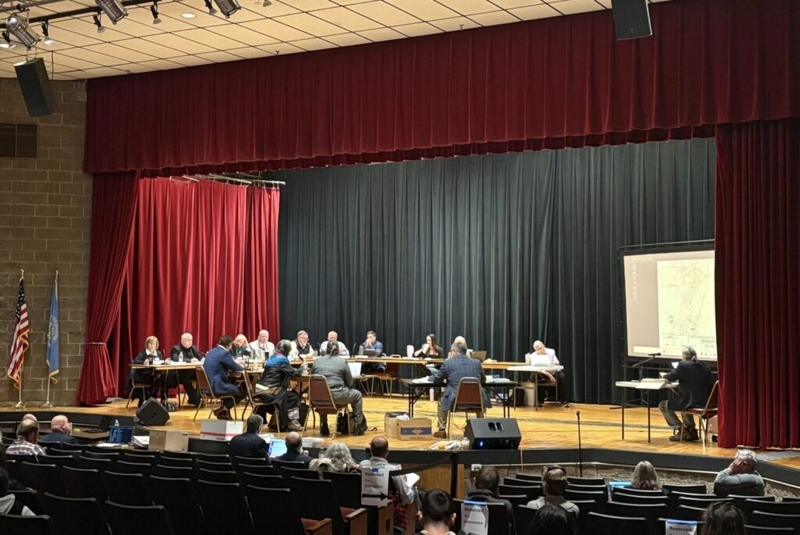
The South Dakota Board of Minerals and Environment conducts a hearing about a uranium exploration permit application on May 19, 2026, at the Mueller Civic Center in Hot Springs, South Dakota. (Photo by Meghan O'Brien/South Dakota Searchlight)
Listen to an audio version of this story by reporter Meghan O’Brien. Broadcasters: See below for a downloadable version with a script.
A new state law requiring language translation services for some government proceedings — like a contentious recent hearing for a permit application to drill for uranium in the Black Hills — has had its first test drive, even though it doesn’t take effect until later this summer.
The law requires the decision-making office or board in an administrative contested case to hire an interpreter or translator when a witness or party needs it.
“Any proceeding that’s open to the public would receive or have those translation services available at no cost to the participants, so it would be covered by the state of South Dakota,” said Rep. Erik Muckey, D-Sioux Falls, the law’s sponsor.
The law was adopted in March, and it takes effect July 1.
Hearing on proposed Black Hills uranium drilling opens with hours of opposition testimony
Meanwhile, a decision on a permit application for a company to explore underground for uranium in the southern Black Hills near Edgemont has been pending since 2024.
Dozens of people have signed on as official project opponents, making the matter a contested case. Some have expressed concerns about potential water contamination they said could result from underground drilling, while others have said the proposed drilling site is too close to Craven Canyon — which is lined with ancient Native American petroglyphs and is used for prayer and ceremonies.
Some of those people speak Lakota, the language of tribes in western South Dakota. Elizabeth Lone Eagle, a project opponent, submitted a request for Lakota interpretation services last August and listed five interested parties in the case as Lakota first-language speakers.
Despite not being legally required to provide a translator since the new law hasn’t taken effect yet, Board Chairman Glenn Blumhardt referenced the new law during a March meeting, when the board was voting to overturn an earlier decision by Hearing Chairman Bob Morris, who had denied interpretation services.
“Is this bill currently in effect? The answer is no,” Blumhardt said. “The point is whether or not this is applicable at this time.”
The board voted to provide translation services as outlined in the law.
What the law says
Muckey introduced the legislation known as Helen’s Law, for Helen Red Feather, one of five Lakota first-language speakers who requested Lakota interpretation services.
“This isn’t just about this particular case and trying to tip the odds of this particular instance, but to make it a fair process for this case and virtually every case going forward,” Muckey said. “I’m just grateful that the department saw that need and was willing to change course to follow the spirit of a new law that was soundly supported.”
The state will pay for interpretation services needed during a proceeding. People involved in a contested case can pay for translation services for processes like discovery and document translation. If they’re successful in the case, they can recover those costs.
Oral interpretation slowed the pace of the uranium drilling permit hearing.
“But I don’t know that I was necessarily concerned about that when we were drafting the law,” Muckey said. “The concern was, are we leaving people out of the law? And the answer to that was yes. And so we had to find a way to correct that.”
Though the bill was inspired by Red Feather’s need for translation throughout the case’s proceedings, it’s not just for Lakota speakers, Muckey said.
“We’re also talking about folks who are hard of hearing. They might be blind, and they might need those types of interpretive or translation services, and you have a litany of other languages that are spoken in South Dakota,” he said. “We can’t turn people away from due process of law.”
State officials offered to pay $61.88 per hour for interpreters during the uranium drilling contested case hearing. The Department of Agriculture and Natural Resources said the rate would be split between the two interpreters who were hired, “so only one interpreter is being paid at a time.”
“I was insulted,” by the rate, said Alex White Plume, an Oglala Sioux tribal member, and one of the two interpreters hired.
“I did it anyway,” he said. “I did it because there was a need and it was important for the ones to hear exactly what it’s like in their own language so they can have a clearer understanding.”
Lakota has experienced a decline in speakers as an effect of colonization, and because of forced attendance at boarding schools that required Native American students to speak English in the 1800s and much of the next century. But White Plume said most of the people in his area still speak their own language.
“I grew up speaking Lakota, and English is my second language,” he said. “The vast majority of the members of my community will still speak Lakota, and it’s funny to hear somebody come speak white-man language amongst us, cause it sounds funny.”
Translating for Lakota speakers in the audience was an honor, White Plume said.
“That was really important for the Lakota speakers to really hear their language and get a clear understanding about what the legal jargon was that the lawyers were speaking,” he said.
Hearing started without interpretation
The uranium drilling permit hearing started May 18 in Hot Springs and was scheduled for five days. On the first day, state officials began the hearing without a Lakota interpreter, despite agreeing to provide one.
A state Department of Agriculture and Natural Resources staff member said potential interpreters had conflicts of interest or scheduling conflicts that prevented them from accepting the role.
After project opponents complained about the lack of an interpreter, the state entered into a contract with White Plume and Leola One Feather to interpret the second and following days of the hearing.
Project opponent files federal lawsuit; uranium drilling permit hearing paused
When some portions of the hearing’s second day proceeded without Lakota interpretation, project opponents objected.
“This is institutionalized racism, and you are promoting it,” Elizabeth Lone Eagle said, standing from her seat in the audience.
She said the board was “forbidding” the translator, One Feather, “from doing her job, because you want your white colonizer sanitized way of doing things.” The audience cheered, and the board did not respond.
On the third day, the hearing was adjourned indefinitely after Lone Eagle filed a federal lawsuit against the board, the state’s Department of Agriculture and Natural Resources, Clean Nuclear Energy and state employees involved in evaluating the permit application, alleging violations of due process. Lone Eagle filed the lawsuit herself, without representation by an attorney.
Lone Eagle, along with six other people, including five described as Lakota first-language speakers, are listed as plaintiffs. The suit alleges “systematic, ongoing, and deliberate denial of meaningful participation to Lakota first-language speaking” project opponents.
A spokesman for the Department of Agriculture and Natural Resources told South Dakota Searchlight “the Board has postponed the hearing pending resolution of the federal case. Because the Department is a party to the litigation, we are not able to comment on the lawsuit.”
Last week, a federal judge denied Lone Eagle’s request for a temporary restraining order that would have stopped the permit hearing’s proceedings, but the lawsuit remains active.
For broadcasters:

Pierre, SD