West Virginia lawmaker raises concerns over Rural Health grant recipient
Sep 17, 2026 | 6:00 am ET
Description
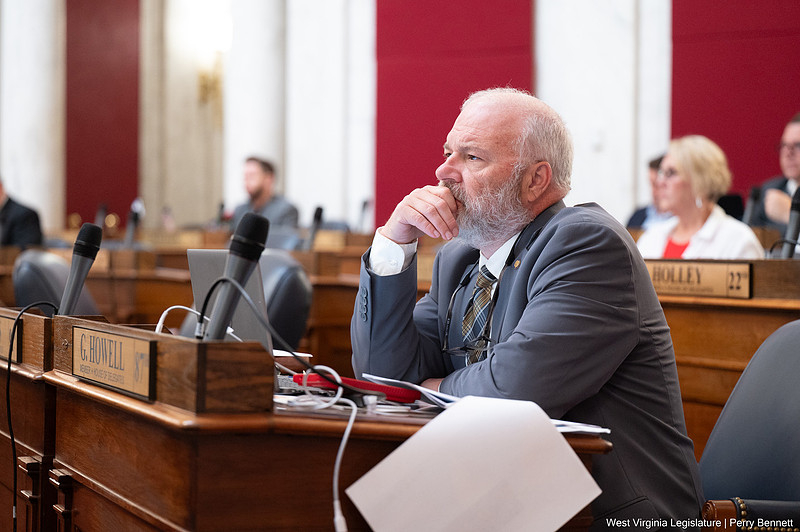
Del. Gary Howell, R-Mineral, watches a presentation during the Joint Committee on Finance meeting at the Capitol in Charleston, West Virginia, on Tuesday, Sept. 15, 2026. Howell raised concerns about one recipient of Rural Health Transformation program funds. (Photo by Perry Bennett/West Virginia Legislative Photography)
As West Virginia continues to announce recipients of its federal Rural Health Transformation program funding, a state lawmaker this week raised concerns about one organization set to receive a grant of more than $1 million.
The state Department of Health awarded the Spotted Owl Health Organization in Kanawha County $1.17 million in Rural Health Transformation funds to fund employer-based work sites, Gov. Patrick Morrisey announced earlier this month.
Del. Gary Howell, R-Mineral, asked questions about the grant award to state Health Secretary Arvin Singh Tuesday as Singh provided an update on the Rural Health Transformation Program to the Legislature’s Joint Standing Committee on Finance.
Howell said Tuesday that after looking into the organization, he has concerns it does not have experience doing employer health care programming.
“The requirements (for the Rural Health Transformation program) were specifically looking for experience with multi-employer worksite healthcare, and the ability to launch quickly,” Howell told West Virginia Watch. “When I went through the public record, Spotted Owl, you know, they were doing wellness programs.”
Howell also raised concerns with Spotted Owl’s prior grant experience. He said $50,000 is the biggest grant the organization has received, according to the records Howell could find. The $1.17 million from the state is 23 times that amount, he said.
“It just seems really odd,” Howell said. “They’ve never been in this field before. Obviously, the other (grant recipients) have. And then when I seen what the grant was, it’s like 23 times the biggest grant (they’ve had). They’ve never administered anything over $50,000. Now we’re asking to do almost $1.2 million.”
According to its website, the Spotted Owl Health Organization, based in Dunbar, operates the “Healthy Kids, Healthy Adults program,” which provides “a holistic wellness offering that will reduce the number of obese kids, adults, families, and communities in WV and thus Kanawha County.” The organization addresses “chronic diseases associated with obesity by introducing education on nutrition and fitness classes.”
Besides the $1.17 million to Spotted Owl, the state also announced Sept. 4 it would give $612,000 to Charleston Area Medical Center/Vandalia Health and $612,000 to the Cabell Huntington Hospital Foundation to fund worksite clinics and employer-based healthcare services.
Singh told Howell Tuesday he was not part of the decision to award Spotted Owl funding but said that every decision the state makes to award Rural Health Transformation funding is based on merit.
“They went up against a bunch of other competitors and demonstrated true merit,” Singh said. “I don’t have the score in front of me but they offer employee-based prevention, occupational health support, recovery focused work force retention and in their proposal they’re planning three anchor employer sites active by year one.”
Singh said the state has performance and payment based milestones for grant recipients. If programs are not meeting expectations, the state has the ability to claw back the federal dollars, he said.
West Virginia received $199 million in Rural Health Transformation program funding for 2026 from the U.S. Centers for Medicare and Medicaid Services. The five-year Rural Health Transformation program is designed to “empower states to transform the existing rural health care infrastructure and build sustainable health care systems that expand access, enhance quality of care, and improve outcomes for patients.” The program is part of the One Big Beautiful Bill, which made historical cuts to healthcare and food assistance.
Singh told Howell he would get back to him about Howell’s question about what metrics Spotted Owl was graded on, and what makes Singh confident they’ll be able to do the work the funding is for.
Orlando Craighead, executive director of Spotted Owl Health Organization, said he was not available Wednesday for a phone interview. In a written response to West Virginia Watch, he said the $1.17 million from the state for its program Work Well WV is the single largest grant the organization has received. Craighead said he does not dismiss the concerns Howell raised about its capacity but will address them.
“We are addressing them through dedicated program management, grant administration, financial oversight, data evaluation, defined performance measures and formal partnerships with healthcare and community organizations,” Craighead wrote. “Grant funds will be restricted to the approved program budget and subject to the state’s reporting, documentation, and monitoring requirements.”
He called Spotted Owl “a community-based public health organization focused on prevention, education, navigation, wellness, partnerships, and population health.”
Work Well WV will work with small and midsized employers to “provide voluntary wellness assessments, health education, screenings through qualified partners, care navigation, referrals, and follow-up support,” Craighead said. The initiative will also “help connect individuals recovering from substance use disorder with employment-support resources and appropriate health and social services.”
Work Well WV isn’t an employer-sponsored health insurance program, he said, and the Spotted Owl will not replace physicians, hospitals or licensed healthcare providers.
Chesapeake Health Center is the first hub and partner that Spotted Owl has established, Craighead said. The organization has plans to establish three more hubs across Kanawha County, he said.
“(Spotted Owl Health Organization’s) role is to coordinate the initiative, engage employers and residents, provide prevention and navigation services, manage closed-loop referrals, track outcomes, and report results to the state. Clinical services will be provided by appropriately qualified healthcare partners,” Craighead wrote.
“We welcome appropriate oversight and the opportunity to demonstrate that a smaller community-based organization can responsibly manage a significant investment when it has clear controls, qualified personnel, strong partnerships, and measurable expectations,” he said.
Charleston, WV