Unionized hospital workers had high hopes after Roger Williams, Fatima sale. Not anymore.
Sep 16, 2026 | 4:04 pm ET
Description
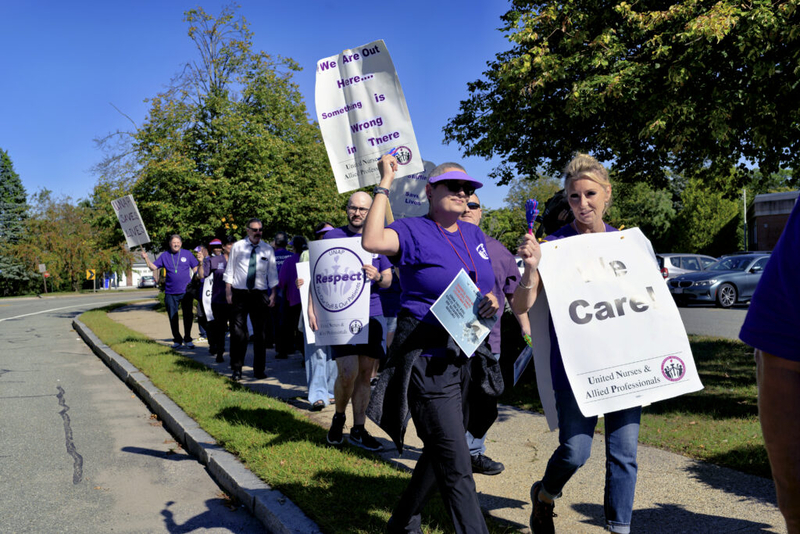
United Nurses & Allied Professionals workers picket outside Our Lady of Fatima Hospital in North Providence on Tuesday, Sept. 15, 2026. (Photo by Michael Salerno/Rhode Island Current)
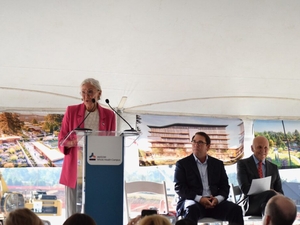
Five months ago, Lynn Blais stood shoulder to shoulder with suit-clad executives at a Friday afternoon press conference in March, smiling and clapping as they celebrated The Centurion Foundation’s long-awaited purchase of Roger Williams Medical Center and Our Lady of Fatima Hospital.
On Wednesday, as Blais, president of the United Nurses and Allied Professionals, sat across the table from several Centurion lawyers and human resources representatives, the celebratory mood was over. The 1,200 hospital union workers — half the hospitals’ combined workforce — still have no contracts, and no sign of progress reaching any new ones.
“They made promises and commitments to the community, to the employees, that they were going to come in and do the right thing, so we helped them to get the money they needed,” Blais, a nurse at Fatima, said in an interview. “They’re now turning their back on the hardworking employees of these hospitals.”
The sticking point: what happens to the nearly 40-year-old home health program, which paired discharged hospital patients with nurses, therapists and home aides for care.
Former owner Prospect Medical Holdings laid off the couple dozen remaining nurses, therapists and aides in January amid bankruptcy proceedings, referring discharged hospital patients to other home health agencies.
But the layoff letter suggested it wasn’t permanent, said Lorrie Miller, an occupational therapist among the dozen remaining home health workers who lost their jobs in January.
Miller transferred to a new position with Fatima’s acute rehabilitation facility, but she still clung to the plan to return to home health.
“I loved the patients, I loved my colleagues, we had a great community and network, and at one point, a great reputation,” Miller said. “It’s really frustrating to be displaced and not really have a lot of support. And now you’re saying I can’t go back?”
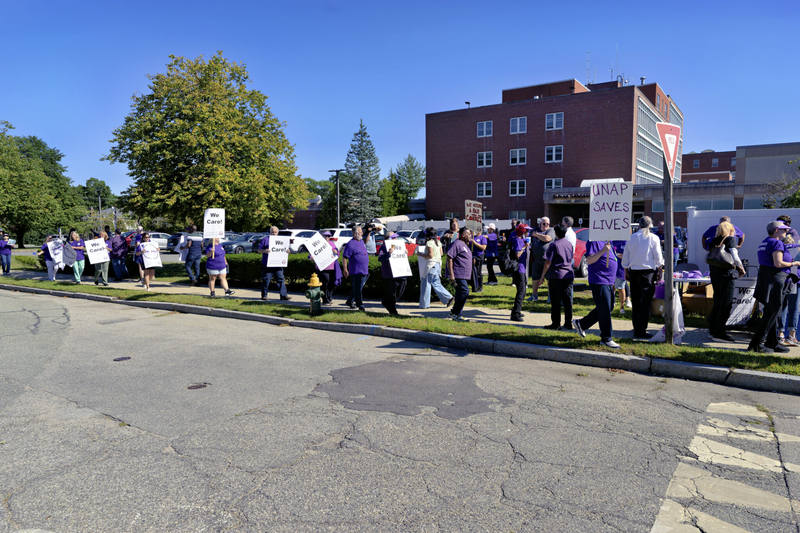
Miller joined an information picket outside Fatima hospital Tuesday afternoon where union workers in purple T-shirts carried signs reading, “We care!”
She does not think her new employer feels the same way.
“I firmly believe that healthcare should be a human service, not a business,” she said.
From skeptic to supporter
Initially critical of The Centurion Foundation’s offer to buy the pair of cash-strapped urban hospitals, Blais and other union healthcare workers rallied behind the Atlanta nonprofit after Prospect filed for Chapter 11 bankruptcy in January 2025, later threatening to close the hospitals.
Union officials held press conferences, made statements, and spent many late nights at the State House, pressing lawmakers to approve Centurion’s eleventh-hour request for state funding to help close the sale.
An $18 million reserve made it into the fiscal 2026 budget, the private investors finally lined up, and by March 6, the $101 million bond-financed deal had closed. Just beginning was a new chapter for the facilities, which represent 500 beds between them, accounting for 50,000 annual emergency room visits and providing critical behavioral health and cancer treatment programs.
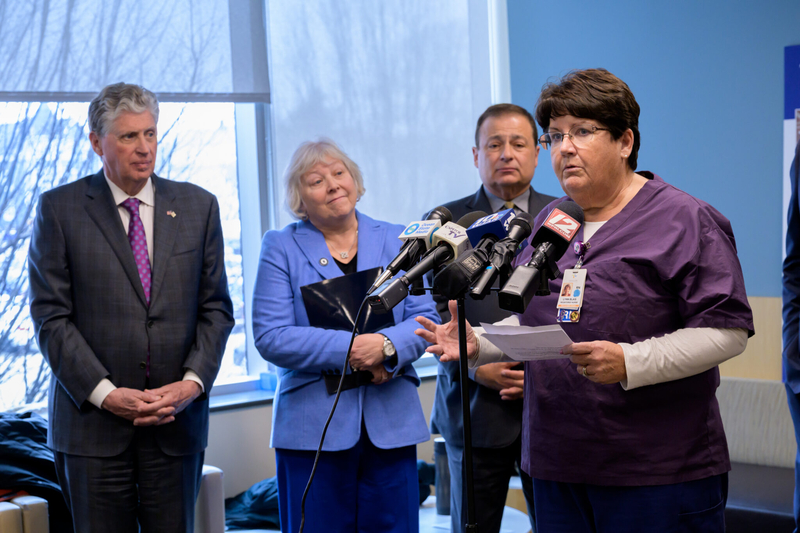
“The verbal commitment I got from Ben Mingle at the State House was to get to the bargaining table, get the contracts done fairly and quickly,” she said, referring to Centurion’s CEO and president. “It’s not fairly, and it’s not quickly.”
They made promises and commitments to the community, to the employees, that they were going to come in and do the right thing, so we helped them to get the money they needed. They’re now turning their back on the hardworking employees of these hospitals.
Otis Brown, a spokesperson for CharterCARE Health of Rhode Island, Centurion’s subsidiary, rebutted the union’s claims.
“CharterCARE has made a competitive wage and benefit package offer at the bargaining table and UNAP has not yet provided a full response to that, despite having it since August,” Brown said, noting that the picket was “not an effective means” of resolution. “We believe that should be the focus at the bargaining table, not a former service line.”
According to CharterCARE, the home health program was already shut down by the time the sale closed in March.
“Our prior owner, Prospect Medical Holdings, made the decision to close it in late 2025 based on declining volume, significant monthly losses, and the availability of more than 60 competing home care agencies in RI,” Brown said.
Chris Callaci, general counsel for UNAP, claims hospital executives kept union workers in the dark about plans to close the home health program until after the sale was finalized.
“They dodged us, and quite frankly, the public,” he said of the surprise announcement. “Now it’s like, in our view, ‘OK, here we go.’”
Nearly three years earlier, Centurion pledged to invest $100,000 in “home health changes,” in its November 2023 application to state regulators.
“With respect to home health, the New CharterCARE System has planned significant outreach to the community in its first year to promote access to home health services,” Centurion stated
Maintaining essential services — including homecare and hospice — was also one of the 85 conditions imposed by the Rhode Island Attorney General’s Office and Department of Health in its June 2024 approval of the hospital sale.
Breaking the rules?
Callaci suggests Centurion has broken the legally binding requirements.
Rhode Island Attorney General Peter Neronha’s office, which took an active role in the sale and federal bankruptcy proceedings, concurred with Brown.
Home health was already “nonoperational” when the sale closed, Tim Rondeau, a spokesperson for Neronha’s office, said in an email.
Brown, of CharterCARE, said the health department and AG’s office were aware of the home health program’s status — meaning, closed — when the sale closed in March,
“The union’s allegation that we have violated any regulatory condition is not true,” Brown said.
Callaci acknowledges that no one has been getting paid or seeing patients through the home health program for months, evidenced by the HR notice sent to union workers in January.
“After careful consideration of business, patient safety and operational factors, we have made the decision to indefinitely suspend all operations of this division,” John Tavares, HR partner for Prospect’s local subsidiary, wrote in a Jan. 7 letter to one home care staff member, and shared with Rhode Island Current. “In connection with this development, all employees working in operations are being indefinitely laid off. Your last day of employment will be January 27, 2026.”
The key word for Callaci is “suspend” — which he said indicates the layoffs are not permanent.
The federal bankruptcy court-appointed patient care ombudsman also alluded to a reopening plan in court documents.
“The goal is for the Rhode Island hospitals to maintain the home care license and reopen the service line if the sale transaction closes,” Suzanne Koenig wrote in her Jan. 27 report to the federal judge. “The Ombudsman hopes that home health will be offered again, as it is a vital service to the Rhode Island hospitals’ communities (which include an older, less mobile patient population), but believes that the service line is being closed safely.”
Prospect still has an active license with the state health department for its home healthcare operations, Joseph Wendelken, department spokesperson, confirmed via email. There is no new license for home health under the new CharterCARE owners, though.
Healthcare facilities must renew their licenses by the end of each calendar year, or else they expire. Prospect filed its 2026 renewal on Dec. 18, 2025, weeks before it declared bankruptcy. No renewal applications for 2027 had been submitted as of Wednesday.
“We are going to fight this with them at the bargaining table, in our own process, where we control our own destiny,” Callaci said.
For now, hospital workers, already at their mental limit and physical workload capacity, remain frustrated, Blais said. Staffing shortages remain a problem at both hospitals, with pricey travel nurses and overtime helping to maintain a bare minimum of operations, she added.
“Until you have a stable workplace and a contract in place, you have a hard time hiring people,” she said. “It’s all just been painfully long, unprepared, unorganized on the employer’s side. People are frustrated.”
- 6:43 pmThis story has been updated to add to and correct CharterCARE Health of Rhode Island's statement regarding the contract bargaining process with union workers. An earlier version of this story omitted part of the entity spokesperson's comments.

Providence, RI