West Valley teen said he ‘went Batman’ to stop Surprise ICE detention center, feds say
May 21, 2026 | 4:03 pm ET
Description
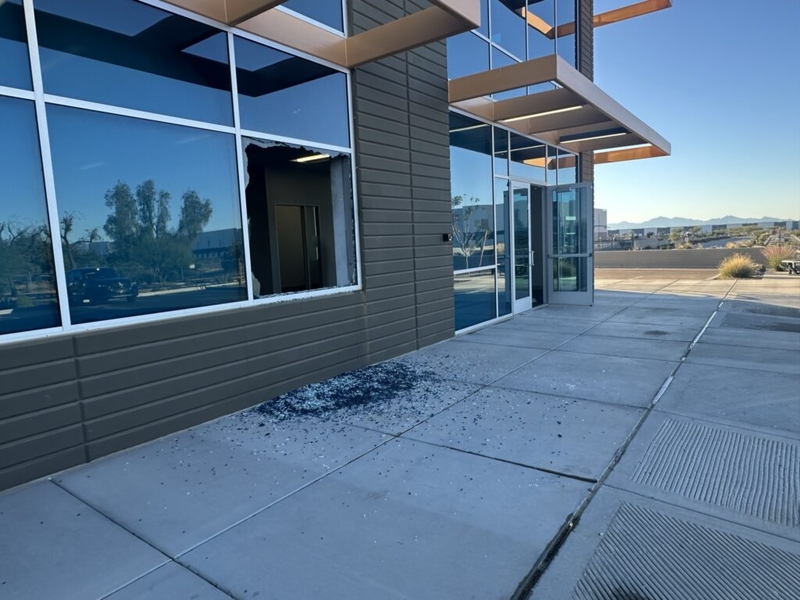
The Federal Bureau of Investigation is investigating an attempted arson of a Surprise warehouse purchased by U.S. Immigration and Customs Enforcement. (Photo by Jerod MacDonald-Evoy/Arizona Mirror)
A 19-year-old West Valley resident is facing federal criminal charges for attempting to set fire to a Surprise warehouse that U.S. Immigration and Customs Enforcement plans to turn into a 1,500-bed detention center.
In February, a window at the warehouse was broken and police found a propane tank had been thrown into the building in an attempt to set the building ablaze. The building’s automated fire suppression system quickly extinguished the fire.
According to federal court documents, Gabriel Mendoza-Acoltzi was spotted on surveillance footage driving his Honda Civic to the warehouse, where he attempted to cut off the building’s water supply, but the water shutoff valve was locked and he was unable to do so. He then went to the front entrance, where he broke a window with a hammer before attempting to set the building on fire.
“Investigators discovered that Defendant utilized a long torch connected to the propane tank with a hose to light the window shades inside the lobby on fire. Defendant then lit the box on fire and at 1:05 am tossed the box through the broken window of the ICE property,” federal prosecutors wrote in a filing asking the court to not let Mendoza-Acoltzi out of detention. “Defendant then knelt next to the propane tank and twisted the top valve multiple times before he tossed the propane tank through the broken window.”
In the filings, prosecutors wrote that ICE has already had to pay over $40,000 for repairs, and it has been quoted more than $400,000 to repair all of the damage. Investigators recovered a “burnt cardboard box filled with charcoal, and an open propane tank from the lobby,” according to court documents.
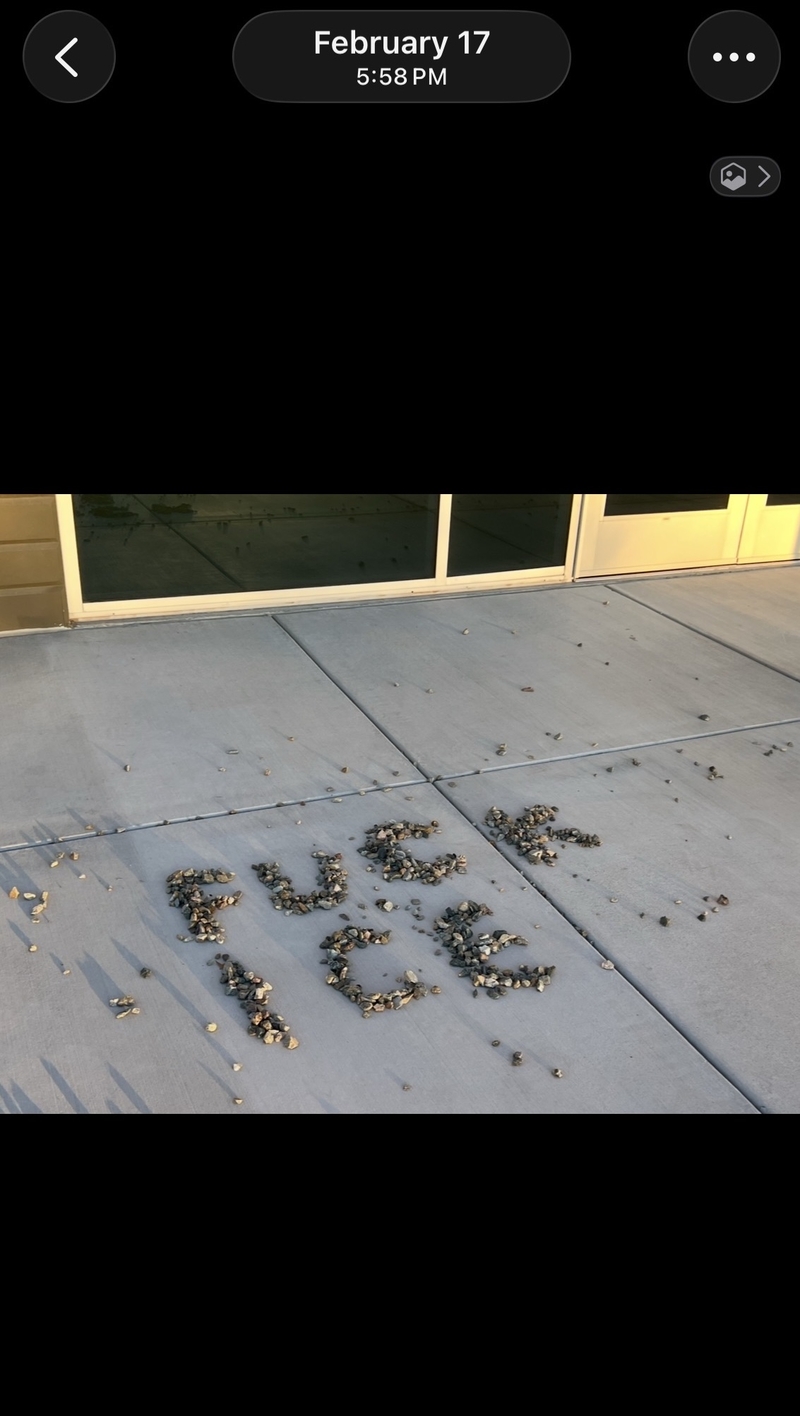
When they arrived on the scene they also discovered the words “F**k ICE” written in rocks, though Mendoza-Acoltzi denied writing the message in an interview with investigators.
A photo provided to the Arizona Mirror by independent researcher Haley Orion shows the message written in rocks was there days prior to the incident.
The government claims that Mendoza-Acoltzi is a flight risk with ties to foreign countries and is driven by political violence.
On the day of his arrest, he fled from law enforcement and “made it about eighty yards before agents caught up with him and tackled him” and it took “three agents to restrain him,” according to court documents. He waived his Miranda rights and agreed to speak with investigators, confessing that he caused the damage and tried to burn the building down to “protest” the warehouse being turned into an ICE detention center.
“Defendant said he wanted to stop DHS from ‘hurting his people.’ Defendant said he just decided one night to ‘go be Batman,’” prosecutors wrote. “[A]lthough he is a U.S. citizen, he is also a citizen of Mexico, a country to which he has traveled five times and where he has extended family. Defendant also has extended family in Brazil, a country whose flag he displayed from the rearview mirror of his Civic. He has traveled to Brazil twice.”
Mendoza-Acoltzi’s attorney refuted the assertions made by the government, describing him in filings seeking release as a “19-year-old with no criminal record whatsoever, strong family ties” who has been enrolled at the Universal Technical Institute and working part-time at In-N-Out while being in constant contact with his parents back in Washington.
Medonoza-Acoltzi’s attorney argues that, while the charges are “very serious,” no one was injured and his client has been fully cooperative with investigators.
“Mr. Mendoza cooperated with law enforcement after his arrest. He waived his Miranda rights and cooperated by answering investigators questions,” his attorney, Brian Soto, wrote in a document advocating for his release under special supervision. “These are not the characteristics of an individual who poses a danger to the community.”
Soto also argues that it took three months between the incident and his client’s arrest and, during that time, the government was in possession of surveillance footage and had identified him as the suspect in the case.
“Yet investigators did not seek his arrest for months. The government’s investigative delay before arrest is evidence that the defendant did not pose the kind of danger to the community that pretrial detention is designed to address,” Soto wrote. “If the government genuinely believed Mr. Mendoza posed a serious risk, they would’ve arrested him the moment they identified him, which was early in the investigation. The delay speaks for itself.”
Soto also offers a different perspective on that arrest that took place.
According to Soto, a “plain-clothes agent seated in an unmarked vehicle with dark tinted windows” was parked next to his car and called himself “Gabe.” Mendoza-Acoltzi did not recognize him and asked if it was someone he knew by saying “Chad, is that you?” and the agent answered “yeah, come over here.”
“At that moment, Mr. Mendoza perceived a threat and instinctively fled. Agents claim they yelled out, ‘FBI,’ once Mr. Mendoza began to flee, but by this time Mr. Mendoza’s involuntary survival instinct had already engaged,” Soto said. “The arresting agents, when asked off the record by (prosecutors), acknowledged that the initial contact was made as described above.”
Soto argues that his brief attempt to flee from law enforcement officers was not a “calculated decision” but the response of a “19-year-old who had just been approached by an unknown individual in an unmarked, dark-tinted vehicle, addressed by his first name, and then lied to about that individual’s identity.”
Once Mendoza-Acoltzi was under arrest, he was cooperative with law enforcement. Soto also argued that the government’s picture of a remorseless politically violent actor is also not accurate.
“Remorse is not a light switch. It is a process, and it develops over time as the weight of criminal consequences becomes real, as family conversations occur, as counsel is obtained, and as the reality of prosecution sets in,” Soto said. “The absence of immediate, demonstrable remorse in a post-arrest interview does not foreclose the possibility of genuine reflection in the days, weeks, and months that follow. Two things can both be true: a defendant may believe sincerely in the righteousness of his motivations and simultaneously come to understand and genuinely regret the harm his actions caused. One does not preclude the other, and Mr. Mendoza is undoubtedly already beginning to feel remorse for his actions.”
The judge ordered Medonoza-Acoltzi to remain in custody. He has pleaded not guilty in court.
If convicted for malicious damage to federal property, he faces up to 20 years in prison and $250,000 in fines. The penalties for willful depredation of federal property can depend upon the extent of the damage caused.
The U.S. Department of Homeland Security purchased the 418,400-square-foot warehouse in Surprise so it could turn it into a detention center in service of President Donald Trump’s mass deportation campaign. The purchase is one of many across the country, and was authorized by the One Big Beautiful Bill Act, the tax cut and spending package that Trump championed and Republicans in Congress approved last year.
People detained in ICE facilities nationwide reached an all-time high of 70,766 in January, doubling what it was when Trump took office. Although Trump has said his deportation efforts are targeting “the worst of the worst,” a large number of those arrests have had no criminal record and are “collateral” arrests of individuals with immigration violations or similar crimes.
There are already six detention centers in Arizona, with a combined capacity of 3,341 beds.
The plan for the Surprise facility has become a flashpoint for local opposition, with multiple protests calling for the purchase to be terminated and more than 1,000 people showing up to a Surprise City Council meeting to urge elected officials to stop the detention center.
A stop work order was issued on the project in late April amid on-going lawsuits against similar facilities nationwide. However, according to USASpending.gov, that order appears to be lifted.
Similar outrage and violence has occurred in other cities. Police in Kansas City are searching for a woman who attempted to set fire to a facility that was planned to be used by ICE, though the company that owned the property had already decided to not move forward with the sale.
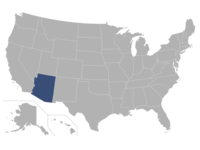
Phoenix, AZ