Raoul suggests underfunding of his office could make winning legal battles against Trump harder
Jun 10, 2026 | 1:45 pm ET
Description
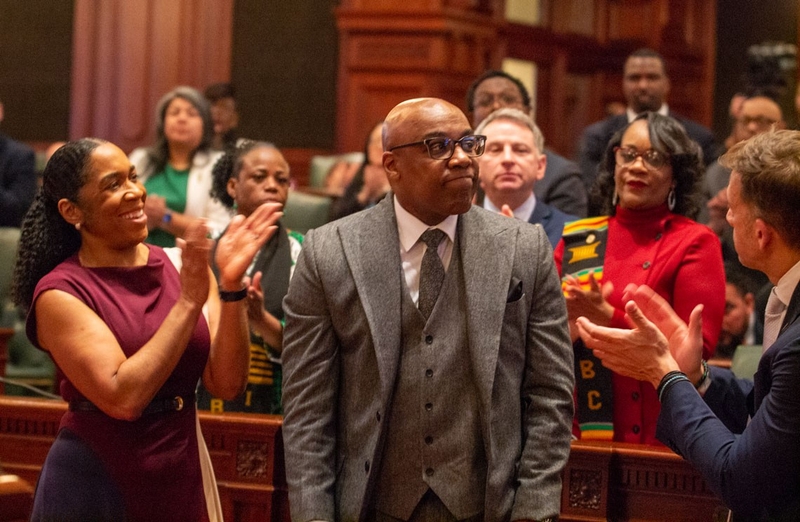
Illinois Attorney General Kwame Raoul receives a round of applause during the governor’s 2026 budget address in February for his efforts suing the Trump administration. (Capitol News Illinois photo by Jerry Nowicki)
Illinois Attorney General Kwame Raoul says his office was underfunded by $10 million in the latest budget, and that could make it more difficult to fight legal battles against the Trump administration while still fulfilling its enforcement duties in the state.
Raoul spoke at a Tuesday event at the City Club of Chicago about the challenges of working with a federal government that has been hostile at times to Illinois. He also touted some of the state’s legal victories against the Trump administration and his efforts to work with the federal government on other issues.
But despite achievements that many legislative Democrats and the governor often celebrate, state lawmakers appear not to have rewarded Raoul’s team with increased funding.
“We can’t do this type of work without adequate investment, and, you know, unfortunately, at approximately 3 a.m. in the morning a week ago Monday, we were shorted about $10 million from what our overall appropriation was for FY26 and I can’t imagine why,” he said.
The attorney general’s office is funded by multiple sources in the budget. This year the total comes out to $184.5 million between all funds. Last year, the total funding amount was $194.5 million.
The state budget passed on June 1 closely matches how much the state is expected to spend by the end of the current fiscal year on June 30, meaning the whole budget is essentially flat.
“I’ve been aggressive about going to the legislature in the seven and a half years that I’ve been in office to appeal for investment in this office,” he said. “Over the course of my seven and a half years, for every dollar of General Revenue Funds spent on the attorney general’s office, we return $21. Anybody who has that in their portfolio is rich.”
Last year, the General Assembly awarded the attorney general’s office $15 million more in operational expenses to compensate for the heavier workload.
In addition to representing Illinois in court, the attorney general’s office enforces multiple state laws dealing with issues like consumer protection, victim assistance, civil rights, and more.
Increased workload
Since President Donald Trump returned to the White House in January 2025 and unleashed federal immigration agents in states, Illinois has navigated a more-difficult relationship between the state and federal governments.
Raoul said that hostility sometimes gets in the way of work to pursue drug and gun trafficking, child sexual abuse material, and organized retail crime. Cracking down on those crimes is normally a collaboration between the state and the federal government, he said.
The hostility has led to more work for Raoul’s office. Between the start of Trump’s term and April 2026, the AG’s office filed 63 lawsuits against the Trump administration. Most of the cases dealt with federal funds being withheld, protecting money for critical Illinois programs.
“Not a single lawsuit have we filed because of a policy difference with the president of the United States or with the federal government,” Raoul said. “Every lawsuit we filed, we filed because what he (Trump) was trying to do, he was doing illegally and unconstitutionally.”
Raoul said the hostile dynamic was clearest in September 2025 with Operation Midway Blitz, the Trump administration’s Chicago-focused mass deportation campaign, and attempts to deploy the National Guard in city streets.
He said Illinois won the U.S. Supreme Court case to block Trump from deploying the National Guard to Chicago because the federal government overstepped during Midway Blitz with the often-violent tactics federal agents used to arrest people suspected of being in the country illegally.
“Its reach was far beyond just a question of immigration enforcement or crime,” Raoul said. “It’s whether we’re going to embrace a sort of an authoritarian approach of giving one man the ability to turn the country’s military against whoever he wishes based on whatever he perceives.”
The Supreme Court ruled in favor of Illinois in the National Guard case in December.
Ultimately, Raoul said, lawsuits against the federal government have protected $8.6 billion in federal funding for Illinois. That includes money for childcare, disaster recovery and preparation, public health, scientific and medical research, and more.
Despite the difficult relationship, Raoul said Illinois has been able to work with federal law enforcement in some cases to successfully combat retail theft and online crimes against children.
“We have continued through all of this sort of conflict to collaborate on fighting crime, and it’s something that should be applauded for these respective leaders,” he said.
Capitol News Illinois is a nonprofit, nonpartisan news service that distributes state government coverage to hundreds of news outlets statewide. It is funded primarily by the Illinois Press Foundation and the Robert R. McCormick Foundation.
Springfield, IL