Waterboro District expelled 16 students this school year, far more than the norm
May 29, 2026 | 4:48 am ET
Description
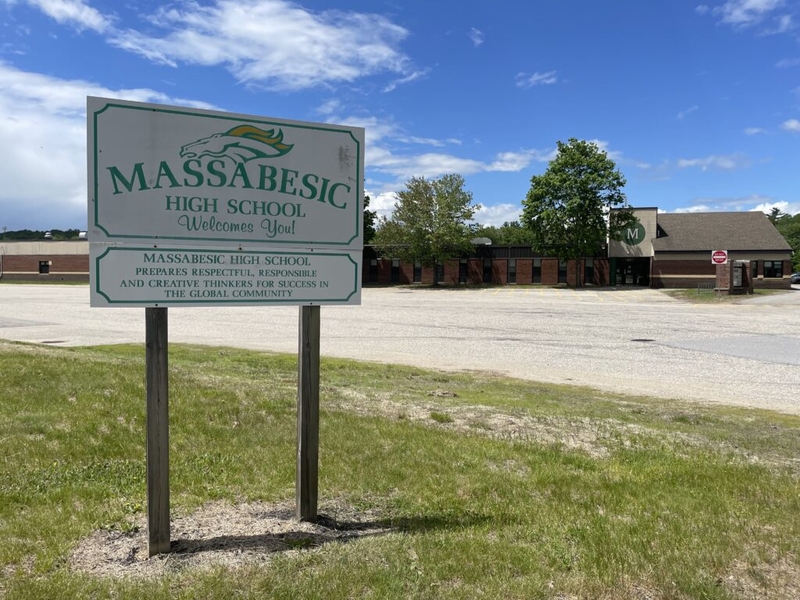
Massabesic High School in Waterboro, Maine is also home to the Superintendent's Office for Regional School Unit 57. (Photo by Lauren McCauley/ Maine Morning Star)
Waterboro Regional School Unit 57 has expelled 16 students so far this school year, an expulsion rate that’s more than 10 times last year’s statewide average.
Twelve of those 16 expulsions took place in less than two months between March 25 and May 13, marking a significant increase for the district, which only expelled three students last school year.
RSU 57 Superintendent Stephen Marquis said that while expelling students is not ideal, it is necessary to maintain a safe and orderly school environment. However, advocates and decades of research say exclusionary discipline can have long-term academic, emotional and legal consequences.
Expulsion levels in Maine have fluctuated over the years. According to state data, they ranged from 18 to 94 total students per year over the last 10 years, excluding the years during the COVID-19 pandemic.
Since the pandemic, those numbers have ticked up. They climbed from 76 in the 2022-2023 school year to 92 the following year, to 94 last year — the most recent data available.
The 94 students expelled in 2025 made up around 0.05% of the state’s students. RSU 57’s 16 students expelled between September 2025 and May 13, 2026 make up 0.56% of the district’s student population.
“We can all agree that it is best practice to endeavor to get expelled students back in school as quickly as possible,” said Eric Waddell, the executive director of the Maine School Management Association.
Marquis said the district, which serves students in Waterboro, Shapleigh, Lyman, Alfred, Newfield and Limerick, never wants to expel students, but that its primary responsibility is to maintain an environment conducive to student learning.
“We want kids to be safe and to adhere to state and federal laws,” said Marquis.
According to Maine state law, school districts can expel students “if found necessary for the peace and usefulness of the school.”
What that means is up for interpretation.
Each school district writes its own policies in alignment with state law, outlining its rules and how it will handle violations.
The result is that expulsions are doled out differently across the state. While some districts only issue expulsions for more serious offenses, including possession of a weapon, assault or use or distribution of a controlled substance, others expel students for lesser transgressions.
Last year, 36 of the state’s 192 school districts administered the state’s 94 expulsions.
According to Michael Rogers, an attorney at Portland-based firm Heron Legal Youth Advocacy, these numbers show that while some districts are working creatively with kids and families on addressing challenging behaviors, that tactic is not universal.
“Some districts have too casual an approach to exclusionary discipline,” said Rogers.
For Marquis, one of the things he considers before recommending that the school board expel a student is whether the behavior in question takes away from the district’s educational objectives.
“Expulsion is considered in only the most serious circumstances,” he said.
Bill making it easier to restrain and seclude students passed by Maine lawmakers
Because of student confidentiality restrictions, Marquis could not discuss specific cases. However, he said most expulsions this school year were related to the use or distribution of marijuana or tobacco vapes.
District policy describes a distributor or supplier as “anyone who gives, sells, or in any way makes an illegal substance available to another person.”
At RSU 57, middle or high school students caught with drugs or alcohol, not including tobacco, receive a 10-day suspension and must contact the school’s substance use counselor, according to the school’s policy. If they are caught again, they will be suspended for another 10 days, pending a hearing before the board to determine further discipline, up to expulsion. When a student is suspended, they are automatically readmitted once they serve their time. When a student is expelled, they must return before the board to request readmission. If they are found sharing drugs or alcohol, students are suspended for 10 days and sent to the board for a hearing and considered for expulsion, according to the same policy.
If a student is using tobacco, they are usually given a shorter suspension to start, but discipline can escalate if a student is found to be sharing tobacco products, said Marquis.
“We’re not asking students to do anything that is beyond their control,” he said. “We’re clear about our expectations.”
Marquis said his objective is for expulsion to provide students a chance to reset and return to school with the tools to make good decisions and succeed.
“We’re working as hard as we can to support students,” he said.
What it means to be expelled
The expulsion process is dictated by state law. Once a student is recommended for expulsion, usually by a school administrator, the school district must provide the student and their guardian with the reasoning behind the recommendation, information about the consequences of expulsion and details of the pending expulsion hearing. The district must also provide a list of free and low-cost legal services.
At the hearing, which is closed-door, the student and the district can give testimony and present and cross-examine witnesses. The school board then makes the final decision.
“The superintendent’s recommendation is reviewed by the board during executive session and is discussed along with review of the relevant facts, policies, and legal standards before any decision is made,” said RSU 57 Board Chair Jodi Laine in a statement.
“These matters are considered carefully on a case-by-case basis,” she later added.
The board took an average of 36 minutes to decide the expulsion cases.
Expulsion is often thought of as a permanent removal from school. But at many schools in Maine, including RSU57, they’re used more like more severe, long-term suspensions. All 16 of the district’s expulsions this school year were indefinite and included reentry plans, documents detailing the conditions students must meet to be considered for readmission.
Exclusionary discipline communicates to kids that when someone makes a mistake or does something wrong, the right thing to do is to send them away.
“Indefinite expulsion allows for the student, family and administration to develop a re-entry plan that brings the student back before the board to ensure that the violation is not likely to reoccur,” said Laine.
Reentry requirements are different depending on the student and the infraction, said Marquis, but can include community service or meetings with a school counselor. The school district also provides coursework, so they don’t fall behind, and access to school resources, including the substance use counselor, Marquis said.
This system, said Marquis, is meant to encourage accountability and student growth.
“Expulsion does not necessarily need to define a student’s experience,” said Marquis. “But it is a defining moment.”
Between September and May 27, the district readmitted five students. Because the expulsion proceedings are confidential, it’s not possible to say if those were students who were expelled this year.
Concerning impacts of exclusionary discipline
But research shows that even if the expulsion isn’t permanent, the damage to a student and their community can be.
Students who are expelled or suspended are more likely to show increased defiant behavior, face further school discipline, experience depression, and become involved in the justice system. They are also less likely to be employed in the future.
At the same time, they miss school instruction, are socially isolated and may have to report their expulsions on college applications, impacting future educational opportunities.
Students attending schools with higher rates of exclusionary discipline are less likely to do well in school, graduate, or enroll in college, and are also more likely to become involved in the justice system.
Additionally, exclusionary discipline is often used unequally along racial lines. RSU 57 said it could not provide demographic information for students expelled this year due to legal confidentiality requirements.
“Exclusionary discipline communicates to kids that when someone makes a mistake or does something wrong, the right thing to do is to send them away,” said Brianna Markoff, an associate professor of education at the University of Maine Farmington. “It teaches them that some people are inherently bad and should not be included in the community.”
Markoff said districts should take into account the short and long-term impacts of exclusionary discipline.
RSU 57 is not alone in navigating challenging student behaviors and vaping or expelling students.
In recent years, Maine has seen a rise in such behaviors related to the post-pandemic youth mental health crisis. The increased challenges have stretched educators thin. Last year, in response, the state passed a law making it easier to restrain and seclude students. Legislators have also recently considered other related laws, including one that did not pass that would have allowed districts to expel students under fifth grade.
Rogers said there are circumstances — including when a child is presenting a serious potential danger to the school community — where he thinks expulsion is the appropriate course of action. But expulsion, he said, is an extreme consequence that should be used only to address extreme situations.
“Expulsion changes the way kids see themselves, lets them know they’re the kind of kid who gets expelled, removes them from their community and significantly affects their long-term prospects,” Rogers said. “Expulsion is being used far too liberally to address things that are better off addressed by services that are better provided in schools.”
Augusta, ME