Federal judge denies injunction that would reinstate suspended UA publications
May 29, 2026 | 6:01 am ET
Description
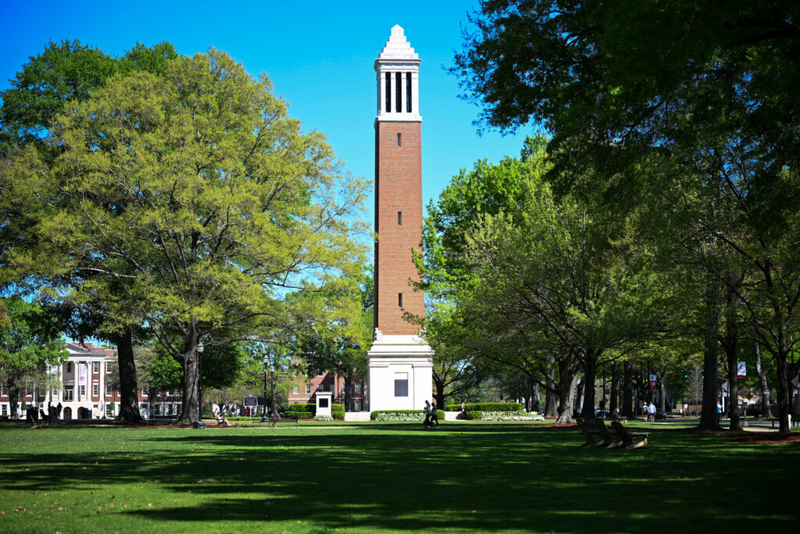
The Denny Chimes at the University of Alabama as seen on March 28, 2026. A federal judge last week refused to stop the university from suspending two student publications, ruling the suspensons did not amount ot viewpoint discrimination. (Andrea Tinker/Alabama Reflector)
A federal court last week declined to issue a preliminary injunction against the University of Alabama that would have reinstated two suspended student publications.
U.S. District Judge Edmund LaCour Jr., a former Alabama solicitor general, wrote in the opinion issued last Friday that UA’s decision to suspend Alice, a magazine targeted at women, and Nineteen Fifty-Six, which wrote on issues related to UA’s Black student community, did not parttake in viewpoint discrimination.
“UA retains authority to regulate content and speaker access in a limited public forum, provided its regulations are reasonable and not a pretext for viewpoint discrimination. Here, the University has, at most, made selections based on content, not viewpoint,” he wrote.
The university last year suspended the two student-run publications, citing a July memo from former U.S. Attorney General Pam Bondi which gave guidance on how to remain in compliance with federal anti-diversity, equity and inclusion (DEI) policies. UA spokesperson Alex House said in December the magazines were suspended to ensure that all students felt welcome to participate in programs in the Office of Student Media where both publications were housed. Neither publication excluded students from participation.
“A magazine about sports reflects ‘the editorial perspectives of students interested in athletics.’ A magazine about history reflects ‘the editorial perspectives of students interested in the past,’” LaCour wrote. “A decision to exclude either of them from board affiliation would be a decision based “on specific topics, … not a decision to discriminate against a ‘sports viewpoint’ or ‘historical viewpoint.’”
LaCour’s opinion also said the magazine staff members didn’t argue that there was a “unified women’s or Black viewpoint.”
“There is no viewpoint inseparable from the editorial activity within the magazines at issue here, just students interested in publishing content by and for women or Black students, whatever their viewpoint. And without a viewpoint, there can be no viewpoint discrimination,” he wrote.
Avatara Smith-Carrington, assistant counsel at the Legal Defense Fund, which represented the students, said in an interview Thursday that the viewpoints of the magazines are tied to the mission to both publications.
“Alice is a magazine that is really geared towards being an inclusive space to talk about issues related to gender and sexuality, with a focus, of course, on students who are women on campus, but the magazine has always operated with an eye towards inclusivity, and that’s been reflected not only in the content that they publish, but also in their editorial boards, and you can look at Nineteen Fifty-Six and see the same thing,” they said. “Nineteen Fifty-Six has a mission that not only speaks towards amplifying the voices of Black students and Black culture on campus, but it’s also done with an eye towards providing opportunities for students around campus to engage in conversations on culture, on history, on all these specific things.”
Messages seeking comment were left with The University of Alabama; Selene, formerly Alice and Sixty-Three Magazine, formerly Ninteen Fifty-Six Magazine Thursday.
Staff members of Alice and Nineteen Fifty-Six Magazine filed a lawsuit against UA in March, saying the suspension violated their First Amendment rights.
Smith-Carrington said that the ruling was disappointing but doesn’t change what the case is truly about.
“These are students in their most pivotal years that sought to actually create a space where students were able to engage with two publications that were really dedicated to inclusivity and diversity and opportunity,” they said. “When we’re thinking about what’s lost here, we’re thinking about the loss of student voices on a campus that desperately needs those voices to be amplified, not censored, not shut down, not silenced.”
Mike Hiestand, senior legal counsel for the Student Press Law Center, an organization that works to advance and defend the rights of student journalists, said in a statement Tuesday the judge’s decision “flies in the face of nearly six decades of student press law.”
“Not only does the ruling permit the University of Alabama to get away with a blatant example of censorship, but it also jeopardizes the First Amendment rights of college student journalists nationwide,” the statement said.
Hiestand also said colleges across the country have been limiting free speech on their campuses.
“Over the last year and a half, we’ve seen college administrators across the country fold to demands to target student speech that in years past would have been recognized and protected as part of the university’s unique function as a ‘quintessential marketplace of ideas,’” he said. “This end-around the First Amendment to gut protections for college student media poses a risk to the independence of all college student media in America.”
Attorneys for The University of Alabama Board of Trustees, who serve as defendants in the case, filed a motion to dismiss the case last Friday.
Smith-Carrington said their team is “assessing all the potential options available” to determine next steps including a response to the defense’s motion to dismiss.
Montgomery