State boards approve additional metrics to improve student achievement
May 29, 2026 | 6:14 am ET
Description
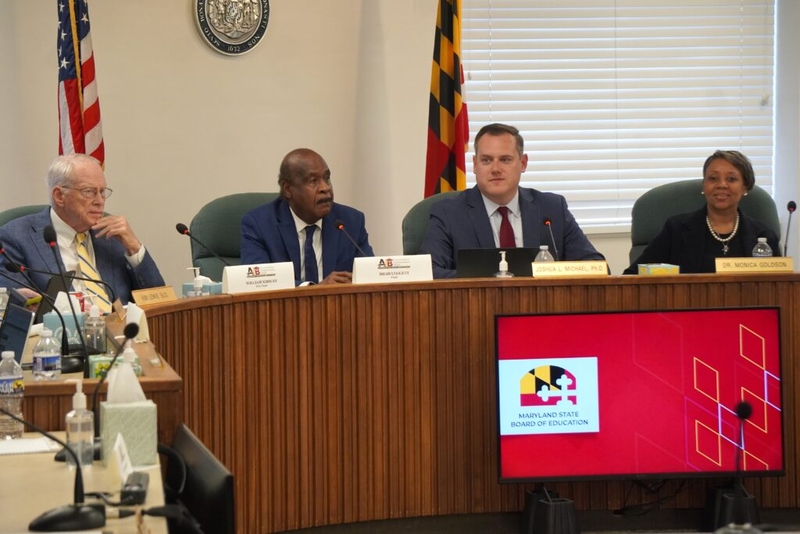
From left, Blueprint for Maryland's Future Accountability and Implementation Board Vice Chair William "Brit" Kirwan, AIB Chair Isiah "Ike" Leggett, Maryland State Board of Education President Joshua Michael and board Vice President Monica Goldson. Both boards met Thursday in Baltimore. (Photo by William J. Ford/Maryland Matters)
Two state education boards approved additional metrics Thursday to improve student achievement that includes a focus on kindergarten and 10th grade students, which is connected to the Blueprint for Maryland’s Future education reform plan.
Thursday marked the first joint meeting this year between the Maryland State Board of Education and the Accountability and Implementation Board. The board also known as the AIB oversees the 10-year Blueprint plan.
In September, both boards approved metrics that dealt with student groupings such as race and ethnicity, disability and language. It was based on results from the Maryland Comprehensive Assessment Program test that showed modest gains overall in language arts and math, but substantial achievement gaps between various student groups.
Almost two years ago, the two boards approved “ambitious” goals for student achievement, for attracting and retaining a diverse teacher corps and reducing chronic absenteeism.
Part of the measures approved Thursday seek to improve kindergarten readiness and assess whether students have met the college and career readiness standard by the end of the 10th grade.
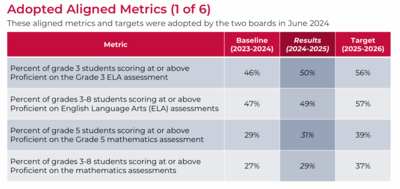
The target in the current school year for the kindergarten measure, which is part of the early childhood education priority of the Blueprint, is for 57% of those students to achieve early literacy. For math, it is 55% for the current year.
The metrics approved Thursday would slightly increase the percentage of students to 60% for early literacy and 58% for math in the 2026-27 school year.
The percentages are based on scores from the Kindergarten Readiness Assessment, which the state updated and administered for the first time this school year.
Before he voted to approve the new percentages, AIB Vice Chair William “Brit” Kirwan said the 60% figure seems low, especially with the state’s investments in early childhood education.
“It seems to be me down the road we should be thinking a lot higher than 60%,” Kirwan said.
Because the kindergarten assessment was changed, AIB Executive Director Rachel Hise said more data would need to be captured in order to assess a trend in how children are doing in kindergarten.
No data was provided Thursday for 10th graders, that is anticipated in the fall. College and career readiness is as a priority in the Blueprint plan.
Some other metrics approved also seek to increase the percentage of schools that have at least two student support professionals such as school counselors, behavioral interventionists and school psychologists. Some data is scheduled to be provided in January with a target date to set a goal in February.
Before the two boards convened Thursday afternoon, the state Board of Education discussed House Bill 1582, which was signed into law Tuesday by the governor.
The law, which takes effect July 1, will let the state begin developing a new school rating system to replace the current one- to four-star system. Officials have said that system does not adequately reflect the quality of a school and shortchanges schools with high numbers of low-income students.
The department-requested bill – labeled the Comprehensive Outcomes and Measures of Progress for Supporting Schools, or the COMPASS Act – adds a couple of other school-quality indicators to assess accountability. One of those include school staffing measures to make sure schools have adequate personnel and the completion of a “well-rounded curriculum” that doesn’t simply focus on reading, writing and arithmetic.
Geoff Sanderson, deputy state superintendent of accountability for the state Department of Education, said Thursday that a state Assessment and Accountability Advisory Committee will convene in July to help work on the new rating system, to be called the Maryland System of Testing and Academic Readiness (MSTAR). Recommendations from the committee would be presented later this year.
Sanderson said the state’s teacher’s union partnered with the department to help assess the school-quality indicators slated to “better inform the culture and climate of our schools” and “make sure the ratings feel balanced.”
A timeline shows a new system would be worked on next school year and, if approval is granted by the U.S. Department of Education early next year, the new system could be implemented as early as spring 2027.
Legislative review
The boards also reviewed other new laws enacted Tuesday, including funding for the popular child care scholarship program, restrictions on cell phone use during the school day for the 2027-28 school year, and minor revisions to the Blueprint plan.
They also reviewed Senate Bill 720, sponsored by Sen. Katie Fry Hester (D-Howard and Montgomery), which takes effect Monday. It requires the state Department of Education to issue guidance on artificial intelligence.
About $500,000 was budgeted for the department to create a Maryland AI Education Collaborative, whose more than two dozen members will study uses of artificial intelligence in each school system. Members will include the state superintendent or a designee, a representative of the state chapter of the Computer Science Teachers Association, three representatives from student organizations and a representative from Morgan State University.
State school board member Peggy Carr, a visiting professor in the College of Education at the University of Maryland, recommended the department review standards from the International Society for Technology in Education. Carr, who was appointed earlier this year by Gov. Wes Moore (D), served as a commissioner of the National Center for Education Statistics.
“These are global standards, and a lot of our competitors globally reference these standards,” Carr said. “If you’re not planning to investigate or explore international technology standards, it would be good to think about.”
Annapolis, MD