Water wars: Oklahoma residents fight for lake water
Jul 28, 2026 | 5:03 pm ET
Description
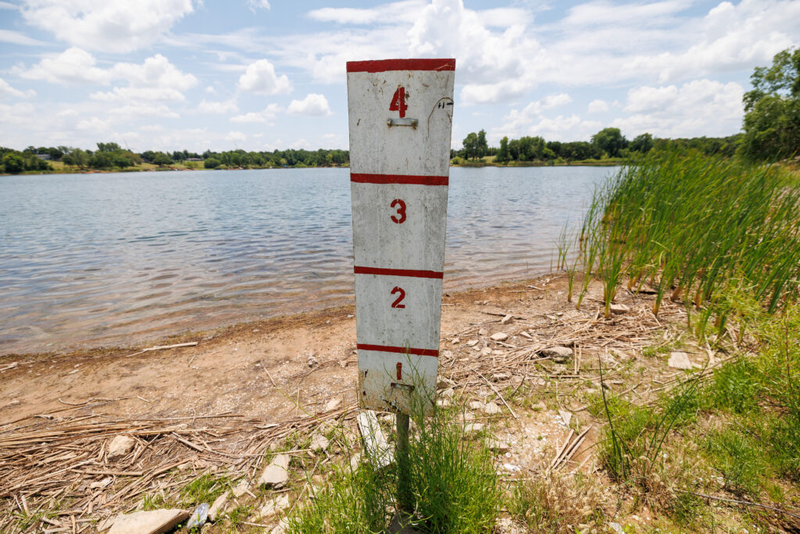
A water level marker at Cedar Lake near Hinton, Okla., Wednesday, July 15, 2026. (Photo by Nate Billings/For Oklahoma Voice)
HINTON – A brown ring of dirt where waters once stood covers white rocks partially encircling Cedar Lake.
It is an emotional reminder to residents of this rustic and blue collar community 45 miles west of Oklahoma City that their way of life and livelihoods are dramatically changing.
Generations of families have celebrated the Fourth of July and other holidays on the beaches of the lake, which has served as a baptismal pool for children and grandchildren.
What began as a hunting club in the 1950s is dotted with original small cabins, newer residences and expansions. Pink and red Crape Myrtles and cedar trees dot the land, which is home to about 400 residents, about half who live there year-round.
Its red dirt and partially paved roads meander past a community garden, chapel and volunteer fire department.
But the residents say their idyllic lifestyle has been threatened by a well-connected political family, whose decision to erect a dam on a tributary feeding the lake has slowly caused levels to dramatically drop and have begun drying up the water wells it feeds.
They said their pleas for assistance from the state agency tasked with ensuring the state’s water resources are being adequately managed and used, have been ignored. Instead, they said the Oklahoma Water Resources Board has slow played a year-old complaint they filed seeking to have the two dams removed.
“I’ve worked 71 years, all my life, to have lakefront property just to watch it dry up,” said Don Machacek, who lives in Oklahoma City but owns property at the lake.
A lack of action
Documents obtained by Oklahoma Voice through an open records request show that the state agency in May 2025 received its first anonymous complaint about the dams, which were erected upstream of the small lake that can hold up to 325.8 million gallons of water.
Even as lake levels continued to drop and residents called repeatedly seeking assistance, emails indicate the agency was discussing the issue for months behind-the-scenes, and had quietly provided several extensions to the representatives of the owners of the dams.
After more than a year of inaction, Cedar Lake residents were outraged when the board earlier this month abruptly proposed allowing the dams to continue holding water while the owners went through the process of obtaining a permit.
The Oklahoma Water Resources Board, which consists of nine members appointed by the governor, was prepared at the meeting to vote on an agreement with no public discussion, but tabled consideration until September after angry Cedar Lake property owners showed up at the public meeting to voice their disagreement.
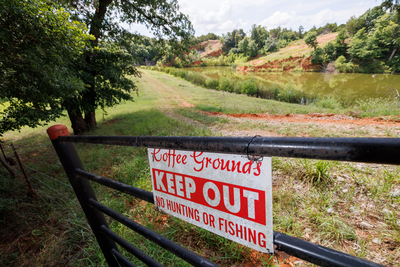
Cedar Lake residents said while the property owner is listed as Coffee Grounds LLC and C&F Ranch, they believe the board’s reluctance to force the dams to be removed is because the property is connected to V. Glenn Coffee, a former powerful state senator who is now a paid senior legal consultant to the state Senate Republican Caucus.
Coffee, who is an attorney, is listed as manager of the two entities and the respondent to the water board’s proposed agreement to allow the dams to remain, according to records.
A former president pro tem of the Senate, Coffee backed bills that made it more difficult to file lawsuits and collect damages. He is also a former Secretary of State under former Republican Gov. Mary Fallin. He became well versed in Oklahoma’s water rights laws and worked helping resolve a major water rights dispute. That dispute involved the Choctaw and Chickasaw nations, the state of Oklahoma and Oklahoma City over transferring water from a major reservoir in southeastern Oklahoma to the capital city.
Coffee declined requests for interviews, but had previously told Oklahoma Voice that once his family became aware of the complaints, they hired two engineering firms and an attorney to guide them.
His attorney did not return a phone call seeking comment, but told the board the dams were safe and well constructed. He disagreed with statements made by property owners and their attorney.
Oklahoma Water Resources Board leadership said after the meeting that it could not answer questions due to the “large number of requests.” The agency provided a statement, but did not respond to follow up questions.
State law allows dam owners to obtain a permit after dam construction, and the dams upstream of Cedar Lake do not pose an “immediate threat” to public safety, the statement said.
Several residents disagree, saying if dams failed property owners downstream would suffer.
The agency’s solutions include establishing a rural water district for Cedar Lake, incorporating the community to make it eligible for financial support for a municipal water system, linking the community to a nearby rural water district, or obtaining expanded surface or groundwater rights to help improve lake levels.
“None of these are going to be a ‘quick fix’ but we are exploring all options and meeting regularly with attorneys for the community,” the agency’s statement said.
Water experts weigh in
Cedar Lake property owners asked Carol Becker, a hydrologist with about 35 years experience, to take a look at their situation.
Becker holds a master’s in hydrology and has done work for the Oklahoma Geological Survey.
“There is no rocket science going on here,” she said.
Becker released her findings last week.
It is “very obvious” that the two dams constructed upstream are capturing runoff from almost 40% of the watershed, she said. Water that would normally flow into Cedar Lake has been impounded, resulting in a lake level drop, Becker said.
She found that since 2022 the groundwater levels in Cedar Lake have “steadily declined” and have reached “historically low levels” and that many water wells have dried up or have limited supply.
Cedar Lake recharges an aquifer, which is located below it. That feeds the water wells that residents rely on, she said.
She said only after the two dams were constructed on the tributaries that feed the lake did residents begin experiencing water issues. Becker’s report found the first dam was built in 2005 while the other was completed in 2019.
Becker discounted drought as a major contributor to a decrease in lake levels and well water.
“I find it really hard to believe that somebody would build the dams above … a community and think that it wouldn’t affect them,” she said.
One of the lakeside residents who has seen the problem with the aquifer up close is Anneliese Herren, who has lived there for about 12 years.
“When it gets to the point where the mud comes up, I just turn it off,” she said.
Using the washing machine and taking showers has become difficult, she said.
“Day by day, it is a guessing game,” she said, adding that she once went three days without a shower.
She has a water softening system, but can’t use it.
“Calcium deposits are showing up in my sinks, in my shower,” she said. “It is everywhere because there is really hard water out here.”
Attorney Christine Pappas is policy and education coordinator at the Water Institute at East Central University where she chairs the department of Politics, Law and Society.
At Oklahoma Voice’s request, she reviewed a copy of the Water Resource’s Board proposed agreement with the dam owners.
She said the agreement was noticeably silent when it came to the impacted residents.
“It seems the water rights issue should be considered in the consent decree,” Pappas said.
“You could divert water as long as it is for a beneficial purpose, if you are not impairing downstream users,” she said. “Usually, they would make you stop taking the water.”
Pappas said a remedy for property owners is to file a lawsuit in district court.
Praying for a solution
But longtime Cedar Lake resident Tammy Cramer said homeowners don’t have the money to hire an attorney to take it to court, where it could take years to find a resolution.
Residents said they have spent the bulk of the $35,531 they raised themselves to pay for an attorney to represent them before the state board.
Meanwhile, their quality of life continues to worsen.
“We pray about it because we are Christian people,” said Julie Lamb, a resident. “We don’t want any conflict with people. We just want to be entitled to our lake water.”
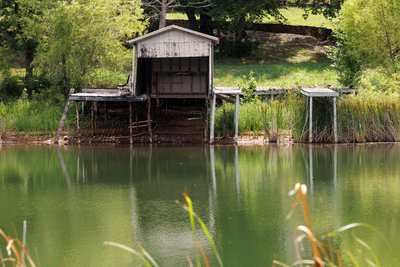
Docks that until a few years ago floated on the lake are now sunken into dry land.
Terry Smith and his wife Rhea have lived at Cedar Lake for a few years, but have been enjoying the waters for 20 years.
Like other residents, the Smiths have had to buy water to be hauled in because their well water levels have plummeted.
“It’s slow to recover,” Smith said. “It hasn’t gone dry. We’re very protective of it. We try not to use too much.”
The two said they worked their entire lives so they could retire at the lake. They bought a home they could afford and have been fixing it up, Rhea Smith said.
But, they’ve had to replace a well pump and say their dock is now damaged.
The low water levels have affected Kacee Corey’s family dynamics and livelihood, she said. Their family has had property at Cedar Lake for 22 years, she said.
“My grandkids don’t want to come out anymore,” said Corey.
Her family can no longer fish from their dock because the receding water levels have left it sitting too far from the lake and surrounded by trees, she said.
“It’s a beautiful piece of property and it’s not being loved anymore and used,” Corey said.
Oklahoma City, OK