Virginia farmers talk meat production, fertilizer costs with USDA officials
Jun 04, 2026 | 5:23 am ET
Description
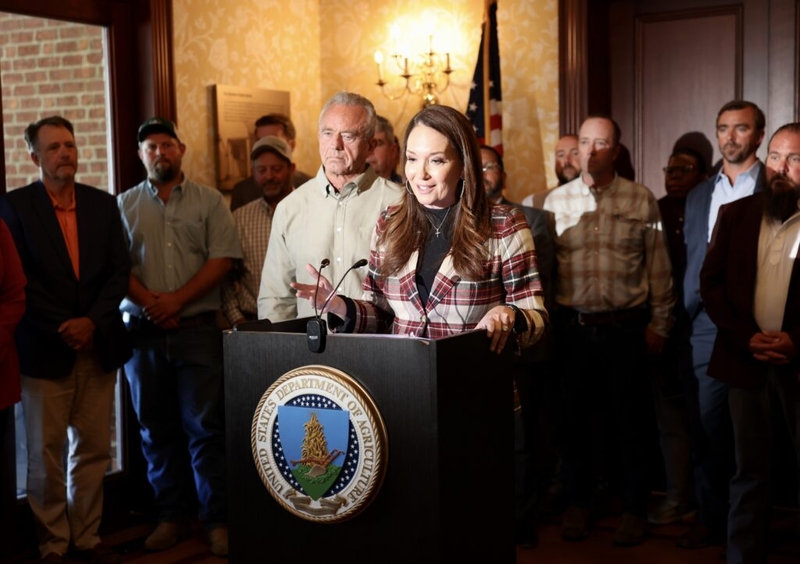
U.S. Secretary of Agriculture Brooke Rollins and U.S. Secretary of Health and Human Services Robert F. Kennedy Jr. participate in a press conference on helping the state's small farmers in Hanover County, Virginia on June 3, 2026. (Photo by Charlotte Rene Woods/Virginia Mercury)
United States Department of Agriculture Secretary Brooke Rollins and Health and Human Services Secretary Robert F. Kennedy traveled to Doswell Wednesday to meet with Virginia farmers and meat producers and discuss the challenges they face – and what the federal government can do to help.
Limited access to local meat processors is a persistent challenge for cattle and poultry producers in Virginia and elsewhere, they said. Production facilities that are USDA approved are often overburdened with the amount of work they have.
Rollins announced on Wednesday an action plan to reduce regulatory burdens on processors and that the fourth phase of the Meat and Poultry Processing Expansion Program has just opened.
“Several of the comments we heard here were: why are we shipping these beautiful beef cattle from Virginia all the way to the middle of the country to get processed?” Rollins told reporters. “Obviously, this won’t change overnight. We have a country to feed, and the world loves our beef from this country, but this is the way, as we deconsolidate a lot of the processing industry.”
The grant program, allotted $60 million in this phase, allows small meat processors to apply for grants that can aid them in buying machinery, upgrades, renovations and other needs.
The grants range from $50,000 to $2 million for expansion projects and $10,000 to $250,000 for equipment-only applications.
After meeting with the secretaries, the newly elected president of the Virginia Cattlemen’s Association Dave Norford said increasing the number of small processors is critical to help local producers get their products to the market.
“There’s not a lot (of small processors). There’s some, but they stay pretty busy. So, if we had access to more of that, then I think the idea is there will be more opportunity for people to directly market their beef,” Norford said.
Virginia farmers are also grappling with the rising cost of fertilizer. As the Strait of Hormuz remains a choke point for the global supply chain amid the Iran war, some fertilizer costs have skyrocketed about 40%. Fuel, a necessary component of fertilizer production, has also experienced a major price jump.
This has led producers to cut back on the amount of fertilizer they buy and spread on their land, which ultimately will impact their yield for this year and next, while corn bushels are already at a low price.
Rollins said she has met with some American-based fertilizer companies and asked them not to raise their prices during this fraught time, and outlined other measures the agency is taking to try and shore up availability of fertilizer. She said it is a long-term issue the Trump administration will continue working on.
“For the short term, we waived the Jones Act, we opened up lines from Venezuela,” Rollins said. “I had American fertilizer companies, there (were) still a few left, come into my office at USDA and basically I said, for the good of the American farmer, will you consider freezing your prices.”
Virginia is also in its fourth year of drier-than-normal conditions, Norford said. This year the drought persists, with an unusually warm spring and a dry winter compounding challenges to groundwater availability.
Norford has about 1000 head of cattle at his Albemarle County farm. He said the USDA offers some programs to help farmers and herd owners with potential feed shortages due to the drought.
“From a cattle standpoint, there’s a program that’s just come online, at least in my area, to help you with some costs,” Norford said. “They would pay you so much per head for your cattle to help you buy feed, buy hay, buy corn from a different area.”
The USDA has several other programs aimed to help provide relief to producers dealing with drought, the leaders said.
Rollins added that the agency is working to process Gov. Abigail Spanberger’s request for a secretarial disaster declaration, which will unleash financial aid to farmers who experienced harsh freeze and frost events earlier this year following a warm spell that set up crops to be in a vulnerable state when the cold returned.
In addition to Rollins and Kennedy, U.S. National Advisor for Nutrition of Agriculture Dr. Ben Carson attended the roundtable event.
Richmond, VA