U.S. Supreme Court denies Alabama’s appeal of panhandling ruling
Mar 03, 2026 | 8:01 am ET
Description
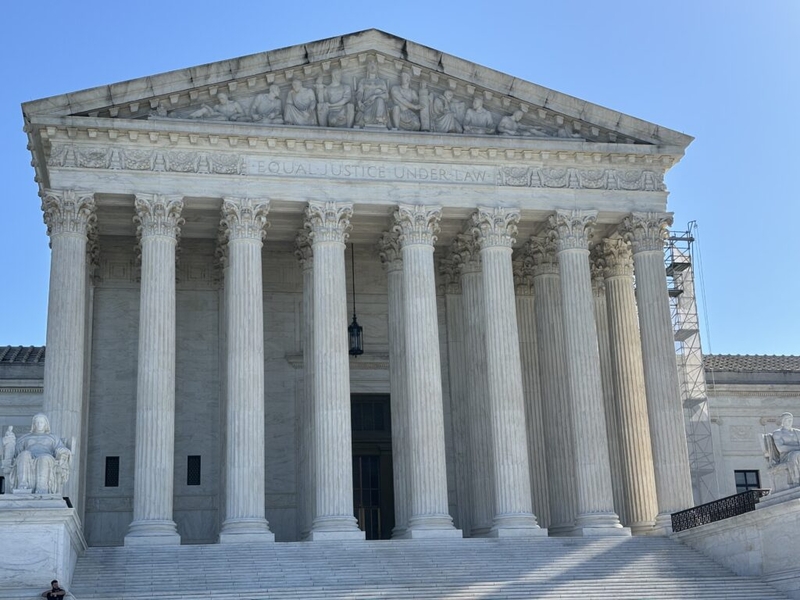
The U.S. Supreme Court on Oct. 9, 2024. The Supreme Court on Monday declined to hear Alabama’s appeal of a lower court ruling prohibiting state law enforcement from arresting people experiencing homelessness for panhandling. (Photo by Jane Norman/States Newsroom)
The U.S. Supreme Court on Monday declined to hear Alabama’s appeal of a lower court ruling prohibiting state law enforcement from arresting people experiencing homelessness for panhandling.
The case, Taylor v. Singleton, started with Jonathan Singleton, a homeless man living in Montgomery. The center filed a lawsuit against the Montgomery sheriff’s office and city police, and Alabama Law Enforcement Agency (ALEA) Secretary Hal Taylor in 2020, challenging two state statutes criminalizing “asking for help.”
A spokesperson from Alabama Attorney General Steve Marshall’s office, who represented Taylor, said in a statement Monday afternoon that the office has a “deep concern” with federal courts’ roles in local governance.
“Our commitment to tackling urban decay remains firm, and we will continue pursuing all available legal tools to do so. While we are disappointed with the Supreme Court’s ruling in this case, our dedication to constitutional originalism is unwavering, and we will press forward through every appropriate channel,” the statement said.
As is custom, the Supreme Court did not give a reason for its decision.
Micah West, senior supervising attorney at the Southern Poverty Law Center (SPLC), which represented Singleton, said in a phone interview Monday that Singleton “is a homeless individual who stands on public streets holding signs saying things like, ‘Homeless. Today, it is me. Tomorrow, it could be you.’”
At the time of the original lawsuit, Alabama law prohibited people from “loitering, remaining or wandering in public to beg,” an act that carries a maximum penalty of 30 days in jail and a $200 fine. Another law made it illegal for someone loitering along the highway to solicit “employment, business or contributions” from people who are driving.” Violations could be to 10 days in jail and a $100 fine, with punishments escalating with subsequent violations.
According to the 2024 Annual Homelessness Assessment Report, there were 4,601 people experiencing homelessness in Alabama in that year, a 39.3% increase from 2023.
After settling with the county and city law enforcement, the case continued with Taylor and Singleton to the U.S. District Court for the Middle District of Alabama, where a judge ruled in 2023 that enforcing those laws was unconstitutional.
“The judge said, in effect, that all of us have a constitutional right to talk to each other when we’re in need and to explain that we’re experiencing homelessness or poverty or illness or falling on hard times,” West said.
The U.S. 11th Circuit Court of Appeals upheld that opinion last April, citing precedent that free speech protections for the First Amendment apply to the act of begging.
The state appealed to the Supreme Court in September. In a brief submitted to the high court on Jan. 26, Marshall wrote that begging is not free speech and the meaning of the Free Speech Clause cannot evolve.
“Just because some lower courts have broken the tradition of begging restrictions from ‘1791 to the present’ does not make this Court powerless to set things right,” Marshall wrote.
SPLC noted that multiple lower courts agree that begging is protected by free speech.
“In short, not only is there no division of authority on the question presented for this Court to resolve, but there is widespread consensus across federal and state courts that Petitioner’s position is wrong,” West wrote.
West said Monday that SCOTUS’ decision to not hear the case is a win for the First Amendment and all people experiencing homelessness in Alabama.
“What that means is that the state of Alabama will not be able to enforce those two laws and will not be able to criminalize people simply for communicating to other people that they need help,” West said. “Going forward, given the clear Supreme Court ruling, I hope that the State of Alabama will focus on providing housing to people who are experiencing homelessness and not criminalizing them.”
Montgomery