Tuscaloosa women’s clinic expands amid ongoing state health challenges
Apr 27, 2026 | 7:57 am ET
Description
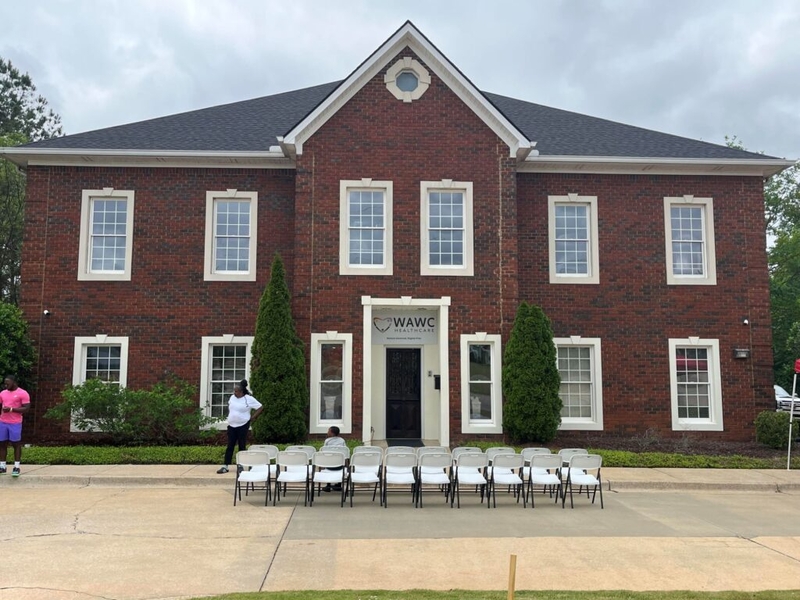
The WAWC Healthcare clinic as seen on April 25, 2026, in Tuscaloosa, Alabama, ahead of the grand reopening ceremony. The clinic outgrew its old location on Jack Warner Parkway even after it could no longer provide abortions. (Courtesy of Robin Marty)
Before the U.S. Supreme Court overturned Roe v. Wade in 2022, the West Alabama Women’s Center saw 250 patients per month, almost all of which were abortions. The clinic opened a new location Saturday with expanded services after rebranding as WAWC Healthcare in 2024.
Even after the clinic could no longer provide abortions, it saw almost as many patients. Executive Director Robin Marty said in an interview Friday morning that the clinic needed more space, and an Actions for Women’s Healthcare grant made that possible.
“That allowed us to use our resources to be able to purchase an amazing new clinic that is now four times the size of our current footprint over at Jack Warner, just the bottom floor, which is where the patient care and the mental health wing that we have developed,” Marty said.
The expansion comes as Alabama continues to struggle with delivering healthcare, particularly to women and rural communities.
According to the American Cancer Society, women in Alabama face the fourth highest incidence rate for developing cervical cancer in the United States, with Arkansas, Oklahoma and Mississippi having higher rates. In 2021, there were 56.9 pregnancy-related deaths per 100,000 live births, according to the Alabama Department of Public Health. Nationwide, the there were 32.9 deaths per 100,000 births in the same year, according to the U.S. Centers for Disease Control and Prevention.
According to the University of North Carolina’s Sheps Center, nine rural hospitals have closed in Alabama since 2009. Only 30% of the state’s rural hospitals have labor and delivery units, leaving many expectant parents to drive long distances for care.
“There’s a lot of talk about mobile centers, tele-med and how to expand that, but the reality is that you can’t have care without community,” Marty said. “You can’t just come helicopter in and make this work.”
The clinic saw 243 patients last month, Marty said, but those appointments look very different than before Roe v. Wade was overturned. Then, appointments were short. Now, she said, the community-focused model leads to longer appointments and more health education.
“What good is it to give somebody healthcare if you’re not hitting every single piece of what they need? You are just pushing a problem down the road,” Marty said.
The new clinic, on Palisades Court in Tuscaloosa, about five miles from the old clinic, is three stories high and includes a mental health wing, birthing suites and a dedicated community space. Tamela Hughes, director of mental health and program innovation, said the mental health wing will serve as a way to destigmatize mental health services.
“It’s showing people that mental health isn’t this scary thing. It can be, if it’s not addressed, but it doesn’t have to be this scary moment where you feel like you’re being judged,” Hughes said.
Marty said that the new clinic is not only expanding services, but it is making rural healthcare community focused.
“The reason we are doing this is because we know that community responds medically best to other people in their community,” she said. “The way to fix our healthcare system isn’t just to pipe in new doctors or make sure that there’s tele-med that can be answered from the city. It’s to get people on the ground and build them from high school all the way up with this type of non-stigmatized patient-centered evidence-based healthcare.”
She criticized rural health funding from the federal government for pouring money into existing hospitals and creating mobile health units. Alabama is receiving $203 million from the Rural Health Transformation Program, divided between 10 initiatives for fiscal year 2026, most of which will be spent on workforce. An 11th initiative, community healthcare, will not receive funding until the third year of the program.
According to a brief from KFF, a national health policy research organization, the fund could partially offset just over a third (37%) of the estimated federal Medicaid spending cuts in rural areas, which are projected to be $137 billion over ten years.
Dr. Keri Chaney, one of WAWC’s providers, is from west Alabama and returned there after graduating from the University of Alabama at Birmingham.
“My background is women’s health and my desire was to be in a community based clinic,” Chaney said.
The expansion in Tuscaloosa is part of a broader growth in WAWC’s services. The organization opened a part-time clinic in Birmingham in January. It also plans to open a clinic in Sumter County, near the Mississippi border, and another between Tuscaloosa and Mississippi, Marty said.
“You have to be able to get to know the community, build trust with the community, and that comes in many cases by just reducing as many barriers as possible for even the start of that care,” she said. “So if we can provide more care that is actually coming to a person so that they can establish this regular relationship with a doctor, with a medical provider, and make sure that that relationship grows from its natural start. That’s how you are going to get people to engage in care.”
Marty said that the WAWC that exists today was always the goal when the Yellowhammer Fund bought it in 2020, but the demand for abortion was too high.
“I’d like to think that we could have had legal abortion and this, because that’s what people really deserve,” Marty said. “But if we had to lose abortion, I’m so glad that we had this to evolve into.”
Montgomery