Trump thwarted in hunt for rare noncitizen voters as midterms near
Sep 28, 2026 | 5:19 pm ET
Description
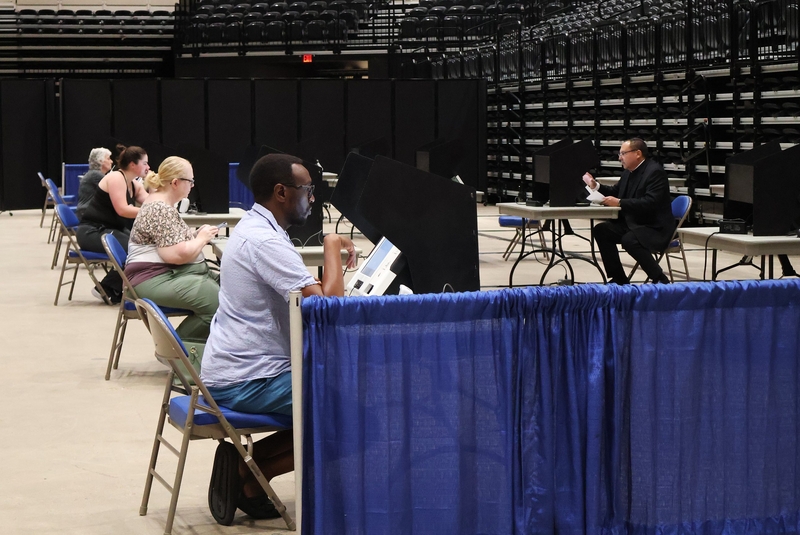
Voters fill out ballots using touch screens during early voting at the Bismarck Event Center in Bismarck, North Dakota, on June 8, 2026. (Photo by Michael Achterling/North Dakota Monitor)
Five weeks before Election Day, President Donald Trump’s sprawling effort to identify and remove noncitizen voters hasn’t produced the kind of large purges that could meaningfully affect the midterm elections.
Even a recent U.S. Supreme Court decision giving states access to a supercharged Department of Homeland Security computer program to verify voters’ citizenship will have a limited immediate impact, election experts say.
As Republicans fight to retain control of Congress, Trump and his allies have spent the past year aggressively seeking to root out noncitizen voting.
They have called into question the security of the upcoming elections, following the lead of the president, who has long made spurious claims of voter fraud to dismiss unfavorable results.
Those efforts are now colliding with federal law — and the reality long shown by studies and available data that noncitizen voting is rare.
Little impact seen from court ruling
The Supreme Court on Sept. 25 ruled in a 6-3 decision that states can access Homeland Security’s SAVE system, which draws upon citizenship information stored across the federal government to scour voter rolls in the hunt for possible noncitizens. A district court judge had blocked the program in June.
But the high court’s decision came during a quiet period under the National Voter Registration Act that prohibits most states from conducting mass purges of voters in the 90 days before a federal election.
The timing limits election officials to only searching for information on individual voters, even though Homeland Security has touted SAVE to states as a tool that can quickly scan millions of names.
The Supreme Court’s conservative majority acknowledged as much, writing in its unsigned opinion that the quiet period “limits the potential impact” of the court’s decision.
Justice Ketanji Brown Jackson, writing for the court’s three liberals, agreed the decision would have minimal short-term effects but argued the possibility of disenfranchising even a few lawful voters outweighed any risk of harm to the government.
David Becker, executive director of the nonpartisan Center for Election Innovation & Research, in a statement emphasized that voters will continue to experience the same safe, secure and reliable voting process this year as in the past.
"This decision will not have any significant impact on the 2026 election, as systematic voter list maintenance is prohibited within 90 days of a federal election, which the Supreme Court explicitly confirmed,” Becker said.
Post-2026
The more significant fallout from the Supreme Court’s decision may come in the weeks and months after the election, when states can once again remove large numbers of voters from their rolls.
The Supreme Court is also set to hold oral arguments in December in a case that involves the reach of the National Voter Registration’s Act’s quiet period — leaving open the possibility the justices could give states more leeway to purge voters ahead of elections.
But for now, the restrictions remain in place.
“Until the Supreme Court says, reinterprets otherwise, the quiet period is still the quiet period,” Aaron Blacksberg, federal policy counsel at the Institute for Responsive Government, said in an interview.
Separately, a U.S. district court judge on Monday blocked the Trump administration’s efforts to require states to use SAVE as a condition of receiving some Federal Emergency Management Agency grants. Judge Amir H. Ali, an appointee of President Joe Biden, wrote that FEMA exceeded its authority in imposing election-related requirements.
Is the data reliable?
SAVE’s critics, which include Democrats and privacy advocates, warn that the system relies on incomplete and sometimes outdated data, resulting in false positives. SAVE was previously used to check whether noncitizens were eligible for various government benefits before the Trump administration last year repurposed it into a tool to check citizenship.
When U.S. District Judge Sparkle Sooknanan, a President Joe Biden appointee for a district court based in Washington, D.C., ruled against the program in June, she highlighted sworn declarations by naturalized citizens that Texas had threatened to revoke their voter registrations because of inaccurate Social Security data in SAVE.
"SAVE was never designed to verify citizenship: it relies on outdated and inaccurate data that produces false matches, risks disenfranchising eligible voters, and exposes sensitive personal information to misuse and bad actors,” Tim Harper, a project lead focused on elections and democracy at the Center for Democracy & Technology, a nonpartisan organization focused on civil liberties in the digital age, said in a statement.
The Trump administration and some Republicans hail SAVE as a powerful tool to ensure the accuracy of voter rolls and identify noncitizens who shouldn’t be registered to vote. They note that its use by states is voluntary.
“It’s remarkable that we had to file an emergency petition in the Supreme Court just so we can use government data to stop noncitizens from voting illegally. American elections are for Americans,” James Percival, Homeland Security’s general counsel, said in a statement.
In an email to States Newsroom, White House spokeswoman Lauren Bis faulted Democrats for not voting for the SAVE America Act, a bill that would require voters to produce documents proving their citizenship before voting. The bill has stalled in the U.S. Senate amid bipartisan opposition.
“The American people overwhelmingly support this commonsense legislation that enacts basic election security measures like voter ID and ensures only Americans are electing America’s leaders. President Trump is absolutely right: we fix this now, or we lose our country,” Bis said..
How many instances of noncitizen voting?
The Trump administration’s intense focus on noncitizen voting — which also includes a legal effort to force states to turn over voter data to the Department of Justice — contrasts with the extremely rare nature of noncitizen voting, according to past studies and election experts.
The U.S. Census in August identified about 24,000 instances of noncitizen voting in the 2020 election out of roughly 160 million votes cast, or 0.015% of all votes. One study of the 2016 election placed the prevalence of noncitizen voting at 0.0001% of votes cast.
But Homeland Security has suggested large numbers of noncitizens may be registered to vote. In July, the department said it had identified over 250,000 potential noncitizens on the voter rolls in California, New Jersey, Nevada and Pennsylvania.
On Monday, U.S. Senate Democrats in a letter to Homeland Security Secretary Markwayne Mullin wrote that they couldn’t trust those numbers. For instance, DHS initially floated nearly 16,000 possible noncitizen voters in Nevada. In the end, the agency provided state officials with a list of 185 people that officials said were noncitizens. All turned out to be citizens.
“Federal law already prohibits noncitizens from voting in federal elections, and every eligible voter across America has the right to cast a ballot — and should be able to do so without fear of being wrongly purged from the voting rolls,” Sen. Dick Durbin, an Illinois Democrat, said in a statement following the Supreme Court’s decision.
The alleged scale of potential noncitizen voter registration by Homeland Security also doesn’t match the scope of the agency’s law enforcement actions. Earlier in September, Homeland Security Investigations, a DHS agency, reported making 160 recent arrests from 1,600 open voter fraud cases.
When noncitizens do end up on voter rolls, administrative errors are sometimes to blame. In July, New Jersey Gov. Mikie Sherrill, a Democrat, announced that a software glitch caused about 6,600 noncitizens to become registered to vote and that about 400 had cast ballots.
And in April, then-Texas Secretary of State Jane Nelson, a Republican, wrote in a letter to U.S. Citizenship and Immigration Services that some noncitizens had been registered to vote because of a clerical error despite acknowledging on a voter application that they weren’t U.S. citizens.
“That is why we urge voter registrars to use all available sources to confirm a person’s citizenship status — including SAVE data and other information about the registrant — when they are investigating whether the person is eligible to be a registered voter,” Nelson wrote in an email obtained by Democracy Forward, a pro-democracy legal organization.
All States Newsroom content is free to republish. Read our republishing policy for more information.