Arkansas judge weighing future of lawsuit challenging state’s abortion ban
Sep 28, 2026 | 6:09 pm ET
Description
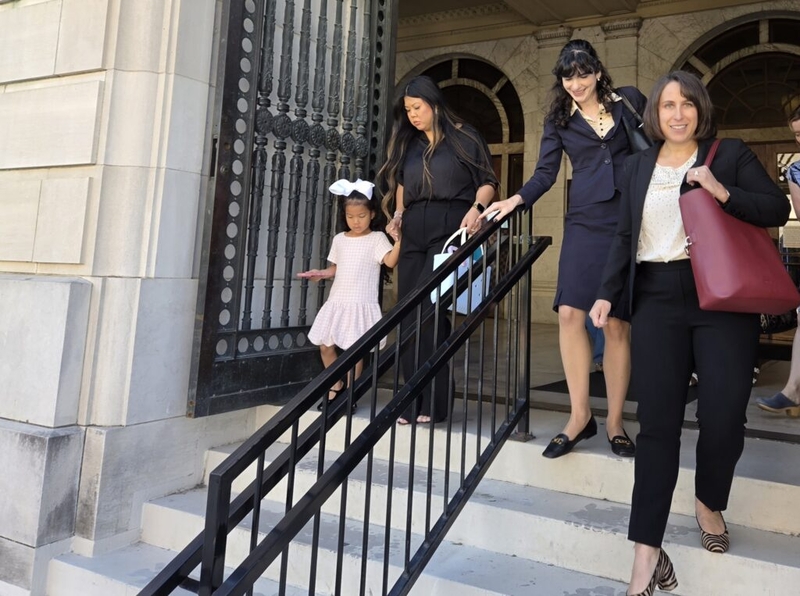
Attorneys Maria Victoria Abut (second from right) and Molly Duane (right) leave the Pulaski County Circuit Courthouse on Sept. 28, 2026 after a hearing over Arkansas' abortion ban. Abut and Duane represent seven plaintiffs, including Theresa Van (second from left), pictured with her daughter, Camille (left). (Photo by Tess Vrbin/Arkansas Advocate)
A Pulaski County circuit judge is considering whether to dismiss the constitutional challenge to Arkansas’ abortion ban after hearing arguments from the plaintiffs and the state in a two-hour hearing Monday.
Circuit Judge Cara Connors did not say when she expected to rule regarding the lawsuit filed earlier this year by six women and an obstetrician-gynecologist challenging Arkansas’ abortion law.
Arkansas has among the nation’s strictest abortion bans, and the challenge against it is the first filed by Amplify Legal, the litigation arm of Abortion in America, an abortion-rights advocacy group co-founded by the late Planned Parenthood President Cecile Richards.
The challenged law bans the procedure with a narrow exception to save the life of a pregnant person in an emergency. It went into effect in 2022 when the U.S. Supreme Court overturned the federal right to abortion, leaving the matter up to the states.
The case has drawn national attention to the fact that Arkansas’ abortion ban puts decisions about treating miscarriages and nonviable pregnancies in the hands of lawyers rather than doctors.
Connors dismissed the case in April under a 2025 state law regarding how circuit courts handle constitutional challenges, but she revived the case in May because the state Supreme Court had previously struck down the relevant law.
Gov. Sarah Huckabee Sanders, Attorney General Tim Griffin, three state prosecuting attorneys and the full Arkansas State Medical Board are defendants in the case.
The lawsuit faces an uphill battle if it eventually winds up before Arkansas’ Supreme Court, where five of the seven justices have Republican ties.
2 women join lawsuit challenging Arkansas’ near-total abortion ban
Protected liberties
Arkansas Solicitor General Autumn Hamit Patterson argued that the case should be dismissed because the state has sovereign immunity, meaning it cannot be sued in its own courts, and because “all the plaintiffs’ legal theories are flawed.”
Molly Duane, the plaintiffs’ lead attorney, said the ban infringes on the state’s constitutional rights to life, liberty and the pursuit of happiness.
“Those rights do not disappear the moment an Arkansan becomes pregnant,” Duane said.
Duane was the lead attorney for Amanda Zurawski, a Texas woman who sued the state in 2023 after being unable to obtain an abortion for a nonviable pregnancy that threatened her life. The Texas Supreme Court upheld the state’s abortion ban.
Unlike the Arkansas and United States constitutions, Texas’ constitution does not have language protecting life, liberty and the pursuit of happiness.
Patterson argued that the constitution’s life and liberty provision “has never been interpreted that broadly” and that it should not include abortion.
Duane told reporters after the hearing that the court should take the cited language seriously, especially since judges and attorneys “spend a lot of time worrying over other words in constitutions.”
“The fact that these constitutional provisions aren’t cited that often [in abortion litigation] doesn’t make them any less fundamental and important,” Duane said.
‘Reasonable medical judgment’
Duane also argued that the ban’s exception allowing abortion to save a pregnant person’s life is unconstitutionally vague. Arkansas law makes it a felony punishable by a maximum prison sentence of 10 years, a maximum fine of $100,000 or both for a medical professional who performs an abortion.
A bipartisan 2025 state law clarifies that doctors can perform abortions to save a pregnant Arkansan’s life within “reasonable medical judgment.” Duane argued that the 2025 law did not serve its stated purpose when two Fort Smith hospitals denied care to plaintiff Leitaea Lowrimore for her ectopic pregnancy in February.
Ectopic Pregnancy Deaths Have Nearly Doubled. It’s Worse in States With Abortion Bans.
Fearing a misdiagnosis and potential prison time, medical professionals declined to confirm that Lowrimore had an ectopic pregnancy, Duane said.
Patterson acknowledged that ending an ectopic pregnancy saves a pregnant person’s life and is not considered abortion in the eyes of the state.
She also said the abortion ban is not vague and instead presents “a reasonable, ascertainable standard” for its exception. Connors disagreed.
“If physicians are not performing abortions they are legally allowed to perform, how is [the law] not vague?” Connors asked.
Roughly 2,600 Arkansans traveled to Illinois or Kansas to receive abortion care in 2024, according to data from the Guttmacher Institute, a reproductive rights policy and advocacy group. Five of the six women plaintiffs, including Lowrimore, received abortions in those states between 2022 and 2026, according to court documents.
The sixth woman, Theresa Van, continued her nonviable pregnancy for weeks after being denied an abortion, and she began planning her funeral in case she did not survive, according to court documents.
The plaintiffs have asked Connors to block enforcement of the law, which would require a separate hearing.
Both sides can immediately appeal Connors’ ruling on the dismissal motion. Duane told the Advocate that an appeal from the state could prevent the plaintiffs from testifying in court, so she hopes Connors conducts the preliminary injunction hearing before ruling on the state’s motion to dismiss.
Connors said she was “not convinced” that she should hold the injunction hearing first. She previously granted the state’s request to block the gathering of evidence in the case.
Little Rock