ICE agent who shot Lorenzo Salgado Araujo in Houston identified
Sep 28, 2026 | 5:27 pm ET
Description
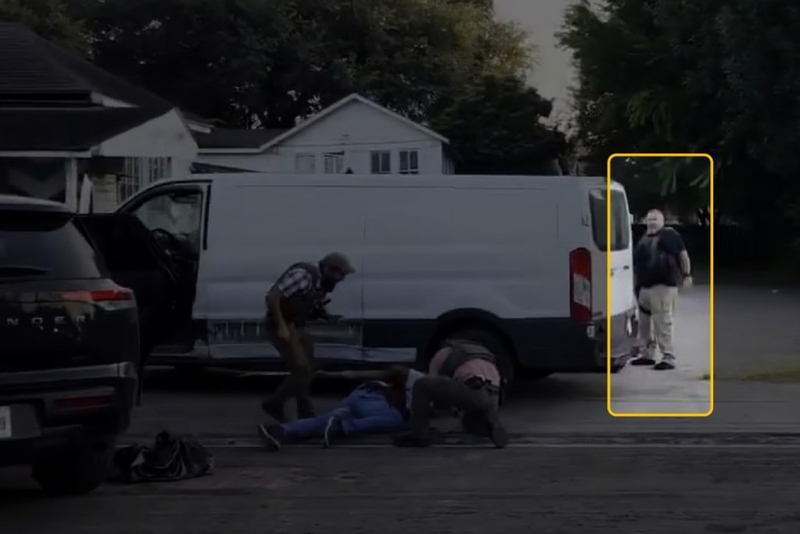
A man identified as ICE Agent Gregory Feathers is seen standing by a white van in video taken by a witness as other agents tend to Lorenzo Salgado Araujo, who later died. (Annotated by The Texas Tribune)
Editor’s note: In recent shootings by Immigration and Customs Enforcement agents, the federal government has withheld the names of the officers involved. This is a departure from the practice of many law enforcement agencies — including Texas’ biggest police departments — and contradicts advice the federal government has reportedly given local agencies in the past.
Today, we are publishing the name of the officer who allegedly shot Lorenzo Salgado Araujo in Houston this summer. In recent weeks, local law enforcement and members of Congress have said their questions about the shooting have not been answered. We are publishing because we believe transparency in the case is of vital public interest as investigators, lawmakers and the public seek to understand what happened and how ICE operates more broadly in this state.
The federal immigration agent who witnesses say fired through an open van window and killed 52-year-old Lorenzo Salgado Araujo in Houston nearly three months ago has been identified to The Texas Tribune as Gregory Feathers by an official familiar with the investigation who is not authorized to speak publicly. His role in the shooting is also corroborated by records, some of which were publicly released.
Feathers was rehired within the past two years after previously retiring, according to two people with knowledge of his employment history, overlapping with the second Trump administration’s aggressive recruitment of former Immigration and Customs Enforcement officers to help meet its ambitious deportation goals. Feathers’ name was included in a Form I-213, which is akin to a police report and details ICE agents’ description of the chase and shooting incident. The form, which is not typically public, was mistakenly released by the U.S. Attorney’s Office last month. Other records obtained by the Tribune identify Feathers as calling paramedics and name him as one of two arresting agents involved in the deadly pursuit. The front seat passenger in Salgado Araujo’s van identified the shooter to the Tribune from a photograph which was separately confirmed to be Feathers by the official familiar with the investigation.
Feathers has not been charged with a crime and the U.S. Department of Homeland Security has defended the shooting as an act of self-defense. But the local district attorney appears to be currently empaneling a grand jury that could result in criminal charges for Feathers, who through his attorney declined to comment. The lawyer, Nicole DeBorde Hochglaube, said that DHS policy prevents her client from speaking during a pending investigation. She also declined to comment.
The district attorney’s investigation is being assisted by the Texas Department of Public Safety. The FBI, the U.S. Attorney’s Office and DHS are separately probing the incident.
The federal government has withheld the shooter’s identification from the public and even members of Congress, as it has done for most immigration agents involved in shootings since Trump returned to office. Texas lawmakers said their questions about those agents’ names and experience have remained unanswered, even as members of Congress are usually entitled to more information about federal investigations than the public.
Major state and local law enforcement agencies across the country typically identify officers involved in shootings on the job soon after the incident, according to policing experts.
Spokespeople for DHS, which oversees ICE, did not respond to detailed questions about Feathers.
“Doxxing our officers put their lives and their families in serious danger,” an unnamed DHS spokesperson wrote in a statement. “Our law enforcement officers are on the frontlines arresting terrorists, gang members, murderers, pedophiles, and rapists. Now, thanks to the malicious rhetoric of sanctuary politicians, they are under constant threat from violent agitators.”
ICE agents, the spokesperson said, are experiencing “coordinated campaigns of violence against them,” which includes a sniper firing at an ICE detention center in Dallas a year ago. The shooter, who killed himself, intended to harm ICE agents, according to officials. Instead he killed two detainees and seriously wounded another.
The spokesperson said there has been more than a 1,600% increase in assaults, a 3,300% increase in vehicular attacks, and an 8,000% increase in death threats against ICE agents since Trump returned to office.
Other immigration agents who killed people in the line of duty in recent months have been identified by news organizations, including ProPublica and the New York Times. There has been no public indication that any of them were subjected to violence afterward.
During Trump’s second administration, immigration agents, who often are masked, have shot at least two dozen people in the past two years — at least six, including three U.S. citizens, have died. Many of the shootings involved agents firing at people in moving vehicles, which law enforcement experts said is typically prohibited or discouraged by local police. The growing tally of deaths at the hands of anonymous federal agents has ignited outcries by Democrats, the victims’ relatives and residents to identify them.
Three of those killed were in Texas: An American citizen in South Padre Island and a Mexican immigrant who crossed the Rio Grande into Starr County, in addition to Salgado Araujo. Earlier this month, a 28-year-old Venezuelan man with a deportation order was shot in the back in Austin by a masked ICE agent, who also has not been identified. He is still alive but seriously injured and remains detained, according to his attorney. Federal officials claimed those shootings were in self-defense, as they have also maintained in the other cases.
U.S. Rep. Sylvia Garcia, a Houston Democrat who represents the mostly Latino district where Salgado Araujo was killed, called for ICE to identify his shooter as well as others involved in such incidents.
“Lorenzo Salgado Araujo had a name. His family had to bury him,” Garcia said to the Tribune. “The federal government should not be allowed to hide the identity of the officer who took his life.”
She is one of a growing number of federal and state lawmakers who have joined Salgado Araujo’s family and other relatives of people whom ICE have killed in demanding that the government release the names of immigration agents who slay or wound people on the job.
“For more than two months, our mom has cried every night wondering who killed her husband, lifelong partner, and our father,” Salgado Araujo’s two sons said in a joint statement to the Tribune. “When a government agent shoots someone, the least they can do is take responsibility for that fatal decision.”
They added that the family has “been in public begging for justice, putting our lives at risk while ICE has hidden the killer and tried to drag our father’s good name through the mud.”
Salgado Araujo’s brother, Victor, who was in the front passenger seat of the van on the day of the deadly pursuit, identified the shooter in a photo to the Tribune. He told his lawyer, in a transcript she provided to the Tribune with his permission, that the agent fired through his window while on foot, striking his brother in the stomach. He and the two other passengers have said in previous interviews that they had no idea that it was immigration agents pursuing them because the officers were in unmarked black SUVs. The brother did not know the shooter’s name.
“The bullet passed right in front of me,” he said in his first public comments since being released from ICE detention last month. It caused his ears to ring for hours after agents threw him on the ground, injuring his knee, he said, while he heard his brother scream, “they have already killed me.”
“It would have been better if they had killed me,” Victor Salgado Araujo said. “That way I wouldn’t be suffering like this. It completely changed my life. They destroyed our whole family.”
His attorney, Ruby L. Powers, said the family and their community deserve answers.
“When a government agent uses deadly force, the public has a right to know what happened, who was involved, and what the evidence shows,” Powers said. “Identifying the shooting agent is not an accusation of guilt — it’s part of the basic transparency and accountability the public should expect any time deadly force is used.”
Police Protocol
The secrecy surrounding the identities of ICE agents in officer-involved shootings stands in contrast to common practice for most local and state police, according to law enforcement experts.
The four largest police departments in Texas – Austin, San Antonio, Houston and Dallas – all have written policies or regular protocols that they generally release the names of any officers accused of shootings on the job within three days, although it can take up to two weeks in certain cases, according to spokespeople for the agencies. Typically, they release related body camera footage in about a month, if not sooner, the spokespeople said.
A 2023 survey of 148 police departments across the country by the Police Executive Research Forum, a national organization seeking to improve law enforcement policy, found that more than a third identify officers involved in shootings that result in deaths or serious injuries. Of those, more than 90% reported no harm as a result to the officers they named and none suffered physical violence.
That identification often occurs before officers are cleared from internal investigations or criminally charged.
In 2019, for example, Baytown police officer Juan Delacruz, shot and killed a 44-year-old woman who had outstanding warrants and suffered from schizophrenia, according to her family. During the struggle with the officer, she used his Taser on him. He fired, killing her in self defense, according to his attorney. The small suburban police department released his name within days. A grand jury later indicted the officer of a felony charge of aggravated assault by a public servant. A jury in 2022 found him not guilty.
In 2023, the San Antonio Police Department quickly identified three officers accused in the fatal shooting of a mother of four who was experiencing a mental health crisis, her family said, when she lunged at officers with a hammer. The department named Sgt. Alfred Flores and officers Nathaniel Villalobos and Eleazar Alejandro and released body camera footage within days, firing all three. Two officers were charged with murder and one with aggravated assault. They have maintained that it was in self defense and in 2025, a jury acquitted all three of the charges.
Last month, Austin police identified Officer Stephen Abbott, a 12-year veteran of the department, two days after he shot at a man suspected of pistol-whipping a victim who fired first at the officer. The suspect, who did not die, was later arrested after barricading himself in an apartment.
In its release of the officer’s name, Austin Police Department wrote that it “understands the importance of building trust within our community and will continue working diligently to develop a strong and trusting relationship.”
Lauren Bonds, executive director of the National Police Accountability Project, an advocacy group that works with civil rights attorneys in police abuse cases across the country, said that most law enforcement agencies have written policies or procedures that they identify officers involved in shootings within days and release body camera footage shortly after.
“That is the general position of law enforcement these days: ‘We are going to release these names and we’re going to release the footage because that transparency gives us more credibility in this process,’” she said.
There are exceptions, however, such as undercover agents conducting drug or national security-related investigations where safety and sources could be at risk if they are identified — although their names would often be known to local and state government officials as well as members of Congress if requested.
Garcia, the Houston congresswoman, said that DHS has not responded to her detailed written questions seeking more information about the shooting, including whether Feathers was the agent who fired the shot and details about his training and history. She said DHS also did not respond to her about Feathers’ salary, whether he is collecting his government pension at the same time as drawing a salary since he previously retired, and if he obtained the $50,000 signing bonus that the administration reportedly offered applicants who joined the deportation mission under Trump’s return. His attorney also declined to answer those questions to the Tribune.
As in the Houston and Austin cases, deportation agents — who enforce civil not criminal laws — are increasingly engaging in the kind of police work that resembles local law enforcement, Bonds said. Prior to this administration, ICE agents did not typically engage in traffic stops for deportation attempts.
“Whether that’s pulling over vehicles in this manner, whether that’s the pit maneuvers and the car slamming, whether using firearms to detain people, using chokeholds,” she said. “This is mostly what local police, not ICE, have the training and experience to properly do.”
Claire Trickler-McNulty, a former senior ICE official during the last three administrations, additionally urged more transparency, explaining that a “short embargo,” such as several days, provides the federal agency ample time for an initial investigation and for the officers to speak with their family before their names are released.
“But ultimately the agency and the officer have to take responsibility for their actions. I take doxing concerns seriously, but without sunlight there’s no way back to public trust,” she said. “Accountability and restoring trust have to come first.”
U.S. Rep. Jamie Raskin of Maryland, the ranking Democrat on the House Judiciary Committee which conducts oversight of DHS, said in a statement to the Tribune that Republicans gave the agency $200 billion “to build Trump’s paramilitary immigration enforcement machine while stripping away all meaningful oversight and accountability.”
“When federal agents use deadly force,” Raskin added, “the American people have a right to know what happened and who was responsible. Federal agents paid with American taxpayer dollars must be accountable to the people who hire them and pay their salaries.”
David Donatti, a senior staff attorney at the ACLU of Texas, which is representing Salgado Araujo’s family, noted that within hours of his death, his “name, face, and history were public, and his character was open to scrutiny.”
That included the highly unusual release of an FBI search warrant claiming that drugs had been found in Salgado Araujo’s van, which DPS later confirmed was not methamphetamine, but crystallized salt used to make cheap hydration drinks that are common for construction workers in Houston’s heat.
“Naming agents is not a verdict,” Donatti said. “It is a precondition for an independent investigation. It lets witnesses come forward, lets the public see whether there’s a history, and ensures that facts are tested before any account hardens into the only story.”
State Rep. Joe Moody of El Paso, who was the lone Democrat to serve on a House committee investigating the botched response of more than 370 local, state and federal officers to the 2022 Uvalde school shooting, said he observed vastly different standards for federal officers compared to state and local police. Several local law enforcement officers were quickly publicly identified and scrutinized, including by state lawmakers and the DPS chief. But unlike local and state police, federal officers did not provide direct interviews to the state House committee overseeing the investigation.
Moody joined the chorus of lawmakers demanding that the names of ICE agents involved in shootings be made public.
“The secrecy here is totally out of step with how things are done in officer-involved shootings,” he said.
He said the federal government should not decide what taxpayers are entitled to know in deadly use of force incidents.
“We must know now,” he said. “Anything less is either a coverup or incompetence that looks like one.”
‘Wait in the dark for basic answers’
Feather’s name was first made public by the U.S. Attorney’s Office for the Southern District of Texas in a record attached as part of its petition to prevent witnesses to the shooting from being released from detention. It does not name Feathers as the shooter but identifies him and another ICE agent as being two arresting officers in the incident. Four were involved in the pursuit, law enforcement officials said.
A spokesperson for U.S. Attorney Aaron Reitz, a former top assistant to Texas Attorney Ken Paxton who took office days before Salgado Araujo was killed, did not respond to detailed questions. Reitz has said that his office is investigating why ICE’s incident report, which is usually not public, was “inadvertendly” released. He said it contained personal information about law enforcement officers and witnesses that could be used by “anti-law enforcement agitators.”
It has since been sealed.
To investigate the shooting, Harris County District Attorney Sean Teare’s office is convening a grand jury, a proceeding which is generally considered secret under the law. Teare has repeatedly maintained that “protecting the integrity of our independent investigation is essential, so that the Salgado family, law enforcement officials, and our community can have confidence in the outcome, whatever it may be,” said Rafael Lemaitre, a spokesperson for the office.
“While it appears evidence in this case may have already been made public by federal officials, it would be inappropriate for us to discuss the investigation further given its active, ongoing nature,” he added.
Victor Salgado Araujo described the shooter as heavy-set, bearded, closely-cropped hair in a military style and with tattoos on both forearms, matching only one officer in photographs and video taken by bystanders during and immediately after the incident. The other two passengers gave similar descriptions to their attorneys, law enforcement officials and Garcia, the Houston congresswoman. None of the four ICE agents involved were wearing body cameras or had dash cameras in their vehicles, according to government officials.
Feathers is also listed on 911 call logs requesting medical help from the Houston Fire Department early on July 7 immediately after the shooting, according to a government document obtained by the Tribune.
The Tribune has found little public information about Feathers, who has a fairly common name, and does not appear to have public social media accounts. At least two other people with the same name and who are active on social media in the Houston area are not the ICE agent.
The original tip that led to Salgado Araujo’s chase was unrelated to him or his passengers and came from a local law enforcement agency in Montgomery County, according to three officials briefed on the matter.
ICE agents wrote that they later received information from DPS, identifying three Guatemalan men. A DPS spokesperson denied that the agency provided information that resulted in Salgado Araujo’s pursuit.
While conducting surveillance on the Guatemalan men, ICE agents wrote in their report that they could make out only the first two license plate letters of the van they were seeking. They matched those of Salgado Araujo’s van, which the officers spotted in the same area. After running his license plate, they determined that Salgado Araujo – who is from Mexico and had no criminal record – was here illegally. They began their pursuit of his vehicle, even though neither him nor his passengers being the original target.
The county’s district attorney said that he expects to conclude a grand jury soon but the prosecuting of a federal agent faces major hurdles as it’s much more difficult for states to charge such officers – especially if the government is uncooperative. In Houston, the district attorney has said that the federal government has not directly provided his office with any information about Salgado Araujo’s shooting. And nine months after immigration agents killed two American citizens in Minnesota, local prosecutors investigating the case have yet to bring criminal charges. The federal government took months to turn over key evidence.
Even when prosecutors do bring such charges to a grand jury, it often declines to indict federal agents. That was the case in the death of 23-year-old Ruben Ray Martinez whom an ICE officer killed in South Padre Island last year.
His mother did not know that it was an ICE agent who shot her son until it was revealed in an unrelated public records lawsuit a year later. She only learned his name after a Cameron County grand jury this spring declined to indict the officer in her son’s death.
Rachel Reyes believes the grand jury’s decision was wrong and urged the administration to quickly release the names of all ICE agents accused in shootings.
“That is the standard we expect from state and local police, and federal immigration agents should be held to it as well,” Reyes told the Tribune last week. “Families should not have to wait in the dark for basic answers.”
Disclosure: The New York Times has been a major financial supporter of The Texas Tribune. The Texas Tribune is a nonprofit, nonpartisan news organization that is funded in part by donations from members, foundations and corporate sponsors. Financial supporters play no role in our journalism. Find a complete list of them and more information about our financial and disclosure policies here.
Austin, TX