Trump DOJ uses case of Utah letter carrier to highlight allegations of voting fraud
Sep 22, 2026 | 6:11 pm ET
Description
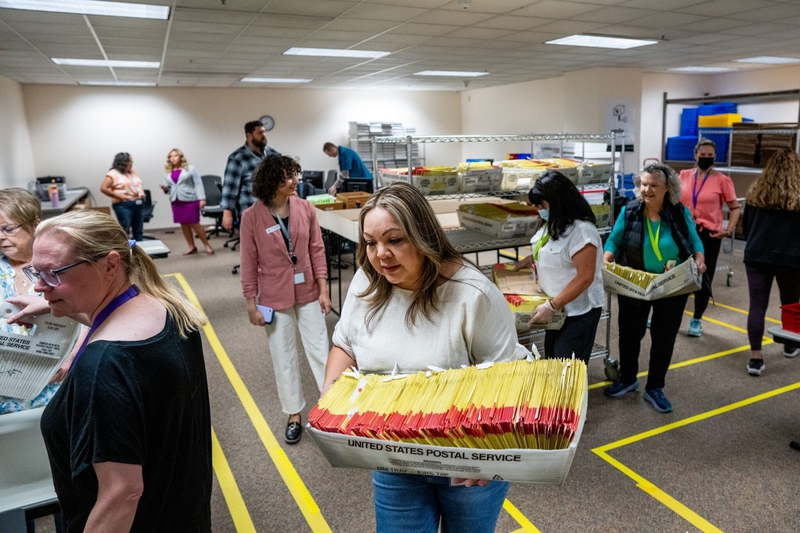
Election worker Davina Trejo carries a box of ballots to her work station at the Salt Lake County Government Center in Salt Lake City as votes are cast in Utah’s primary election on June 25, 2024. (Photo by Spenser Heaps for Utah News Dispatch)
Federal officials charged a Utah letter carrier Tuesday with throwing 300 primary ballots in a church parking lot dumpster, an incident that a top U.S. Justice Department official said made the case for stricter regulations of voting.
The prosecution of Damon Matai Seei, of Payson, Utah, showed “voting fraud is real,” acting Deputy Attorney General Trent McCotter said at a press conference at DOJ headquarters in Washington.
The Justice Department gave the arrest an unusually high profile, spotlighting the administration’s efforts to combat voter fraud after the U.S. Supreme Court this month blocked a new U.S. Postal Service rule limiting mail voting from going into effect for this year’s elections.
The regulation was meant to “address the chronically abused mail-in ballot system,” McCotter said. He criticized the trial judge who initially blocked the rule, which would have required special tracking and design features, among other things such as creating a national database of eligible voters.
“Election integrity should not be a political or partisan issue,” McCotter said. “Who could be against properly tracking mail-in ballots? Unfortunately, but entirely predictably, that regulation was blocked by a judge in Massachusetts. … The Trump administration, however, will continue taking aggressive actions to protect our elections.”
Postal Service rule
U.S. District Judge Indiria Talwani’s order blocking the rule is only in effect for the Nov. 3 elections, a provision meant to preserve the status quo because the rule was finalized mere months before the midterms. The merits of the case are still being argued. The U.S. Supreme Court upheld Talwani’s decision.
The prosecution of Seei, and the attention the administration sought to give it, undercut a key argument the administration made in the case: The rule included only “modest” technical specifications for a category of mail and should not be interpreted as an election regulation.
The U.S. Constitution grants states the authority to administer elections, with policy oversight from Congress.
In siding with the Democratic states and voting rights groups who filed suit, Talwani and the U.S. Court of Appeals for the 1st Circuit said the rule was clearly an attempt to affect election policy and was not restricted to a modest mail regulation.
Trump and mail-in voting
President Donald Trump has railed against mail-in voting and claimed, without evidence, that it is a major source of election fraud and contributed to his 2020 loss to President Joe Biden.
Since Trump retook office in January 2025, the department has charged 70 immigrants with illegally voting, compared with only 13 in the four years of Biden’s term, McCotter said Tuesday.
“And we intend to bring many more,” he added.
Homeland Security Investigations, a Homeland Security Department agency, has made 160 recent arrests, from 1,600 open voter fraud cases, HSI acting Deputy Executive Associate Director Matthew Millhollin said.
A reporter in the room noted that 70 prosecutions amounted to a bare fraction of the 150 million votes cast in the 2024 election.
McCotter responded that the Utah case involved 300 ballots, and that law enforcement had only scratched the surface of possible incidents. “Thousands more” cases were being investigated, he said.
“The folks on the other side, the opponents of the president, insist this has never happened, that there is no voting fraud,” he said. “And so when we have dozens of cases … I think that discourages and defeats their characterization.”
No partisan motive alleged
Seei, who is no longer a postal worker, intentionally threw out about 300 mail ballots on June 3 that were being mailed to voters in advance of the June 23 primary in Utah, according to charging documents.
In an interview with law enforcement, he indicated he did not have a political motive but said he threw away the mail, which also included advertisements, “because he wanted to ‘lighten his workload’ so he could presumably go home earlier,” prosecutors said.
Melissa Holyoak, the top federal prosecutor for Utah, traveled to Washington, D.C., for Tuesday’s press conference. She noted that 95% of the state’s voters cast their ballots by mail.
Many people in Seei’s delivery area in Eagle Mountain, Utah, complained to the Utah County Clerk that they hadn’t received ballots, Holyoak said. Using county databases, the clerk found that voter participation was “remarkably low” in the area where complaints originated.
“As American citizens, we have certain freedoms and rights,” Holyoak said. “And one of those fundamental rights is the right to vote. But when defendant allegedly tossed the mail-in ballots into a parking lot dumpster, those citizens' right to vote were also thrown away.”
The federal public defender representing Seei did not immediately return a call seeking comment.
All States Newsroom content is free to republish. Read our republishing policy for more information.