Trump homeless adviser comes to Utah, says blue cities are embracing crackdown strategies
May 22, 2026 | 7:02 am ET

Description
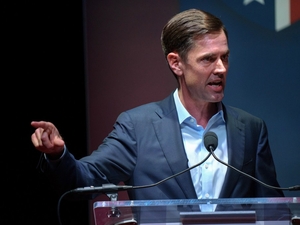
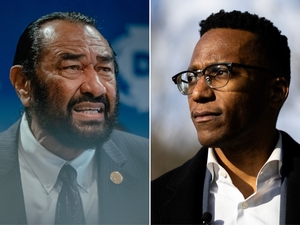
Robert Marbut, a senior adviser on homelessness for President Donald Trump’s administration, speaks during a conference hosted by Solutions Utah at The Grand America Hotel in Salt Lake City on May 21, 2026. (Katie McKellar/Utah News Dispatch)
Robert Marbut, a senior adviser on homelessness for President Donald Trump’s administration, told a packed room at The Grand America Hotel in Salt Lake City on Thursday that federal officials’ homeless strategy isn’t as partisan as some may believe — and it’s already starting to be embraced by multiple blue cities.
“There are about 35 blue city mayors now doing this program, following what we’ve promoted … they’re not waiting for Congress to do it, but they’ve already made these changes,” he said. “These blue city mayors, they’re all liberal, they’re all very active, but they all have been elected in the last 18 months, and they’re not accountable to that sort of bad history, and they’re also using common sense.”
Marbut has drawn controversy from national and local anti-poverty advocates for criticizing longstanding “Housing First” models, which prioritize access to permanent supportive housing as a prerequisite for mental health and substance abuse treatment.
Instead, Marbut argues in favor of strategies that crack down on drug use and camping, forcing people to choose between jail or treatment, and types of housing assistance that come with treatment requirements — all meant to push people toward “self sufficiency.”
Marbut — who served as Trump’s homeless czar during the president’s first term and who has worked for more than 40 years as a consultant on homeless issues, including in Utah — highlighted initiatives in five Democratic-controlled cities that he applauded as “moving the ball” away from “Housing First” models and embracing a tougher approach that requires addiction and mental health treatment.
He applauded San Francisco Mayor Daniel Lurie and Philadelphia Mayor Cherelle Parker for cracking down on open-air drug use and public camping. He also lauded Austin Mayor Kirk Watson for clearing out homeless encampments and Houston Mayor John Whitmire for embracing the Trump administration’s shift away from “Housing First” and toward “self sufficiency.”
“Probably the strangest one,” Marbut said, is Portland Mayor Keith Wilson, whom he recently met with. After they did a joint presentation together, Marbut said the mayor told him they agreed “about 90% of the time” when it came to homelessness issues.
During his presentation Thursday, Marbut painted a picture of federal funding that has grown exponentially for permanent supportive housing while requirements that the programs have some type of wraparound treatment service have decreased, along with transitional housing availability. The result, he argued, is that local, state and federal systems have “lost our guiding star,” which he said should be “self sufficiency.”
Success, Marbut argued, is when people are able to move on their own to market-rate housing, rather than being moved into subsidized housing or continuing to be supported by other welfare programs.
‘Compassion that kills’: Gov. Cox says ‘sea change’ in Utah’s homeless system is coming
Marbut was a keynote speaker for a conference hosted by the homelessness advocacy group Solutions Utah. The group was formerly known as the Pioneer Park Coalition (originally founded as a coalition of business owners to advocate for revitalization around the downtown area that has a long history of grappling with homelessness issues) before it was rebranded last year to align with a mission of improving Utah’s statewide homeless services system.
It’s not the first time Marbut has been in Utah, and he has longtime ties with the Pioneer Park Coalition. More than 10 years ago, he worked as a consultant for the group.
Marbut was warmly received inside the Solutions Utah conference. There, a high-ranking state homeless leader, Tyler Clancy, applauded Marbut for visiting Utah this week and touring the state’s homeless system.
Utah state leaders have embraced the Trump administration’s strategies and have called for increased “accountability” on government spending, providers and people who use the services, especially “high utilizers.”
Some protests Marbut and his policies
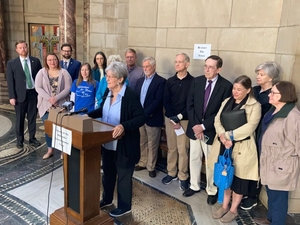
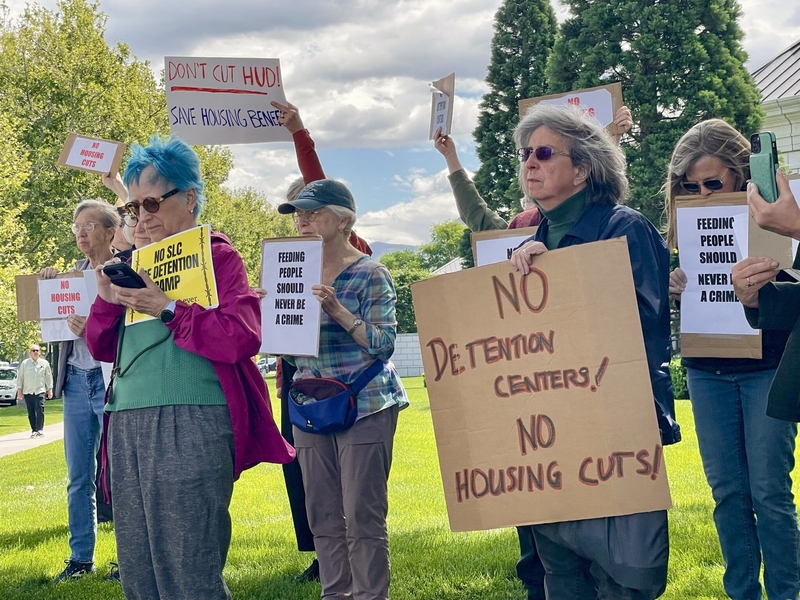
Outside The Grand America Hotel, a crowd of about three dozen protesters — including faith-based anti-poverty advocates — criticized Marbut and Utah state leaders for embracing his philosophies.
They argued state and federal officials should be doing more to make it easier to access housing and hunger assistance — not harder, by putting more requirements on those services.
The Rev. Brigette Weier, the pastor at St. Matthew Lutheran Church in Taylorsville and a member of the Crossroads Faith and Advocacy Coalition to End Hunger and Homelessness, argued Marbut’s policies don’t target the “root causes of homelessness and hunger,” but rather “blames the victims of these cruel policies that keep wages low (and) housing, childcare, healthcare, completely unaffordable.”
“He thinks that they are about people making poor decisions for themselves,” she said. Instead, she argued that many homeless families and their children didn’t choose a life of poverty. “So Mr. Marbut, Gov. Cox, and all our elected officials … we ask you on behalf of our children, choose better. Choose to end generational poverty and trauma, choose humane and dignified responses to these complex challenges.”
Corrections officials are building a 180-bed program for homeless Utahns with criminal records
Several at the protest expressed opposition to federal proposals that would cut housing voucher assistance or add rules that they said would put millions of Americans at risk of eviction.
Marbut, however, pushed back on claims that he has proposed housing assistance cuts, but rather he has argued in favor of “rebalancing” funding to promote different types of housing programs that include more guardrails.
“We want to change the type of housing. We want people that have assistance with no rules to go into treatment with rules,” he said.
To fears of cuts on housing programs, Clancy said that’s not happening in Utah, but rather state leaders are investing more money into the homeless system with an eye on programs that emphasize treatment requirements.
“The ‘Housing First’ takes on a lot of different iterations. It’s an investment philosophy,” Clancy said. “Really when we zoom out, all we want to make sure from a systems perspective is that if someone … falls on hard times, let’s make sure that they have that individualized path that they need that they need to (get back on their feet).”
For most, housing is the main solution
While Marbut and Utah state leaders have focused much of their arguments on improving homeless services for people struggling with addiction or mental health issues, another speaker during Thursday’s conference emphasized that people who fall into that category make up a smaller percentage — roughly a quarter — of Americans experiencing homelessness.
‘Housing not handcuffs’: National advocacy groups take aim at Utah’s homeless campus
The majority are people who are “economically driven” to homelessness directly because of housing costs, with many struggling to afford rent, said Gloria Gong, executive director of the Government Performance Lab at Harvard University’s John F. Kennedy School of Government.
“Recognize that you have a system here that is helping thousands of people every year who are in that category,” Gong said, but she said they tend not to get as much attention because they’re “invisible” compared to people living on the streets because they may survive by couch surfing or living in their cars.
Gong said about 25% of people experiencing homelessness fall into the other group, who need extra support like addiction or mental illness treatment to help them stay in housing.
“This is a small group in the greater scheme but they’re more visible to us,” she said, adding that they require a more “individualized approach” to help.
For the others, though, she said the solution “is not actually complicated, it’s just really hard,” which is to build “a lot more housing” to increase supply and reduce housing costs.

Salt Lake City, UT