Three-judge panel to rule on NAACP challenge of redrawn Tennessee district map
May 22, 2026 | 6:01 am ET
Description
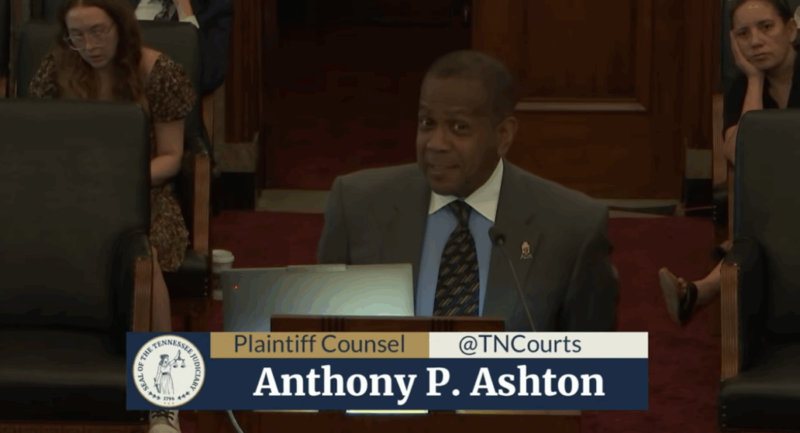
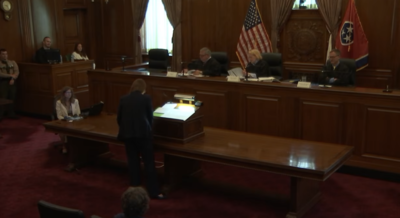
Anthony Ashton, an attorney representing the NAACP Tennessee State Conference and other plaintiffs in a lawsuit challenging the redrawn 2026 congressional map, delivers his opening arguments to a three-judge panel during a hearing on May 21, 2026. (Courtesy of the Tennessee Administrative Office of the Courts livestream)
A panel of three Tennessee judges will soon decide whether the state’s General Assembly overstepped its authority when members repealed a law preventing mid-decade redistricting and changed rules for the 2026 congressional election during a special legislative session.
The NAACP Tennessee State Conference, NAACP Tennessee President Gloria Sweet-Love and others filed a lawsuit to halt the use of the state’s new congressional map on May 7, less than three hours after Gov. Bill Lee signed the map into law. Tennessee’s congressional districts were redrawn to eliminate the state’s only majority-Black, majority-Democrat voting district in Memphis.
During a hearing on Thursday, NAACP attorney Anthony Ashton argued that legislators ran afoul of Tennessee’s constitution by acting outside of Lee’s specifically stated purpose for the special session: to make statutory changes necessary to change the composition of Tennessee’s congressional districts and facilitate the 2026 congressional election.
In repealing a decades-old law that prohibits mid-decade redistricting, extending the qualification timeline and allowing new candidates to enter the race, waiving the residency requirement for candidates and waiving the requirement to notify voters of district changes via mail, legislators “went far beyond what was necessary,” Ashton said.
NAACP Tennessee files lawsuit challenging redrawn US House district map
Taylor Meehan, outside counsel representing state defendants, contended that legislators’ actions were covered by the governor’s proclamation.
“The legislation coming out of the special session was constitutionally within that call. To conclude otherwise would require the most crabbed reading, or even a misreading of the proclamation,” Meehan said.
The panel, including Chancellor Anne Martin, Chancellor Tony Childress, and Judge James Gass, intends to “issue a decision as quickly as possible,” Martin said Thursday.
Did legislators overstep in nixing mid-decade redistricting rules?
Ashton said the legislature did not need to repeal the law prohibiting mid-decade redistricting to advance the governor’s goal. Rather, lawmakers could have suspended the law as they did with other statutes governing election deadlines and rules.
“They completely repealed a law which didn’t need to be repealed for purposes of doing this one-time redistricting,” he said. This action could impact every election in the future.
“You could redistrict every two years if you wanted,” Ashton said. “That is not what was called upon them to do, and therefore it is outside of the proclamation, and therefore it must be stricken.”
Meehan said that without repealing the law, “Tennessee could not redistrict a second time this cycle, as the governor expressly called upon the legislature to do.”
Martin, the panel’s chief judge, asked Meehan to address Ashton’s argument.
Meehan pointed to a 1936 case, Corn v. Fort, as justification. Ashton later called Meehan’s characterization of the case overly broad.
“We can question the wisdom of the repeal … but it’s squarely within the four corners of the proclamation,” Meehan said.
Martin noted that there is “not much case law” on this question, “and it’s all very old.”
Changing election rules and timelines
Ashton also argued that extending the candidate qualification deadline from March 10 (which had already passed by the time the legislature drew the new map) to May 15, and allowing new candidates to enter the race for newly drawn districts, was not necessary to change the composition of the districts. The proclamation did not say the legislature could change mandatory deadlines, only “comply” with them.
Adding more candidates to races that already began months prior does not make the 2026 election easier, Ashton said. “If you’re not making things easier, you’re not facilitating it.”
Changing residency requirements also did not have “anything to do with facilitating the election” and was not necessary for redrawing districts, he said. The 2026 election would take place whether the legislature did these things or not.
Ashton also targeted legislation changing voter notification requirements by allowing election commissions to post notice of changed districts online instead of mailing notices to voters.
“Changing a notice requirement obviously does not allow the composition of the districts to change … it doesn’t facilitate the election because it doesn’t make the election more likely to happen … and it doesn’t make the election easier. If anything, people not knowing where they are to vote and not knowing what district they’re in makes things harder,” Ashton said.
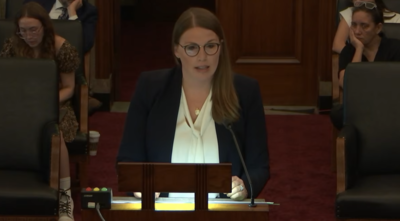
Meehan argued that an election cannot be held without knowing which candidates will be running in which district, and said the changes fall within the proclamation whether or not candidates welcomed them.
The state, she said, did not repeal the notice requirements, but changed them to offer more flexibility, “getting notice to voters immediately versus waiting on the mail.”
Meehan noted that some counties, including Davidson County, still intend to notify voters of their new districts by mail.
Changes in the 2026 election timeline have been compared to a proposed deadline extension in 2022. The Tennessee Supreme Court ruled that year that the U.S. House election would proceed despite legal challenges to a map that split Davidson County into three voting districts, because an injunction extending the candidate filing deadline would “detrimentally” impact election officials and the public interest.
Meehan said the 2022 case was different in that it also involved changes to State Senate districts that would be more difficult to accomplish for elections administrators and would affect the ballot creation deadline. Changes to the 2026 election apply only to U.S. House districts and the legislature set aside funding to help local elections commissions enact those changes, she said.
Questions of legal standing
Meehan challenged the plaintiffs’ standing to bring the lawsuit, arguing that passing legislation outside of the governor’s proclamation is a generalized grievance — not a “distinct and palpable injury to the particular plaintiffs here, distinct from the injury that the Tennessee legislature didn’t follow the constitution.”
Candidate Devante Hill, one of the plaintiffs, had already mounted a campaign for District 9 and invested about $100,000 for marketing and voter outreach to communities within the former district boundaries before lawmakers passed the new map, the lawsuit states. Now, 100 days prior to the election, Hill is running in what is now District 5. Many of the voters he spent money and time reaching are carved out of the district he is now campaigning for, equating to unrecoverable financial loss.
State responds to Tennessee NAACP lawsuit challenging redistricted map
Martin commented that running for office requires knowing one’s constituents.
Meehan said Hill has not provided an affidavit explaining how he would have campaigned differently, or demonstrating the extent of financial injury.
Childress asked Ashton to explain how the plaintiffs were injured, citing a previous redistricting case decided in December 2025. In that lawsuit, voter Gary Wygant alleged that the 2022 Tennessee congressional district map violated the constitution by splitting more counties than necessary to comply with federal law. Another voter, Francie Hunt, alleged the map was unconstitutional because districts were not numbered consecutively. The Tennessee Supreme Court ruled that Hunt did not show injury, and Wygant had standing only in his county, which was split and therefore may have diluted voting power compared to counties that remained whole.
Ashton said Shelby County was one district before the new map split it into three, diluting the power of Shelby County voters.
Meehan also said the law in question did not waive sovereign immunity, which protects the state from lawsuits. Ashton argued that the ability to sue the state is a constitutional right.
“As far as this case is concerned, elections need to be free, fair, they need to be devoid of confusion,” Ashton said. “Essentially what we’re being told is … that the General Assembly created a crisis by acting as it did, and because it created a crisis, we should just all live with it. That’s not what the law says.”

Nashville, TN