In Democratic runoff, Reps. Al Green and Christian Menefee clash over influence of big money in politics
May 22, 2026 | 6:00 am ET
Description
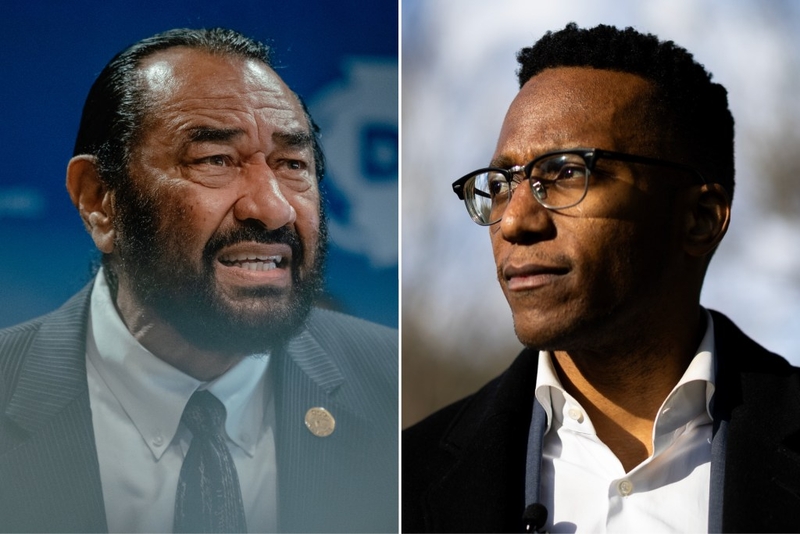
From left: U.S. Reps. Al Green, D-Houston, and Christian Menefee, D-Houston. (The Texas Tribune)
WASHINGTON — With little ideological daylight between the two candidates, the runoff between Democratic Reps. Al Green and Christian Menefee has focused on a more symbolic debate: the influence of big money in politics.
Green has criticized the more than $4 million that a cryptocurrency super PAC spent on behalf of Menefee, a whopping total that has given Menefee the money edge and made the 18th Congressional District home to the most expensive House runoff in Texas. In the meantime, Menefee has called out Green for accepting contributions from corporate PACs, or groups that raise money from a company’s employees and donate it to political candidates.
The clash is emblematic of a broader wedge between Democrats, many of whom rely on large fundraising hauls to remain competitive, even as they denounce the outsized influence big money plays in the political arena.
“We’ve built incredible momentum without taking any corporate PAC dollars,” Menefee said in an interview. “At the same time, I believe Citizens United was a mistake and should be overturned, and not a single super PAC should exist.“
Menefee won his current seat in a special election that stretched into a late January runoff, through which he reported raising over $2 million. Since then, he’s raised over $850,000. Green, meanwhile, has hauled in $1.4 million since the start of the cycle in January 2025. Individual donors can give up to $3,500 per election to a candidate’s account, but most of Menefee’s contributions come from those giving four figures. His donors include Houston billionaire philanthropist John Arnold and trial lawyer and megadonor Amber Mostyn.
Green is running in the 18th District after his current seat, District 9, was redrawn to favor Republicans. His donations stem from a mix of small individual donors giving less than $200 and larger four-figure sums. Big-name donors include former Houston Metro chair Carrin Patman, HillCo lobbying firm cofounder Bill Miller and healthcare executive Tahir Javed. He’s also been boosted by donations from PACs for United Airlines and beer wholesaler, credit union and realtor groups, along with various unions.
But all that has been dwarfed by the support Menefee has gotten from the crypto super PAC, Protect Progress. The group dropped $1.5 million on ads boosting Menefee ahead of the March primary election, and it has spent more than double that amount leading up to the runoff, according to Federal Election Commission filings that show Protect Progress has poured in more than $4 million on Menefee’s behalf.
On the House floor on Friday, Green introduced himself as an “unbought, liberated, unafraid Democrat, unbought by crypto cash.” He’s also criticized Menefee for aligning himself with “Trump crypto cronies” and making a “deal with the devil” in a now-deleted video on YouTube.
Protect Progress is affiliated with Fairshake, a deep-pocketed super PAC that reported $193 million cash on hand at the beginning of the year. Protect Progress boosts left-leaning candidates who support cryptocurrency and blockchain technology, while its Republican counterpart, Defend American Jobs, spends on behalf of Republican candidates.
The super PAC recently spent $500,000 on a TV ad that featured Rep. Jasmine Crockett, who advocated for Menefee by saying “we need a new generation of fighters.”
The crypto super PAC spending is done independently of the campaign, but experts say these kinds of super PACs spend on candidates who signal they would be more open to working with the industry with subtle nods, often through wording on their campaign websites or in social media posts.
Menefee wrote on his campaign site that blockchain technology, the decentralized system used to record and verify crypto transactions, offers the potential to “increase trust, transparency and efficiency” with rules to protect consumers. Industry group Stand with Crypto gave an “A” rating to Menefee and an “F” to Green because he voted against several crypto bills, including the GENIUS Act, the first federal framework for regulating the crypto industry that passed in July 2025.
“All I can control is how I run my campaign, which I’m very proud of, because we have taken $0 from some corporate PACs, unlike my opponent,” Menefee said. “We’re going to keep fundraising from real human beings at a grassroots level, less than $100 per donation, and we have outraised, at this point, 20 different candidates in this campaign.”
Menefee has said he supports regulating the crypto industry, and that the differing perspective between himself and Green is due to a generational difference. Green is 40 years older than Menefee, a divide that’s also become a key issue in their race.
Green did not respond to a request for comment.
Both candidates support abolishing Citizens United, the landmark Supreme Court decision that enabled corporations and outside groups to spend unlimited amounts independently on elections. They also both support multiple bills introduced this year that aim to increase transparency in campaign finance.
One such bill, the Abolish Super PACs Act, would effectively end super PACs by capping contributions to the organizations at $5,000 a year. Another, coined the Disclose Act, was reintroduced in March and would combat dark money in politics by unmasking anonymous donors.
Green is a co-sponsor of both acts. Menefee said he supports the Abolish Super PACs Act, and his campaign said he would sign on as a co-sponsor to the Disclose Act in the coming days.
Michael Beckel, money in politics reform director at the nonpartisan group Issue One, said there has been an explosion of big money in politics in the 16 years since Citizens United passed, putting the issue at the forefront of many Democratic campaigns.
“In more and more Democratic primary environments, candidates are looking to differentiate themselves, looking to signal to voters that they want to be part of the solution, not just part of the broken status quo,” he said.
He added that some Democrats have sworn off corporate PAC donations, while others are “happy to fight fire with fire.”
“The logic that we’ve seen, very broadly speaking, is presented as an argument to say, ‘we don’t want to fight with one hand tied behind our backs,’” he said.
The candidate who wins the May 26 runoff will likely win the November general election because of the district’s makeup. Had the district lines existed in 2024, Kamala Harris would have won it by almost 55 points.
Austin, TX