Three summers after costly cyanobacteria treatment, a small NH lake is still in the clear
Sep 25, 2026 | 5:00 am ET
Description
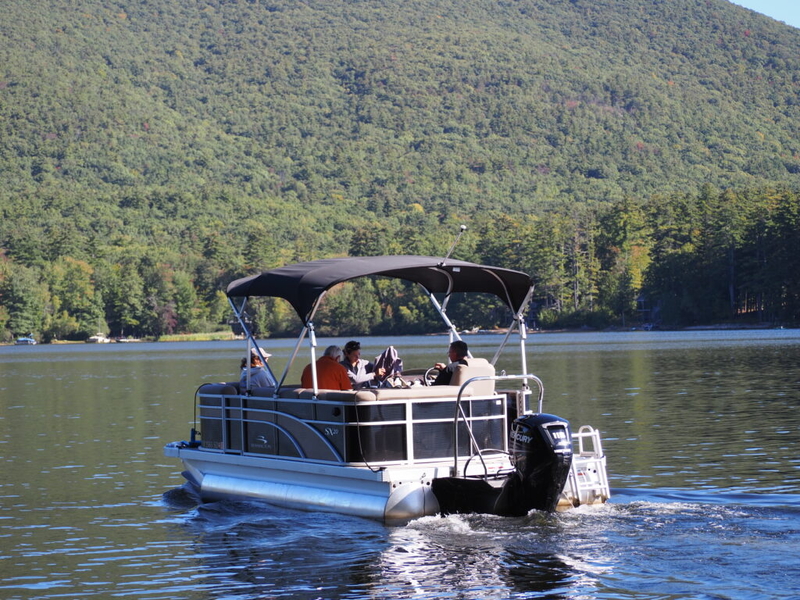
A team of researchers with the UNH Lakes Lay Monitoring Program heads out to track water quality on Lake Kanasatka in Moultonborough Thursday, Sept. 24. At the helm is lakeshore resident Kevin Kelly, who has helped measure water quality on the lake for decades. (Photo by Molly Rains/New Hampshire Bulletin)
Clear waters in Moultonborough’s Lake Kanasatka this summer strengthened residents’ hopes that an expensive, last-ditch chemical treatment undertaken several years ago was paying off.
This year has been a “beautiful” one on the lake, said waterfront resident Kevin Kelly. Conditions have improved each year since the treatment was applied in 2024, after anguish and health concerns over recurrent cyanobacteria blooms peaked the year before.
For Lake Kanasatka, the treatment “is doing what it’s supposed to do,” said Amanda McQuaid, director of the UNH Lakes Lay Monitoring Program. She spoke by the lake’s shore on Thursday, a bald eagle crying from somewhere in the pine branches above her head.
Yet experts, including McQuaid, have been clear that the treatment, which for Lake Kanasatka cost more than half a million dollars, is not permanent. Nor is it necessarily well-suited to all of the many other water bodies across New Hampshire dealing with similar bloom struggles, McQuaid said.
“We don’t want everyone to be like, ‘Oh, let me try to do that now,’ because it’s not going to work,” she said.
Cyanobacteria blooms occur when a type of bacteria normally present in water bodies at low concentrations begins to grow unchecked. Excessive nutrients, such as from erosion or fertilizer runoff, and rising temperatures linked to climate change can both worsen the blooms; the bacteria can sometimes produce a range of toxins harmful to both humans and animals.
The treatment pursued by the Lake Kanasatka Watershed Association involves depositing alum into the water, where it binds with the nutrient phosphorus and settles to the lake floor. Scientists hope it will last at least a decade, McQuaid said.

Some consider it experimental, and the decision to pursue the treatment felt risky at the time, recalled resident Kirk Meloney.
“It was a concern to me, dumping all this stuff into this precious water body,” said Meloney, who at the time was leading the Lake Kanasatka Watershed Association as its president. But he wanted to “listen to the science,” he said.
The condition of the water seemed to warrant the drastic move. Recalling the years before the treatment, McQuaid likened the color of the lake’s water during the summer of 2020 to Gatorade. By 2023, she said, the water body was in the thrall of blooms worse than any previously observed at the site.
“This whole area was solid green, scummy — like, thick,” she said. Some of the affected water spilled over into Lake Winnipesaukee, to which Kanasatka is linked.
Conditions have steadily improved since the 2024 treatment.
Last year, the lake still saw some blooms, including in September, Kelly recalled. But this year, the water has been mostly clear.
The cyanobacteria “blips” that still occur now and then, McQuaid said, are often linked to heavy rain, which dumps nutrient-laden runoff into the lake. But on the whole, phosphorus levels are a fraction of what they were before the treatment, and the lake ecosystem seems to be bouncing back.
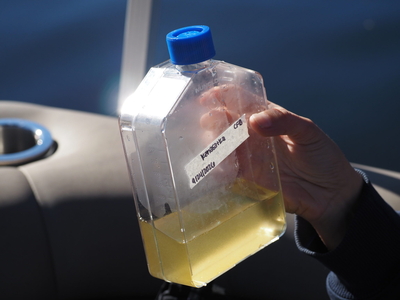
On Thursday, a loon and its chick drifted on the water, disturbed occasionally by predatory dive-bombs from the bald eagle. On a pontoon boat nearby, McQuaid’s team lowered a cone-shaped net to the deepest reaches of the lake, bringing up water teeming with typical algae and twitchily swimming zooplankton. These, McQuaid said, are signs of a healthy ecosystem.
“All of this is related to those loons,” she said, holding the bottle of plankton in the sun. “A good base of the food web supports the fish, supports the loons.”
It’s likely that the alum treatment is only part of the explanation for this year’s happy conditions on Lake Kanasatka. Cyanobacteria blooms were generally less severe this year in many lakes, McQuaid said.
The summer’s rainstorms were mild, McQuaid said. And on Kanasatka, residents have also stepped up their preventative work, such as by taking steps to better manage stormwater on their properties and nearby roads.
Steps like these are fitting for most water bodies, McQuaid said. But the alum treatment, she cautioned, isn’t as universal.
The treatment targets an overload of nutrients that have built up over time in a particularly affected lake, not cyanobacteria themselves, she said.
It is also expensive. Lake Kanasatka’s treatment cost about $600,000; the grant the watershed association received from the state, for $500,000, halved the million dollars that the Legislature had initially allocated to the Cyanobacteria Mitigation Loan and Grand Fund in 2023. (Though another million dollars in American Rescue Plan Act money was later allocated to the fund, as of fall 2026, its balance had fallen to about $200,000 after multiple attempts by the Legislature to find ways to replenish it were voted down or sent to study committees.)
Thus, even in cases where such a treatment may be warranted, not every lake will be able to fund it. Those on Lake Kanasatka feel fortunate.
The Lake Kanasatka community raised more than $400,000 themselves for the project; once the chemical treatment had been paid for with help from the state grant, Meloney said, the watershed association was able to leverage the additional money for more preventative work to stay ahead of the blooms.
“That put us into such a great position,” he said.

Concord, NH