After Obama-era Chesapeake Bay executive order rescinded, environmental groups brace for fallout
Sep 25, 2026 | 5:25 am ET
Description
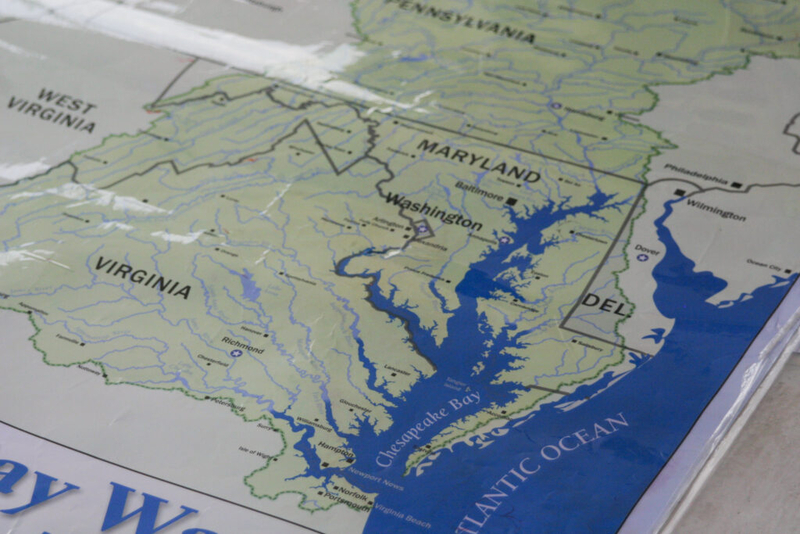
Map of Chesapeake Watershed states. March 30, 2026. (Photo by Shannon Heckt/Virginia Mercury)
Virginia environmental advocacy organizations are trying to determine the full extent of impacts from President Donald Trump’s rescission of a landmark Chesapeake Bay pollution reduction law last week.
“We’re still waiting to find out what all of the fallout is going to be,” said Jay Ford, the Virginia policy manager for the Chesapeake Bay Foundation. “The immediate impacts are a clear weakening of federal leadership right after the signing of the new Bay agreement.”
Trump rescinded Executive Order 13508, signed in 2009 under former President Barack Obama. The federal effort brought states and localities together collaboratively to identify pollution sources and ways to reduce sediment and nutrient loads.
The order also charged Chesapeake Bay watershed partners with creating stormwater management best practices.
“As of 2025, the jurisdictions of the Chesapeake Bay watershed — New York, Pennsylvania, Maryland, Virginia, the District of Columbia, Delaware, and West Virginia — have collectively met 100 percent of their goal for sediment reduction, 90 percent of their goal for phosphorus reduction, and 57 percent of their goal for nitrogen reduction,” Trump said in the rescinding statement.
These reductions are due in part to the Chesapeake Watershed Agreement, a multi-state agreement formed in the 1980s that brought together the states whose waterways feed into the Bay. The partners pledge to collaborate on goals and benchmarks to meet pollution reductions.
The latest iteration of the agreement was signed last year and established four main goals and 21 outcomes the states can strive towards over the next 15 years.
“Given this significant progress, and the need to provide clarity on how to continue improving the environmental health of the Chesapeake Bay, it is appropriate to revoke Executive Order 13508,” Trump said.
But leading environmental groups said it’s not the right time to pull back on the provision that has helped make so much progress.
“The irony is that the success touted in (the) executive order was made possible in part by the executive order that was just rescinded,” said Hilary Falk, president of the Chesapeake Bay Foundation. “Weakening federal leadership makes it harder for localities and communities to tackle pollution, flooding, and other major challenges that we are facing.”
Trump framed the original order as overly broad and unclear on implementation standards, stating “this lack of clarity has led to harmful economic impacts on affected Americans.” He used stormwater management fees, which he dubbed “rain taxes,” as an example of this dynamic.
A representative of the federal Environmental Protection Agency supported Trump’s move in a statement this week, saying it “emphasizes that Americans don’t need to choose between clean water and economic prosperity. With practical and focused actions, they can have both.”
Stormwater fees, which are not directly related to the previous executive order and can’t be repealed by Trump’s order, are used to fund stormwater infrastructure that aids in managing flooding, which contributes to pollutants flowing into the Bay.
Many Virginia localities have put these fees in place. The Chesapeake Bay Foundation is concerned that the president’s repeal of the former order will encourage localities to pull back on those investments, amping up the risk of floods devastating communities statewide, especially in the coastal region.
“In an area like Hampton Roads, the stormwater management is important for water quality, but it’s also important for habitat,” said Alison Prost, CBF’s senior vice president for programs. “It’s important for resiliency and what it means for the communities down there. So, if the federal government is not going to take that holistic approach, I think it may make those challenges harder.”
While the latest Bay agreement is still in place, Ford said there are also worries about potential breakdowns in state partnerships on reducing pollutant loads in the Bay. It’s also unclear if federal funding that previously supported many of these efforts, could be lost.
“All the states have their jurisdictional bounds, but the federal government is really the umbrella that helps make sure everyone’s communicating appropriately and they’re sharing best practices,” Ford said. “Federal agencies, they figure in pretty much every major work group and, you know, scientific tact component of both the Bay program and the work that flows from it.”
Members of Virginia’s congressional delegation have urged the president to reverse his actions.
Sens. Mark Warner and Tim Kaine, both Virginia Democrats, and U.S. Rep. Bobby Scott, D-Newport News, condemned the move.
Scott serves on the Chesapeake Bay Watershed Task Force and said the repeal represents the federal government “walking away from that responsibility,” which “jeopardizes the hard-fought progress we have made.”
“Rolling back efforts to clean up the Bay is dangerous not just for our environment but for our economy,” Kaine and Warner said in a joint statement. “We should be building on the progress we’ve made instead of walking away from a framework that has guided restoration efforts for more than 15 years.”
Richmond, VA