Indiana nabs $175M from feds to fix regional electricity ‘choke point’
Sep 24, 2026 | 5:41 pm ET
Description
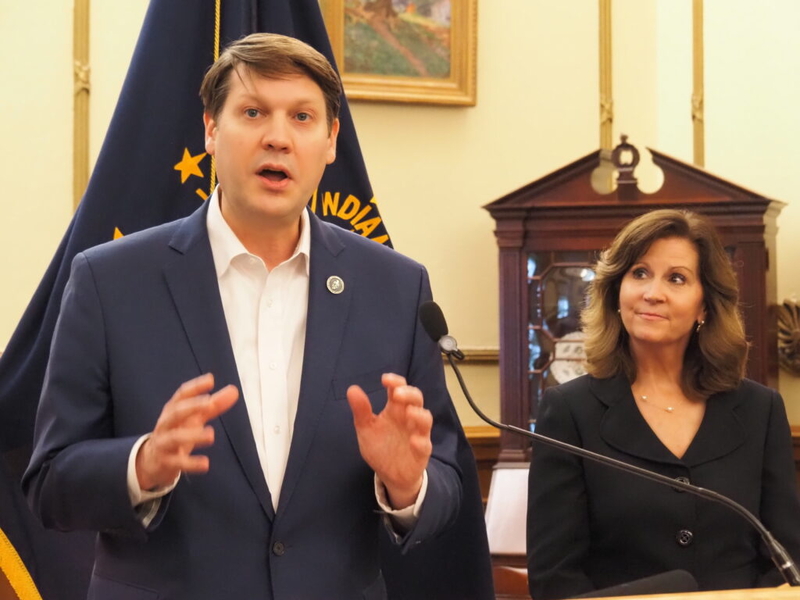
U.S. Department of Energy General Counsel Jonathan Brightbill announces $1.9 billion in transmission grants, while Indiana Energy and Natural Resources Secretary Suzanne Jaworowski looks on, at the Statehouse in Indianapolis on Thursday, Sept. 24, 2026. (Photo by Leslie Bonilla Muñiz/Indiana Capital Chronicle)
Indiana has won $175 million in federal funding to upgrade a critical “choke point” between two regional electricity grid operators, officials announced Thursday.
“The challenge isn’t simply generating more electricity,” U.S. Department of Energy General Counsel Jonathan Brightbill said. “It’s making the grid so that it can move power where it is needed quickly, affordably, and reliably across one of the most important regional seams in the country — and that comes and lands right here in Indiana.”
The “seam” is where the Midcontinent Independent System Operator’s service territory meets that of the PJM Interconnection. The border between the two regional transmission organizations runs through Illinois, Indiana, Michigan and Kentucky.
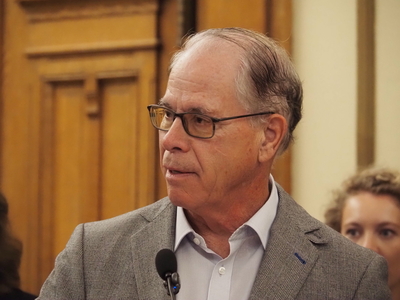
Brightbill said the project will unlock 2,000 to 4,000 megawatts of transfer capacity for an interconnection in the Hoosier state that Gov. Mike Braun dubbed a “pinch point” and a “choke point” in comments to reporters.
The work is expected to save ratepayers in and outside of Indiana between $50 million and $150 million annually by relieving congestion at that interconnection point.
“Congestion, that may cut off access to generation that’s available,” Brightbill said. “The way the bulk power system works, you end up with pockets. And then with dynamic pricing … you can end up with prices spiking in localized areas that then will cost those local ratepayers a lot of money.”
The four-year project will include:
- Replacing old power lines with new ones with materials that carry electricity more efficiently.
- Implementing dynamic assessment of the lines, allowing them to carry more electricity under ideal weather conditions. Static lines are set more conservatively, for the worst-case scenario.
- Adding topographic software so grid operators can direct electricity from cheaper sources along more efficient routes to where it’s needed.
The project’s sponsors will put up an additional $150 million for a total price tag of $325 million.
Brightbill was in Indiana to announce the selection of 31 projects nationwide worth more than $5 billion. The $1.9 billion in federal investments are set to leverage an additional nearly $3.4 billion.
“Selected projects will reconduct or rebuild more than 1,500 miles of transmission infrastructure. They will deploy cutting-edge, grid-enhancing technologies across nearly 21,000 miles of transmission lines,” Brightbill said. “And, together, we are expected to unlock more than 23 gigawatts of additional grid capacity. That’s a lot.”
Money for the initiative was authorized under the 2021 Bipartisan Infrastructure Law during former President Joe Biden’s administration.
Originally called Grid Resilience and Innovation Partnerships, President Donald Trump’s administration has renamed the program to SPARK, which stands for Speed to Power through Accelerated Reconductoring and other Key Advanced Transmission Technology Upgrades.
Nuclear regulation deal inked
Also on Thursday, Indiana became the 41st state to take over responsibility of non-energy nuclear and radioactive materials used in medical, industrial, academic and fusion technologies from the federal government.
The U.S. Nuclear Regulatory Commission can hand down oversight under the Atomic Energy Act of 1954. Kentucky became the first “agreement state” in 1962. Dozens of states have followed in its stead, with Indiana the latest.
The announcement has been in the works for years. Then-Gov. Eric Holcomb in 2021 submitted a letter of intent to pursue a deal.
“Agreement state status gives us better customer service, faster permit review times — which was always an issue — faster incident responses, and lower regulatory fees,” Braun said.
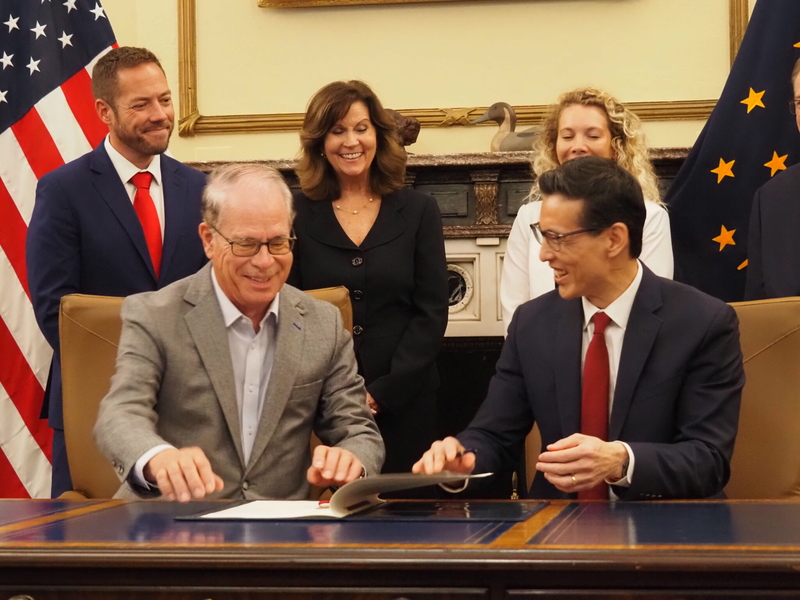
The Indiana Department of Homeland Security will manage the program.
Spokeswoman Ashley Morgan said the agency will have five health physicists responsible for handling licensing and inspections.
The work will be largely funded by licensing fees. An eight-page fee schedule shows costs, mostly in the thousands, for each type of license.
The state Department of Homeland Security also houses a dedicated radiation team managing nuclear emergency response and risk, and works with communities exploring nuclear — in collaboration with the Indiana Office of Energy Development.
“Making more licensing and permitting decisions here in Indiana rather than in Washington means Hoosiers have more control over Indiana’s energy future,” Braun said, calling the deal a “necessary step for Indiana to meet our nuclear energy generation goals.”
Federal officials, however, maintain regulatory authority over all commercial nuclear power reactors, research reactors and nuclear fuel cycle facilities, according to the Nuclear Regulatory Commission’s website.
Indiana currently has no nuclear plants in operation. But Braun and other state leaders hope to “lead” the nation in nuclear energy.
Commission Chair Ho Nieh said permissions for nuclear-fueled energy production will come faster under Trump’s “new NRC.”
“If Indiana and companies in Indiana want to pursue nuclear energy, I can assure you that the NRC will not be an impediment,” he said. “We will perform our safety responsibilities with efficiency, with credibility, and predictability … There’s a new NRC that has been created here, one that is going to safely enable and accelerate the deployment of nuclear technologies in America.”
The federal agency plans to approve applications for first-of-its-kind reactors in 18 months or less, and repeat reactor types in a year or less, Nieh said.
Indianapolis, IN