Takeout Boxes Are Filling Landfills. This Town Has A Plan To Phase Them Out
Jul 13, 2026 | 6:01 am ET
Description
Photo courtesy of Honolulu Civil Beat
The disposable cups, plates and bowls that make it possible to eat and drink on the run typically don’t receive much attention on their one-way trips to the landfill.
But what happens when that landfill reaches capacity and you have to start trucking waste across the island? That’s the case in Hilo, where the South Hilo landfill closed in 2019, and some residents have begun to rethink their plastic to-go waste.
Lawmakers are rethinking it too. Last fall Bill 83, which banned single-use plastic serviceware in the county, unanimously passed through the Hawaiʻi County Council. As a result, beginning in December, people who order their food and drinks to-go will be offered compostable products instead. Although the county doesn't have an industrial-scale composting facility, the hope was that such a bill would be just the push the county needed to create one.
In the 50,000-person city of Hilo, however, a public-private coalition isn’t waiting to find out. Instead, it’s preparing to roll out the nation’s first comprehensive system of washable, reusable to-go containers later this year.

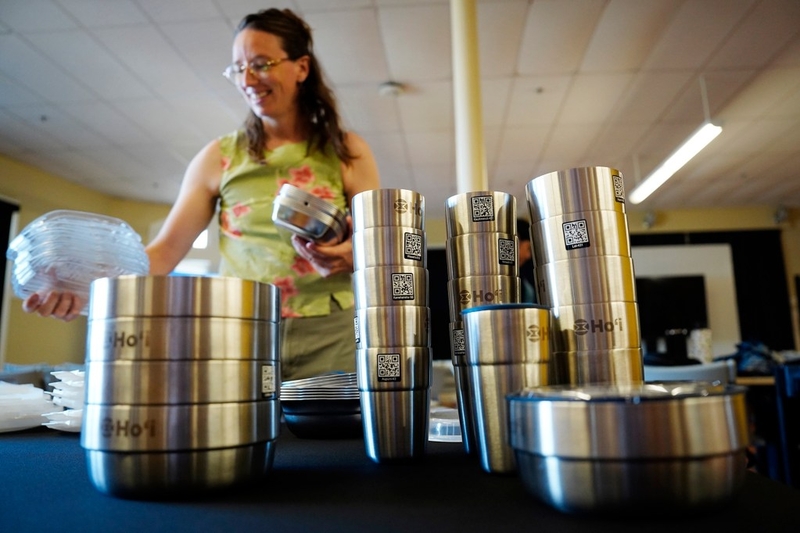
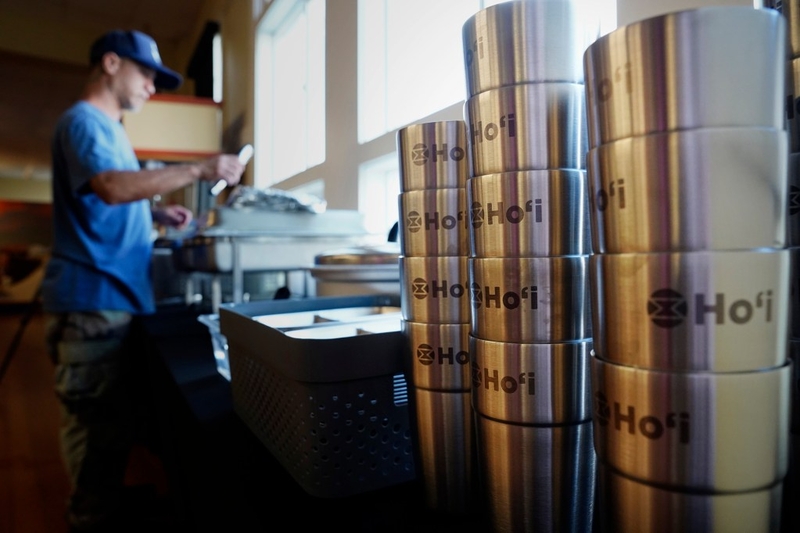
The program is called Ho‘i, after the Hawaiian word for “to return.” The containers will be available to check out like library books and, as with the library, they will cost nothing unless people fail to return them.
The name, Ho'i, is also intended to be an invitation to residents to return to an older sense of responsibility to a place that sees an estimated 15-20 tons of plastic marine trash wash ashore every year. And some experts believe it may prove to be a model for the rest of the island — and the state.
“If Ho‘i proves successful in Hilo, we see potential for replicating it in other parts of the county, especially in dense commercial areas,” Daniel Girvan, director of Hawaiʻi County Department of Environmental Management, said in an email.
Returning To The Start
John and Bethany Letoto own Kalo and Cream, a pop-up artisan soda company, and they often set up a booth at public events, where they can go through hundreds of plastic cups in a day. They started out using compostable cups until an entire box of them melted in the sun. Now, Bethany said, “we do what makes sense financially, which is to buy the cheapest possible plastic cup we can get off the internet.”
In February, the Letotos saw a presentation about the Ho‘i program from Kuʻulei Kanahele, the outreach coordinator and cultural adviser for Zero Waste Hawaiʻi Island, the organization that is spearheading the program. The couple instantly recognized it as the waste solution they'd been looking for, and signed up to be one of the first participating businesses. Bethany also applied to fill a temporary role with the organization as its business development lead, hoping that other small businesses would be as excited as she was.
Not everyone has been quite so sold on the idea from the beginning. Three years ago, when Zero Waste Hawaiʻi Island began applying to becoming a pilot city with Perpetual — a Florida-based nonprofit dedicated to helping cities develop accessible reusable serviceware systems — Kanahele admits even she was skeptical.
A Native Hawaiian pig farmer who also runs a local farmers market in Panaʻewa, Kanahele was initially hired to host a gathering of elders, Native Hawaiian culture keepers and business owners to explore the idea of a reuse program that involved reusing sturdy plastic containers. She wasn’t wed to the idea.
“At first the consensus was no. The response was, ‘We don't want any more rubbish here, so it's not ideal to bring a bunch of thicker plastic, because that's only going to be thrown away,’” Kanahele recalled.
Over the course of several hours, the group thought deeply about what it might take to make reuse work in Hilo. The containers would need to be something there than plastic. And behavior change would only come about if they invested in education, outreach, school programming and contextualizing reuse as it relates to Aloha ʻāina, they decided. Kanahele suggested stainless steel containers, and explained that the alternative to reuse was more plastic piling up in the one landfill on the island.
“By the end of these challenging discussions the consensus was, ‘Yes, reuse is better than inaction,’” she said.
A System Designed To Be Easy
Since then, the program that the group of community members envisioned has become a reality. Hilo became one of four U.S. pilot cities where Perpetual is working to launch reuse programs, alongside Galveston, Texas; Savannah, Georgia; and Ann Arbor, Michigan.
In partnership with Hawaiʻi County and University of Hawaiʻi Sea Grant, the project has received over $2.2 million from the U.S. Environmental Protection Agency, $1.4 million from private foundations and $45,000 from the county for a total of $3.7 million in seed funding. With that funding the coalition members have been able to purchase an initial round of serviceware (with another on the way later this year), an industrial scale dishwasher, two vans and 100 return bins, among other resources.
The county released a request for proposals in 2025 and rewarded the contract to Vytal, a German company that has created the QR codes and online system intended to make it easy for customers to check out the containers with a single tap of their phones when they order take-out. The company has created similar reuse systems in Germany, as well as in Belgium, France and a growing number of European nations. For the duration of its initial three-year contract, Vytal will rent out the dishwashing hub and charge restaurant owners a membership fee associated with the number of containers they use every month.
If everything goes as planned, the Ho‘i program will launch later this year, just as Bill 83 is set to go into effect.
After watching multiple start-up companies work to get a critical mass of people using reusable products and failing, Moss and her co-founder decided the most effective approach would be to work on, “the system-level shifts that individual companies really can't do on their own.”
Perpetual focuses on small cities, Moss said, because they are places where a more immersive experience is possible, and the potential for a cultural shift is more likley. “You can get every restaurant on board,” she added.
Hilo-based county council member Jennifer Kagiwada, who has been involved since the program’s early days, is optimistic about the effort and what it might mean for the rest of the state.
“It is not something that feels like it's coming from Florida or Germany or anywhere else," she said. "It's very much branded for Hawai‘i, with a lot of input from local people.”
Kagiwada and her staff have visited local food businesses to drum up interest in the Ho'i program and she has helped work with several county departments to help grease the wheels in the process. She also made sure that the language in Bill 83 included reusable serviceware as an acceptable alternative to its compostable counterpart at a moment when it stood to be removed from the bill.
Hawai‘i County’s mayor, Kimo Alameda, was opposed to Bill 83 on the grounds that compostable foodware is more expensive than plastic. Now, he sees Hoʻi as an alternative that can help businesses comply with the new ordinance.
“Through careful implementation and community partnerships, we are hopeful that this program can demonstrate environmental and economic benefits,” he told Civil Beat in an email.
The added costs of both compostable and reusable serviceware is still a point of discussion, however. Most businesses that sign on to the program will also offer their customers single-use compostable options, and some may charge extra for them, whereas the Ho’i containers are free if returned and cost customers $15 to keep.
For participating businesses, the Ho'i containers will end up costing more than the soon-to-be-banned plastic but less than compostables, Letoto said.
Kanahele also said the washhouse will be available for Hilo residents to have large loads of dishes washed after gatherings and events at a small cost — an unusual feature that she hopes helps the community embrace the program.
Reuse Vs. Compostables
Meanwhile, the answer to the larger question of what will happen to the single-use compostable containers is also still unfolding.
Kristine Kubat, executive director of Recycle Hawaii, told Civil Beat that provided the county can set up a workable system to compost this growing waste stream, she sees compostables as the most feasible option for avoiding plastics over the long term.
At Kubat’s suggestion, Rep. Chris Todd, who represents Hilo, advocated to have $250,000 in Green Fee funds dedicated to purchasing one or more in-vessel composting systems — large machines that aerate and churn compostable waste, turning it into compost in as little as 24 hours — for a pilot program on Hawai‘i island.
“One of our opportunities at the state is to be a force multiplier,” Todd told Civil Beat. The funding for the composting machines is currently with the state Department of Agriculture but will move to the county soon. “It’s a proof of concept that we could then apply elsewhere,” Todd added.
At the Hawaiʻi County Department of Environmental Management, Girvan confirmed that getting a system for large-scale composting on the island up and running will take time.
“This is a multi‑year effort, but the planning is underway," he said. "Our goal is a system that supports the ordinance, expands organics diversion, and reduces landfill dependence across the island.”
Kubat has reservations about the Ho’‘i program, based on the fact that Perpetual has often framed reusable plastic as a transitional approach.
“There have been times when they've been promoting their reuse program, and they were just fine with plastic. It was the community that pushed back,” Kubat told Civil Beat. She also pointed to a clause in the Vytal contract that says the company can replace lost stainless steel containers with plastic ones.
Moss responded to that claim. “While it doesn't explicitly say 'no plastic,' a choice to allow plastic would have to be approved by the County, ZWHI, and Perpetual, and we are the organizations who have been so committed to not using plastic in the first place,” she said.
A Winding Road Ahead
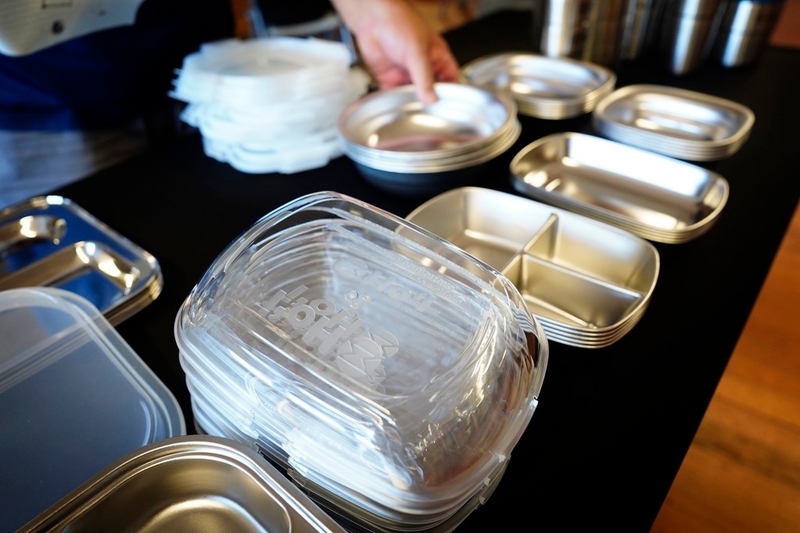
In June, Zero Waste Hawai‘i Island held an open house for food business owners, where Letoto and Kanahele worked with local food vendors to serve traditional Hawaiian foods in the new stainless containers and share information for people who are still on the fence about Ho'i.
“No one trusts that the water is warm,” said Letoto, who was there serving soda in stainless cups. “Everyone is waiting for everybody else to dip their toes in first.”
Kwai-Chang Publico, owner of cold-pressed juice company So Juicey Hawaii, has both feet in. And he attended the open house to talk about what attracted him to the program.
So Juicey provides lunches to a Hawaiian immersion school in Hilo and Publico plans to start out using the Ho‘i containers for that effort and to replace the plastic tubs he uses for prep cooking. Like Letoto, the idea of the shift made complete sense to him from the start. He already offers his juices in glass jars and he said the majority of his customers return them.
Business owners won’t have to wash or transport the containers, yet at a time when many small food businesses are struggling to find employees and food costs have gone up, Publico said he understands why adding another process, even a relatively simple one, isn’t an easy sell for most restaurants.
“There's going to be a lot of obstacles, naysayers, and a lot of difficulty implementing this system,” Publico said. “But it has to be done. We have to be the ones to step up and make this change if we expect to have any kind of normalcy later on for the next generations.”
The fact that plastic bag bans appear to be making a dent in plastic litter in the states that have enacted them also helps make the case for cutting back on more single-use plastic — even if change can take time, he said.
“There's nothing like seeing one blue collar, tattooed Hawaiian brother get out of his big Dodge truck and walk into KTA with a reusable bag,” Publico said. “If we could get there with that, I think we can get there with this.”
Civil Beat's coverage of environmental issues on Hawaiʻi island is supported in part by a grant from the Dorrance Family Foundation; coverage of climate change and the environment is supported by The Healy Foundation, the Marisla Fund of the Hawai‘i Community Foundation and the Frost Family Foundation.
Honolulu, HI