Farmers’ use of food processing waste will be regulated under new Pa. law.
Jul 13, 2026 | 5:29 pm ET
Description
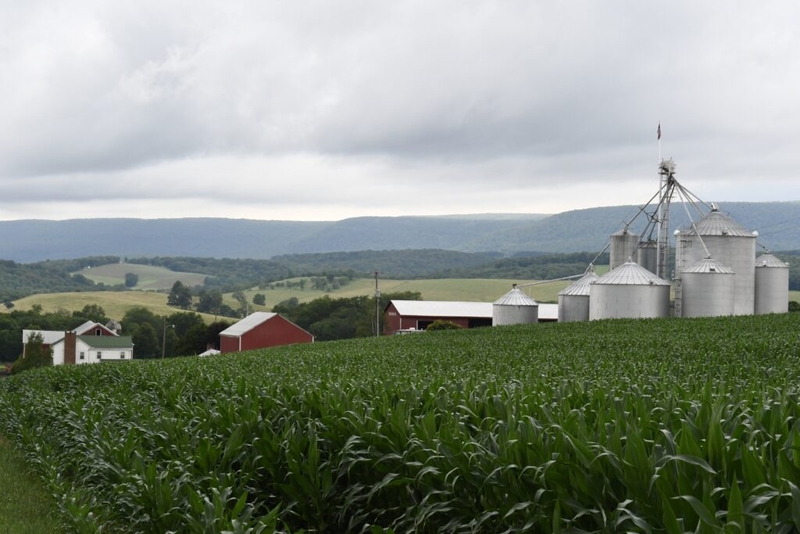
A western Pennsylvania farm. (Photo by Peter Hall/Capital-Star)
The practice of spreading residual waste from slaughterhouses and other food processing plants will be more closely regulated under legislation that became law Sunday along with the state budget.
Food processing residual waste (FPR) is used by some farmers to add nutrients to fields where they grow crops. It’s a less expensive alternative to traditional chemical fertilizers, but it can also cause environmental damage and disturb neighbors with its strong odor.
Last month, state Attorney General Dave Sunday’s office charged a Cumberland County man and a waste hauling company with violating the Clean Streams Act by failing to report a large spill of FPR at a Franklin County farm.
Neighbors soon noticed an odor in their drinking water that smelled like “dead poultry” and “decomposing animals mixed with chicken manure” that investigators linked to the spill, according to the attorney general’s office.
State Rep. Paul Friel (D-Chester) said the law, which is based in part on a pair of bills he introduced and passed in the House, directs the state departments of Environmental Protection and Agriculture and the State Conservation Commission to develop regulations to manage the hauling and application of the material.
The material is currently regulated under the state’s Solid Waste Management Act but application of FPR to farmland is exempt from permitting requirements if farmers and haulers follow the DEP’s manual outlining best practices.
“Right now it’s largely unregulated and there’s a giant loophole for unregulated landfills,” Friel told the Capital-Star, noting the law gives the agencies authority to enact temporary regulations until permanent ones are approved.
Sen. Greg Rothman (R-Cumberland) was the prime sponsor of similar legislation in the Senate. He said, applied improperly, the dangers and negative impacts of FPRs far outweigh any farming benefit.
“FPRs do not just emit a foul smell, they can be toxic and their misuse has impacted our communities and quality of life for far too long,” Rothman said, adding that the new law enacts commonsense reforms to protect Pennsylvanian’s health and the environment.
Rob Kole, chairman of the board of supervisors in Dickinson Township, Cumberland County, said people in his rural community have become deeply concerned about the use of FPRs by farmers in that rural community.
He described the township as the epicenter of the issue in the commonwealth because one farm there has developed a business around FPR application. Kole said much of the waste is trucked in, sometimes from several states away, because Pennsylvania lacks stringent regulations. Each of Pennsylvania’s neighboring states has some level of regulation for FPR application.

It has also created a divide between farmers and other residents.
“A lot of times these people are painted as city people who have moved out to the country and don’t want to deal with country smells,” Kole said, adding that the township receives complaints weekly that include reports of respiratory problems caused by the material.
And while odor may be the most noticeable effect of FPR use, the most pressing concern is the effect it can have on ground water, Kole said. He added that Dickinson Township formed a coalition with neighboring townships to push for action.
“There’s not really much we can do,” he said. “Residents have asked us to change the zoning or take other actions but we’ve been told any path to change begins in the legislature.”
The FPR regulatory framework was passed as part of the Fiscal Code, a set of laws that provide state agencies with the instructions on how to carry out duties assigned by the legislature. It’s common practice to write legislation into the Fiscal Code bill, which is drafted and passed in conjunction with the budget.
At least one lawmaker took issue with the legislation because it contains language preempting local laws governing the use of FPRs.
“This legislation strips local governments of local control,” Sen. Katie Muth (D-Chester) said, noting that many are not aware of the practice. “Maybe not an issue everyone understands or has even read about, but it’s a real issue.”
Rep. Michael Stender (R-Northumberland), who proposed an amendment incorporated in part into the final version of the law, said the legislation was developed through extensive negotiation between lawmakers and feedback from stakeholders.
Municipalities have little authority to regulate normal farming practices, he noted. Under the state Agriculture, Communities and Rural Environment law, local ordinances cannot exceed, duplicate or conflict with state law.
Those with interest in the final regulation will be able to continue participating in the process, he said.
“The positive thing we like about rules and regulations is that it gives everyone in the state the opportunity to comment,” Stender said, adding that Muth’s concerns about local control are misplaced.
The FPR law also provides for civil penalties of $500 for a violation of the regulations and an additional $100 fine for each day the violation continues. Those would be borne by haulers and farmers who apply FPR outside of the regulations.
And the law against dumping waste would still prohibit the application of FPRs in any way not related to normal farming practices, Stender said.

Harrisburg, PA