Superman building developer David Sweetser dies
Jul 22, 2025 | 3:45 pm ET
Description
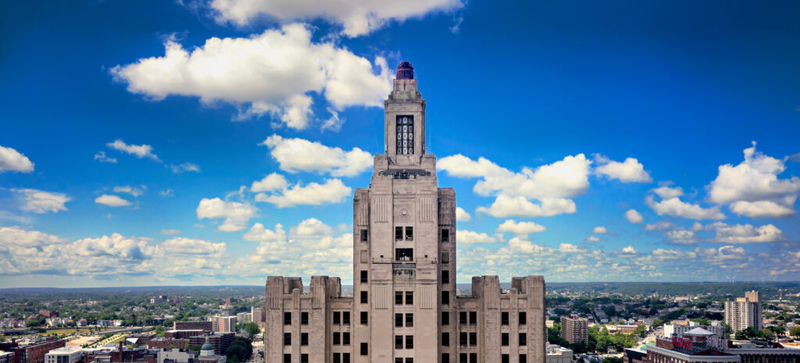
The Superman building looms over downtown Providence. The skyscraper has been owned by High Rock Development of Newton, Mass., since 2008. (Photo by Michael Salerno/Rhode Island Current)
David C. Sweetser, whose company has owned the most iconic piece of Providence’s skyline for nearly two decades, died on July 19. He was 70.
“He was a highly intelligent man who cared about the city of Providence,” Joseph Paolino Jr., a downtown developer and former Providence mayor, said in an interview Tuesday afternoon. “He was very excited to do over the Superman building.
Sweetser’s company, High Rock Development, purchased the 26-story office tower at 111 Westminster St. in 2008 for $33 million. The skyscraper has been vacant since Bank of America moved out in 2013. It got its nickname for its resemblance to The Daily Planet newspaper building where Clark Kent worked in the 1950s TV show.
Bill Fischer, a spokesperson for High Rock Development, declined to answer questions about how Sweetser’s death will impact the redevelopment of the downtown Providence skyscraper.
“David loved and embraced the communities he worked with, and was particularly bullish on Providence – truly believing that the redevelopment of the Superman Building would be a beacon of achievement for all,” Fischer said in a statement. “Today, with utmost respect for his wife Jayne and family, we quietly mourn his passing and honor his legacy.”
Information on the cause of death and funeral arrangements was unavailable.
A Massachusetts native, Sweetser was longtime friends with the family that owns Market Basket, and helped build local facilities for the New England grocery store chain, according to news reports.
Paolino met Sweetser soon after High Rock bought the Superman building. They remained in touch through occasional phone calls in which Paolino did not hesitate to vent about the building’s vacancy to Sweetser.
“He certainly knew my frustrations about it,” Paolino said. “It was a real passion project for him.”
After several false starts, plans to revitalize the former bank building as a 300-unit apartment complex with commercial space emerged in 2022, aided by $65 million in state and city public financing for what was initially a $220 million redevelopment cost.
But progress has stalled as costs have risen, prompting the development company to ask the Rhode Island General Assembly to rework a state tax credit program for its benefit during the 2025 session. The legislation was later worked into the state’s approved fiscal 2026 budget, which took effect July 1.
The tax change lets High Rock seek an additional $4.6 million in state sales tax credits on project construction costs, if approved by the Rhode Island Commerce Corporation under its Rebuild Rhode Island program. The company has not submitted an application to Commerce as of Tuesday afternoon, Matt Touchette, Commerce spokesperson, said in an email.
Nick Hemond, a lobbyist hired by High Rock, told lawmakers earlier this year that the state tax credit was the “last piece of the puzzle” to getting the project back on track.
Sweetser’s death casts new uncertainty on the project, Paolino said.
“I don’t know who his partners were, or his investors, maybe they are going to take over the project,” Paolino said. “Maybe it will speed it up. Maybe his family will decide to sell it.”
Paolino also suggested a potential sale could be an opportunity for a group of local business leaders to come together and buy the property. He was not ruling himself out, but noted that the building was “challenging” to redevelop.
“Any time I can do something to help the city, I will do it,” Paolino said.
Providence Mayor Brett Smiley offered condolences in a statement Tuesday, but did not comment on the building’s future.
“David loved this city and had a vision for its continued success,” Smiley said. “His commitment to Providence will have a lasting impact for generations.”
The property overlooking Kennedy Plaza was valued at $13.5 million in 2025, down $500,000 from the prior year’s assessment, according to the city assessment database. A 30-year tax deal inked between the developer and the city of Providence in 2022 would save the developer $29.4 million in city property taxes over the next 30 years if the development is completed. The payment schedule assumes the regular payment of $500,000 in annual property taxes — undiscounted — through 2026, with discounts beginning in 2026 as the property value increases alongside its redevelopment.
Updated to include comments from Providence Mayor Brett Smiley.

Providence, RI