St. Ambrose, Mount Mercy universities see delays in reaching final merger
Jul 29, 2026 | 11:29 am ET
Description
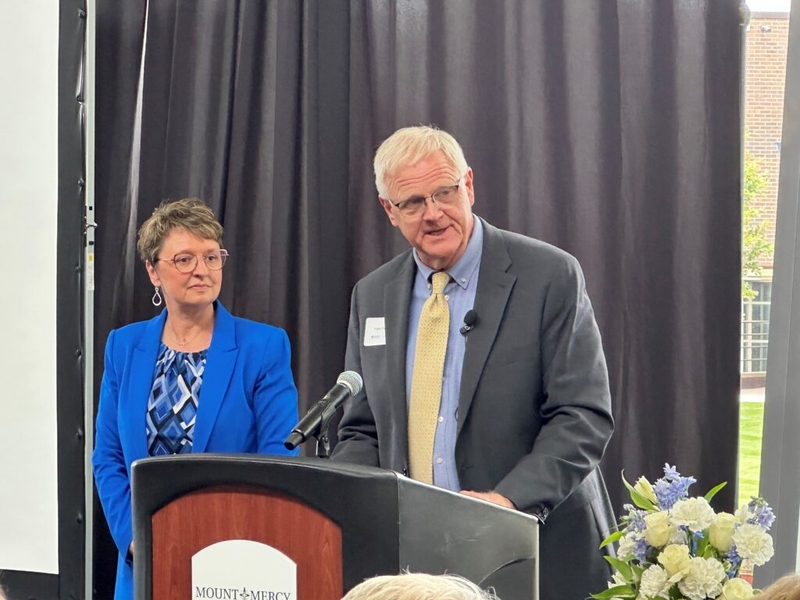
St. Ambrose University President Amy Novak (left) and Mount Mercy University President Todd Olson speak during an event. As Mount Mercy and St. Ambrose universities come close to a full combination, changes in curriculum and business are expanding opportunities. (Photo by Brooklyn Draisey/Iowa Capital Dispatch)
Close to two years after announcing plans for their strategic combination, two Iowa Catholic universities say they’re still waiting for final approvals from the U.S. Department of Education and its accrediting body, delaying a full merger and affecting the institutions’ financial picture.
St. Ambrose University in Davenport and Mount Mercy University in Cedar Rapids have nearly completed the process that will turn Mount Mercy from its own institution into a college of St. Ambrose, but maintaining its own campus and extracurricular activities. It has been just over one year since St. Ambrose was named as Mount Mercy’s corporate owner.
Amy Novak, president of St. Ambrose University, said the institutions have received “generally speaking, very strong affirmation” from the bodies that oversee their accreditation, including the Higher Learning Commission. However, final approval from the U.S. Department of Education and Higher Learning Commission are still required before some internal processes can come together.
“We’ve been told our application looks strong and there’s no major concerns,” Novak said. “It’s just a matter of sort of getting in line to get your application processed, and I think just the reduction of the number of employees in the Department of (Education), without the subsequent reduction in the regulations, has meant that there is just more work to do by fewer people, and that’s slowed the process down.”
Mount Mercy University President Todd Olson said the institutions received a provisional program participation agreement from the Department of Education in the spring. The delay in final approval meant the universities “can’t realize all of the savings that we had anticipated” in contractual areas, Novak said.
Mount Mercy Vice President for Business and Finance Brittney Burmahl said one major thing the lack of final approval has impacted is the ability of Mount Mercy and St. Ambrose to bring student data together, meaning financial aid and other information is still being processed and dispersed separately.
“That might be one of the biggest lifts that we have to complete here in the fall, and of course, there’s just never a good time to do that, right? So our goal is to hopefully complete that in a way that our students see as minimal disruption as absolutely possible,” Burmahl said. “But that’s definitely something that kind of stays in the back of my head as we kind of wait for that final approval.”
While the wait continues for those last OKs, university staff and faculty have worked together to examine both universities’ curricular programming and internal operations and identify the policies and processes that would work best for all.
Business continues toward combination
For now, Olson said he still serves as president of Mount Mercy University, but once the two institutions become one, he will transition to the role of campus president, reporting to Novak and involving himself in governing and advisory board meetings. He said he’ll “be sticking around for several years” in this position.
While both institutions are now governed by the St. Ambrose University Board of Trustees, Olson said a campus board has been formed to advise and advocate for the university’s mission, values and connections with the Cedar Rapids community.
The 20-person board is “off to a very good start,” Olson said, populated by local business and community leaders, Sisters of Mercy and Mount Mercy alumni. He added the board’s creation “sends a clear message” that Mount Mercy isn’t going anywhere and remains committed to its communities.
“I think that thoughtful structure, number one, makes clear there is one governing board for the overall university, and at the same time, takes seriously in a formal way the needs and status and visibility of Mount Mercy,” Olson said. “And what we’re committed to there, among other things, is seeing that we do not lose our strong connections in the Cedar Rapids and corridor communities.”
Another process already complete is the combination of faculty governance structures at St. Ambrose and Mount Mercy to one joint faculty senate, Olson said. The staff liaison group at Mount Mercy and staff assembly at St. Ambrose are also working to create a common structure across the two campuses, but that work is not done.
“We’re functioning in many respects as a single institution while still running the separate entities,” Novak said.
Burmahl said every day brings changes in the process of bringing two university operations systems together, but despite “a little change fatigue,” staff are taking the days one at a time with the bright future ahead in mind.
Each university has its own policies in place for things like travel, phone plans, purchasing and more, Burmahl said, and staff are employing Novak’s phrase of “one plus one equals three” to see what can be picked and chosen to make collective policies better than they were.
How the business sides of St. Ambrose and Mount Mercy will work together once the combination is complete is still unclear, Burmahl said, but her goal is to “create bench strengths” across different areas and provide both groups with the benefits and flexibility that comes with having more people to lean on.
New curriculum has students ponder essential questions
Developing new educational standards and curriculum for Mount Mercy and St. Ambrose to share was one of the first obstacles officials and faculty at the institutions started working on after the merger was announced in 2024, said St. Ambrose Associate Dean of Core Curriculum, Mission and Vocation Ella Johnson.
Both universities were in different parts of the curriculum review and updating process when the merger work began, she and Mount Mercy chemistry professor Kristopher Keuseman said, and St. Ambrose faculty had revised their program mission and identified question-based curriculum as the best path.
“Even in the very beginning of the integration, before it was announced, I think the presidents and boards really worked to make sure that this integration was going to be, in general, based on shared values and shared vision for what an education of the whole person should be, and so I think that that leads very well into the integration work that we have for curriculum,” Keuseman said.
Each course in the new core curriculum was designed from scratch by groups of faculty at both universities, Johnson said, and students will need to take one course each in 12 interdisciplinary areas, which are connected to six essential skills, including intercultural competence, inquiry and analysis and evidence-based reasoning.
Some courses piloted the new curriculum last year ahead of full introduction this fall, with the faculty members saying they saw positive results. Assessment data showed better engagement with the “contemporary questions” introduced through the curriculum, Keuseman said, and they hope to see that continue and for students to reap the benefits in their post-college life.
Students are able to choose whether they want to continue their education with the old or new curriculum, Johnson said, and there are “crosswalks” between the two.
“We did a lot of work to ensure that students could have a choice between either staying in the old or the new… we didn’t want any added obstacles to their degree progress,” Johnson said.
Looking to future students and opportunities
When Mount Mercy and St. Ambrose were ready to announce their strategic combination, St. Ambrose graduate student Jack Day said he was one of the first to know, since he was serving as student body vice president-elect at the time. At the time he was excited about what it could mean for collaboration, and so far he’s been able to work with Mount Mercy students through student government, Dance Marathon and student ministry.
Day said he’s been able to better connect with his faith through his meetings with students at Mount Mercy and them sharing their Catholic beliefs, and he’s also been able to tell prospective students and their families about the doors this combination will open for them through his job in the admissions office giving tours.
“We have … expanded opportunities for our students to interact with students at the other campus, to take courses through the other university, to be engaged in another community outside of the one that their home school is in, if you will, so I think it’s very exciting,” Day said. “It should be exciting for prospective students.”
“Optimistic” was the word Olson used to describe his feelings as the universities come closer to the fall semester, despite concerns of federal actions impacting things like loan availability for graduate students. He’s optimistic about enrollment on both campuses, as well as about faculty and staff conversations between colleges and the quality of incoming students.
Novak said philanthropy has been strong on both campuses, and she’s hopeful that once the two institutions are fully combined that program offerings can be expanded.
Payton Donohoe, a junior at Mount Mercy studying nursing, said the merger opens up many new doors for students and faculty, though the announcement those years ago surprised him at first. It began to make sense, though, as he spoke to “higher-ups” at Mount Mercy and learned more about what St. Ambrose’s acquisition would mean for the institutions.
Other students were uncertain about the merger, a feeling Donohoe said has dissipated some as fears of the unknown have been addressed and the process has moved ahead.
While Mount Mercy’s nursing program stayed with its original curriculum for courses last year, Donohoe said new students will have a good opportunity to interact with new materials and lessons. The merger will also help with easing the transition from undergraduate to graduate programs, like for exercise science students hoping to continue into physical therapy.
As for him, Donohoe said he’s most excited for the new interactions he’ll get to have with the study body in Davenport, through student organizations and other efforts, saying the merger will open up “a new community as a whole between campuses.”
“I’m just thankful for both universities including the students in the process, you know, keeping us informed as much as they can as things are constantly changing, they’re doing a really good job at that,” Donohoe said. “I commend both the presidents and the board of trustees and the staff and faculty for making this happen. This is definitely a tough process, you know, and there’s a lot of moving factors in this.”
Des Moines, IA