Maryland students continue minimal gains on test scores, but demographic gaps remain
Jul 29, 2026 | 4:30 am ET
Description
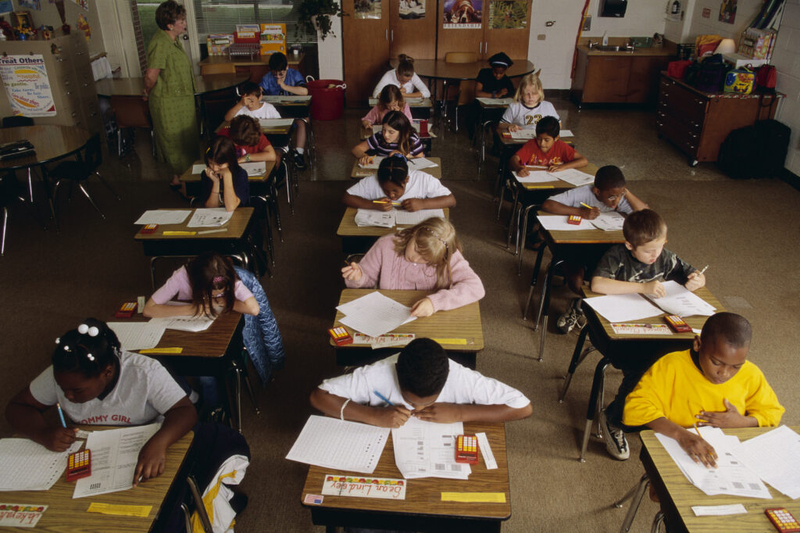
Elementary school students take a standardized test in this file photo. Test results released Tuesday showed Maryland public school students making steady progress in math and language arts proficiency, but wide gaps still remain between different demographic groups. (Photo by Will and Deni McIntyre/Getty Stock Photo)
Test results released Tuesday by the Maryland State Department of Education show public school students making steady progress in math and language arts proficiency, but wide gaps remain between the scores of different demographic groups.
Nearly 52% of students who took the Maryland Comprehensive Assessment Program test this spring were proficient in English Language Arts and about 27% of students were proficient in math. Both were gains of less than a percentage point from the previous year’s test.
The results mark the fourth straight year of language arts increases, gains that are being attributed in part to the “science of reading” curriculum that state Superintendent Carey Wright brought with her from Mississippi, where test scores rose significantly when she served as superintendent there.
One of the biggest gains made in the MCAP came from middle school students in language arts: Eighth graders’ proficiency rose from 48.4% last year to 50.2% on the test taken earlier this year.
When compared to 2022 — two years after the start of the COVID-19 pandemic, as schools started to return to normal — seventh grade language arts proficiency rose from 42.7% to 54.6%. Economically disadvantaged students saw similar improvements, rising from almost 24% proficient in 2022 to about 36% this year.

Geoff Sanderson, deputy state superintendent of accountability for the state Department of Education, said test scores improved among various student groups at a slightly better rate than the overall scores. But gaps remained.
For Black students, language arts proficiency rose from 39.4% last year to 40.7% this year, and Latino students went from 33.7% to 35.1%. The percentage for students with disabilities was unchanged at 14.6%.
However, 68.7% of white students scored proficiently in language arts this year, up from 67.9% last year.
School board member Peggy Carr, a visiting professor in the College of Education at the University of Maryland, said “we need to keep our eye on that” and other data.
Some high school students are assessed in various math subjects and 10th graders in language arts. Science is also taken by students in fifth and eighth grades.
School district snapshot
Once again, Worcester County public school students showed the highest level of proficiency in English at nearly 70%. The district was also first last year, at 68.5%.
Students from the Lower Shore county also had the highest level of math proficiency at about 49%, up from 47.7% last year. Between 2022 and this year, Worcester improved its math proficiency by 16.5 percentage points.
Board member Alverne “Chet” Chesterfield, a Lower Shore resident, asked how Worcester County was able to make such an improvement.
Wright praised Worcester County School Superintendent Annette Wallace, who became the district’s leader in July 2025, after working as a math teacher, principal and chief operating officer in the county schools.
“I’m sure that her colleagues are calling her and asking her how that’s being done because she’s getting the results,” Wright said. “She is on it like every single day.”
In terms of language arts, several other school districts achieved at least 60% student proficiency this year: Carroll (67.5%), Calvert (66.6%), Howard (65.9%), Frederick (64%) and Harford (61.%).

Three school districts increased by double-digit percentage points in language arts between 2022 and this year:
- Harford: from 49.8% to 61.1%, an 11.3% increase
- Calvert: from 55.9% to 66.6%, a 10.7% increase
- Baltimore City: from 22.4% to 32.9, a 10.5% increase
Besides Worcester County in math, Calvert County was the other school district that improved by double digits from 27.8% in 2022 to 37.9% this year, a 10.1% increase.
Howard (42.9%) and Carroll (41.9%) joined Worcester as the only school districts with students who exceeded 40% proficiency in math.
Board member Xiomara Medina, an associate director of clinical training and field placement at Bowie State University’s Department of Counseling and Psychological Studies, said the year-to-year gains may be minimal, but they still represent student improvement.
“Yes, there’s a ton of work to do. We know that,” Medina said. “But we don’t want to come off as disparaging for superintendents and principals, ‘And it was only 0.2%.’ No, no, no. The work that is happening, it’s showing. It’s improving.”
A deeper dive on the results will be conducted next month.
This year’s test was the last for students in third through eighth grades, as the state transitions into the newly designed Maryland System of Testing Academic Readiness (MSTAR) beginning in this school year.

Wright said one change with the new test is that it will specifically measure each grade level by what’s being taught in the classrooms. In the current language arts test, for example, students receive a litany of questions that may be on different levels.
One main difference is that the new tests will be shorter, “which I know [is] a treat for teachers,” Wright said during a briefing with reporters after Tuesday’s morning session during state Board of Education meeting in downtown Baltimore.
Maryland READS, an organization that promotes the importance of literacy, urged state education officials and the General Assembly to continue investing in the professional development teaching program known as “coaching.”
The legislature approved just over $14 million in the current budget for the state to hire 61 literacy and math instructional coaches for the upcoming 2026-27 school year.
“Every family whose child crossed into proficiency this year deserves to celebrate that, but let’s be clear: This is not the moment to take our foot off the accelerator,” Trish Brennan-Gac, executive director of Maryland READS, said in a statement Tuesday.
“We know we are gaining ground, but we are nowhere near ending Maryland’s reading crisis,” she said. “Too many Maryland students still cannot read at grade level, and incremental progress cannot become an excuse to slow down.”
Leadership change
Also Tuesday, the board voted unanimously to keep Joshua Michael as board president, and chose James C. Bell Jr. as the new board vice president. Bell replaces former Prince George’s County CEO Monica Goldson, who remains on the board.
“As we begin this new board term, I believe Maryland has an extraordinary opportunity,” Michael said. “We see public education facing challenges across our nation, but I would argue that we are a shining star in terms of what’s possible for students from all backgrounds and all walks of life in public education.”
Annapolis, MD