Speechless in Knoxville
Jul 13, 2026 | 5:59 am ET
Description
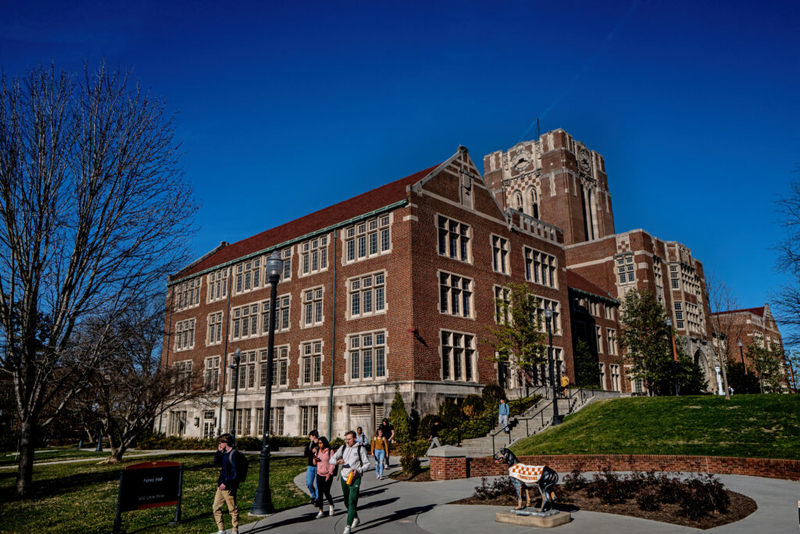
The University of Tennessee-Knoxville settled for $1.9 million a free speech case filed by a professor after she was fired for social media posts made after right-wing activist Charlie Kirk was shot and killed. (Photo: John Partipilo/Tennessee Lookout)
How fitting it was that Tamar Shirinian landed on the happy side of a nearly $2 million legal settlement just as the country was celebrating its 250th. After all, when we think of the things that make America America, what is more quintessentially American than building wealth by suing the pants off someone?
The pants here belong to the University of Tennessee. Shirinian is the (now former) UT Knoxville anthropology professor who brought the full weight of right-wing outrage down upon herself last fall when she said some not-very-nice things about the conservative provocateur Charlie Kirk on social media shortly after he was killed. Although Shirinian had shared her thoughts in a nonpublic comment replying to a nonpublic Facebook post, a conservative activist got hold of a screenshot and in a very public X post shared it with the world.
Before going any further it is worth recalling the specific words that Shirinian wrote about Kirk, which were plenty caustic.
Within days UT Knoxville Chancellor Donde Plowman suspended Shirinian and initiated termination proceedings. Shirinian, in turn, filed a First Amendment lawsuit against the university. Plowman fired Shirinian in February. With the lawsuit on the docket for an early 2027 trial in federal court, UT opted to settle and pay off the professor.
I had three reactions back when the offending comment and the university’s response to it first surfaced. One was to think wow, that’s harsh, Shirinian really went there. The second was to think wow, Plowman is clueless enough to take marching orders on university governance from U.S. Sen. Marsha Blackburn, who instantly branded Shirinian as a “lunatic” who “should be fired immediately.” And the third was to think wow, Shirinian should get herself a good attorney and sue the university because she’ll win and they’ll have to pay her lots of money.
This was not clairvoyance on my part; anyone with a passing acquaintance of how the First Amendment applies to public-sector employment could see it coming from a mile away. Or maybe from 225 miles away —the distance from Knoxville to Clarksville — where Austin Peay State University in January agreed to a hefty settlement with one of its professors, Darren Michael, who was fired for comments he made about Kirk. Across the country literally hundreds of people were caught up in a campaign to punish critics of the newly sainted Kirk. Many have filed lawsuits that did or will succeed.
Republican push for tips on Charlie Kirk posts drives firings of public workers
Those like Shirinian and Michael who found themselves on the business end of an employer’s ax for talking about Kirk in other than reverential terms are winning lawsuits because government employees (including professors at state universities) have First Amendment rights to speak their minds on their own time about matters of public interest. A government agency can act against the employee if it thinks the speech threatens the ability of that agency to function effectively. But the burden is on the government employer to make that case concretely, not just fret ambiguously that something bad might happen.
With Shirinian, university leaders pushed that case with claims that her remarks about Kirk might draw harm to the UT community. In her letter firing Shirinian for cause, Chancellor Plowman framed Shirinian’s misconduct as a “safety risk you created and continue to create.”
In a deposition earlier this year, Plowman admitted that Shirinian’s comment neither called for anyone to be harmed nor encouraged anyone to commit violence. “I think her comment led to the potential for harm,” was Plowman’s feeble and evidence-free conclusion.
When UT system President Randy Boyd was pushed by Shirinian’s lawyer for “actual evidence” to support the claim that people at UT were put at risk, Boyd weirdly pointed to “the counterfactual … the fact that we did take the action … [and] nobody was hurt.” That’s quite an argument: Firing Shirinian caused nobody to be hurt. It also caused no space aliens to land in downtown Knoxville. We did X and Y didn’t happen, so we can attribute the absence of Y to X. Surely the leader of the University of Tennessee system can conjure up something better than middle school logic.
Plowman was asked how she squares punishing Shirinian with the university board of trustees policy on free speech:
“The university must be committed to maintaining a campus as a marketplace of ideas for all students and all faculty in which the free exchange of ideas is not to be suppressed because the ideas put forth are thought by some, or even by most, members of the university community to be offensive, unwise, immoral, indecent, disagreeable, conservative, liberal, traditional, or radical, or wrongheaded.”
Plowman in reply offered up a string of feckless denials that what Shirinian said even qualified as expression: “There was nothing in her post about her beliefs,” and “there is nothing in this that is about an exchange of ideas,” and “it’s an opinion that does not exercise appropriate restraint.”
With these answers Plowman revealed not just an inability to comprehend and apply this most basic and crucial university policy, but also an alarming disrespect for the nature and role of free speech. Hearing an executive officer of an essential state institution speak of an “opinion that does not exercise appropriate restraint” is unnerving and chilling. And for added measure Plowman admitted that she casually ignored required procedural steps in these sorts of faculty discipline cases.
Shirinian’s attorney confronted Plowman and Boyd with an intriguing comparison case. In 2016 UT law professor Glenn Reynolds reacted to news about protestors blocking traffic by tweeting the suggestion “run them down.” After an investigation the Law School’s dean concluded that Reynolds’s comment was an exercise of his First Amendment rights, even if it offended many in the community, so no disciplinary measures were necessary.
How is it, Plowman and Boyd were each asked in their depositions, that Reynolds’s plainspoken call for violence was an allowable exercise of free speech, while Shirinian’s provocative statement, which incorporated no call for violence, is a firing offense?
“I don’t see any relevance of that case to this one,” was Plowman’s bafflingly inane evasion. Boyd conjured a bizarre distinction between the two situations: with Reynolds “there wasn’t an actual murder, and there’s no students’ faculty, or staff’s lives at risk because he is on the campus” whereas with Shirinian there was a murder (Kirk’s, which Shirinian of course had no part in) and Shirinian’s comments “could have” incited violence and riots. They didn’t.
After approving the settlement with Shirinian, UT Board of Trustees Chair John Compton said “continuing litigation could require significant time and attention, and financial resources … better directed toward advancing the institution’s mission, vision, and values.” Let me translate that: The depositions made it clear how flimsy the university’s position was so administrators abandoned a sinking ship, leaving Tennessee taxpayers to foot the bill for the constitutional ignorance of university leaders.
Nashville, TN