Should teachers have to pass a test? Shortages lead to consideration of certification alternatives.
Jul 07, 2026 | 6:00 am ET
Description
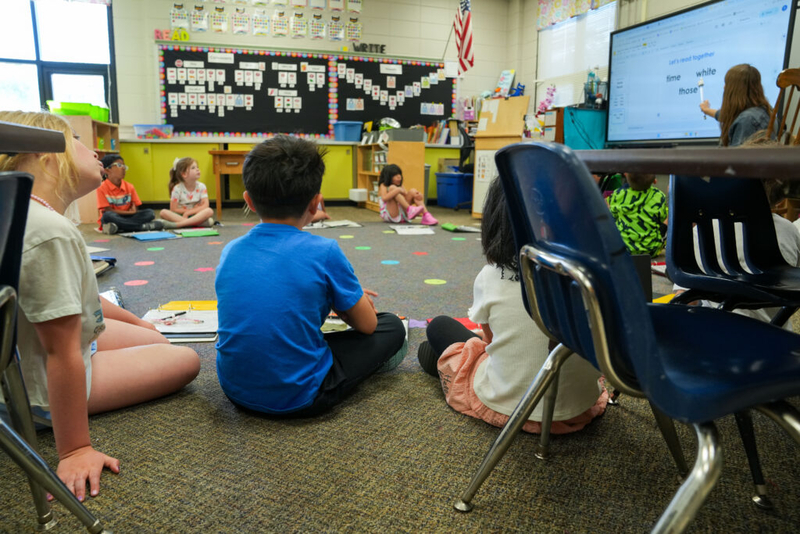
A Sioux Falls School District educator teaches students reading at Lowell Elementary during the 2024-2025 school year. (Courtesy of the Sioux Falls School District)
Teacher shortages in rural and tribal schools are driving the South Dakota Department of Education to explore alternatives to licensing exams.
State Education Secretary Joe Graves asked members of the state Indian Education Advisory Council for their input on the possibility last month. He did not offer a timeline for the possible change.
Statewide, the number of teacher openings fell recently to 290, down from a high of 410 at the same time in 2023. But district-specific data show elevated vacancies in rural and tribal districts such as Sisseton, Todd County and Oglala Lakota schools. Those three school districts reported average full-time staff vacancies of 2.64, 3.83 and 7.23, respectively, at the start of the school year from 2019 to 2025. The average school district in South Dakota reported 0.59 vacancies.
Graves said willing, educated teachers with relevant “cultural backgrounds” — particularly Native American teachers — are especially in need but are often failing the licensing exam.
“Meanwhile, we’re replacing them with people not just lacking their cultural background, but people we’re recruiting from across the Pacific Ocean,” Graves said.
Governor awards $500,000 to program converting paraprofessionals to teachers
In 2025, 446 teachers hired from overseas were leading classrooms statewide. Many of those educators are “high quality people,” but it’s “galling” to some educators observing the situation that they can’t fill that role, Graves told South Dakota Searchlight after the council meeting. Meanwhile, some school districts are relying on untrained, long-term substitutes.
Offering an alternative certification pathway for some local teachers could help solve the problem, Graves said during the meeting. The state has required teachers to pass a certification exam — the Praxis Series, a standardized test of academic skills and subject knowledge — since 2005.
Sisseton-Wahpeton Oyate Tribal Education Director Sherry Johnson partnered with a national nonprofit to conduct research on alternatives after years of concern about the exam’s impact on Native American teacher candidates. Johnson was awarded a fellow, Diana Martinez, from Leadership for Education Equity to study the issue. Martinez presented her findings to Graves in June.
Johnson said the research stems from a “longtime concern among tribal educator directors” about potential teachers not passing the certification test.
“We can’t always bash and bash the system,” Johnson said. “When you’re going to bash the system, you need to come to officials with some resources and examples and solutions.”
International hires & ‘grow your own’ programs: Schools seek solutions to teacher shortage
About 61% of all candidates pass the certification exam each year in South Dakota. The certification exam is a “barrier” for aspiring Native American and other minority teachers, contributing to the rural teacher shortage, Martinez said.
According to a 2019 study, the pass rate was 75% for white candidates, 33% for Black candidates, 56% for Latino candidates and 30% for “other races,” which includes Native Americans. Non-white candidates are also less likely to retake the exam, which costs hundreds of dollars.
Research has indicated that the lower success rates for candidates of color may be partly attributable to deficiencies in the educational opportunities they received as children, or to cultural bias in the tests or administration of the tests.
Martinez’s research points to a portfolio approach as the solution: a certification process in which candidates document their teaching, lesson planning, student assessment and professional development skills rather than taking a standardized test.
“We don’t want to produce something to make it easier to be a teacher,” Martinez said. “We want them to go into this having the right skills. This is supposed to be rigorous still. If you make it easier, you won’t get the results you want.”
Martinez said several other states have implemented alternative certification pathways — such as California, Minnesota and New Mexico — resulting in increased certification and retention rates among teachers. Other states have relaxed their professional standards, Graves said.
While Graves said he is “very hesitant” to relinquish the “rigor” of the test, he asked advisory members if there could be a “middle ground.”
“If we give it up, we’ve lost something in the profession,” Graves said. “And I also think if we keep holding to this standard, we’re driving, say, five teachers out of the profession a year who are particularly well suited to teach at certain schools in the state. That’s a loss as well.”

He said the department is researching alternatives, such as temporarily altering certification requirements for school districts with severe teacher shortages or with high poverty rates.
“How do we address what we hope is a short-term problem of the teacher shortage without creating a long-term liability for the profession?” Graves asked while framing the problem for South Dakota Searchlight.
Members of the advisory committee were split. Some shared stories of difficulties passing the exam. Pierre teacher Megan Deal said the state should keep the exam.
“We want highly qualified teachers in our state,” Deal said. “Are our lawyers not going to have to take the bar anymore? Are doctors not going to have to take anything? Yes, it breaks my heart if they keep failing it, but we’ve all had to pass it to get our teaching certificate.”
In fact, it is now possible to become a lawyer in South Dakota without passing the bar exam. Law school students selected for a pilot program can earn entrance to the state bar by completing two years of full-time public service employment, such as in the office of a state’s attorney or public defender, and passing a review of their work portfolio.
Brian Wagner, tribal education director with the Lower Brule Sioux Tribe, said children need to see themselves in their teachers. Native American children comprise 10.5% of public school students, yet 1.4% of teachers are Native American, according to Kids Count South Dakota, a nonprofit organization focused on child development.
Schools serving student bodies that are at least 25% Native American — along with rural public schools — have the highest teacher turnover and vacancy rates in the state, according to the same report.
Waiving the certification test could increase Native American teacher representation and improve outcomes for Native American students, Wagner said.
“I’ve worked with people who’ve passed the Praxis that can barely tie their shoes, but they’re good at taking tests,” Wagner said. “I’ve worked with elders who have no degree at all, other than having walked in life, that are the best teachers I’ve ever worked with.”

Pierre, SD