Shaheen and Hassan re-introduce $65 billion federal opioid response plan
Jun 25, 2026 | 11:33 am ET
Description
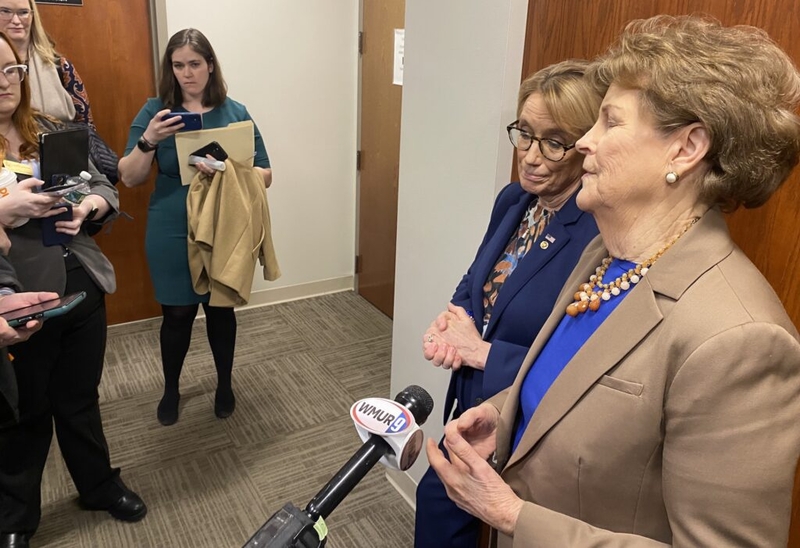
U.S. Sens. Jeanne Shaheen (right) and Maggie Hassan (second from right) answer questions from reporters during an event in Manchester in February 2025. This week, Shaheen and Hassan filed legislation to increase funding to address the opioid crisis. (Photo by William Skipworth/New Hampshire Bulletin)
This story was updated at 4:10 p.m. June 25 to correct that the bill increases funding for the State Opioid Response Program by nearly $4 billion annually not cumulatively for five years.
U.S. Sens. Jeanne Shaheen and Maggie Hassan filed legislation this week to increase federal funding to address the opioid crisis to the tune of billions of dollars.
The two New Hampshire Democrats re-introduced the Turn the Tide Act, which would raise the total spent on various addiction remediation efforts to around $65 billion nationwide over 10 years.
For example, it would increase funding states receive for the State Opioid Response Program by almost $4 billion to $5.5 billion annually for five years. That program, which provides more funding per capita to states hardest hit by the opioid crisis, gave $29.9 million to New Hampshire in fiscal year 2025. New Hampshire spends much of the money on The Doorway recovery program. The Doorway operates nine treatment centers throughout New Hampshire in a “hub-and-spoke” model that helps patients navigate various recovery services like medication-assisted treatment and mental health therapy.
The senators are also trying to create a new grant program for children in families affected by addiction to deal with the associated trauma. The legislation would also expand a federal program that seeks to create housing for people in recovery and require Medicare Part D plans to fully cover naloxone, an emergency drug used to counteract drug overdoses.
New Hampshire has been one of the states hit hardest by the decades-long opioid crisis. In 2017, 424 people died due to opioids, according to the National Institute on Drug Abuse. That’s about 34 deaths per 100,000 people, more than twice the national average of 14.6 per 100,000.
However, New Hampshire and the United States as a whole have begun to see some relief from the epidemic. From 2022 to 2024, New Hampshire saw a 44% decrease (from 427 to 240) in deaths involving opioids, according to the New Hampshire Drug Monitoring Initiative. Public health officials are still finalizing 2025’s figures, but their preliminary estimate is 187 deaths.
Still, treatment professionals and advocates believe there’s more work to be done.
“We’ve made important progress to reduce overdose deaths in New Hampshire, but the fentanyl crisis continues to devastate families across our state,” Hassan said in a statement to the Bulletin. “We cannot let up now and must keep doing everything we can to keep fighting. This bipartisan bill will strengthen prevention and recovery programs, address workforce shortages that make it harder for people to get care, and help communities save lives.”
Shaheen’s team pointed to the Trump administration and Health Secretary Robert Kennedy Jr.’s back-and-forth funding of addiction recovery programs as the rationale for congressional action. In January, the administration announced just under $2 billion in cuts to more than 2,000 programs. However, within 24 hours, after bipartisan backlash, it reversed course and reinstated the funding.
“Substance use disorder impacts communities in every corner of our state, and I’ve heard from countless families who have been torn apart by this crisis,” Shaheen said in a statement. “We’ve made great strides in combatting substance use in New Hampshire, but there is more work to be done. I’m proud to reintroduce this critical legislation that will secure long-term investment in prevention and treatment to ensure we keep up the fight against the substance use crisis for years to come.”
Shaheen and Hassan have attempted this legislation before and will again face an uphill battle getting the high price tag past fiscal hawks within the GOP. They introduced the bill in 2024, but it failed to make it out of committee. Shaheen is hoping she can get the bill across the finish line during her last year as a U.S. senator before she retires following November’s elections.
Concord, NH