Schoolyard farm showcases community resilience
May 26, 2026 | 4:55 am ET
Description
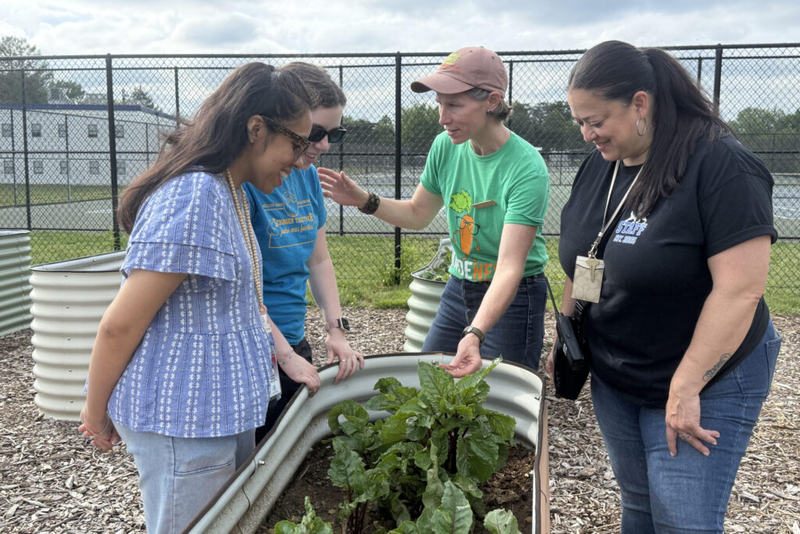
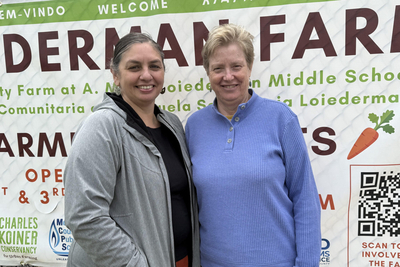
Charles Koiner Conservancy for Urban Farming Executive Director Kate Medina, and Loiederman school community liaison Carol Fernandez, right, welcome teachers from nearby Weller Road Elementary to explore the Farm Hub for a potential field trip. (Photo by Rosanne Skirble/Maryland Matters)
On a cool spring day recently, the 1-acre farm A. Mario Loiederman Middle School in Wheaton buzzed with activity.
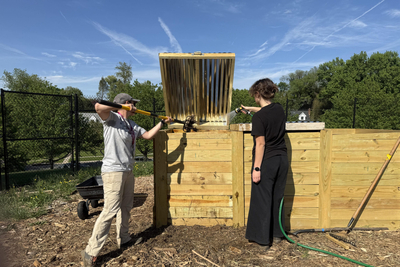
In the lower field educational garden, students in the afterschool farm club are assigned their tasks, first to check on the seedlings and then to shovel and spread woodchips along paths in the upper larger production plot. They do this alongside a team of high school Department of Recreation TeenWorks interns who are crafting a wooden cover for the compost bin.
It’s affectionately called La Ranchera, a reference to the nearly two-thirds Latino population at the school who live nearby. But a little over a year ago this was the school’s backyard, then a grassy field over backfill from construction of Loiderman’s new Performing Arts Center, says Kate Medina, executive director and co-founder of the Charles Koiner Conservancy for Urban Farming (CKC).
The nonprofit has partnered with Montgomery County Public Schools to develop and run the Loiederman project. Medina says CKC was a natural fit. “We always had the mission to create and sustain a network of neighborhood farms,” she said.
In 2016, the Montgomery County Council afforded special agricultural tax credits to the downtown Silver Spring Charles Koiner family property, making it the first urban farm in the county. Three years later it became the first urban farm in the state to be protected by a conservation easement.
Rethinking school yards
In the 2024 agreement with CKC, the county school system designated Loiederman as a Resilience, Education, Action, Climate and Habitat (REACH) Hub. Medina says the pilot program at the school essentially is a mandate to rethink school yards as educational and community assets.
“It’s an opportunity for people to have not just a one-time snapshot or one chance at outdoor education, but to really see nature as this changing, evolving dynamic place and learn from every aspect of that,” she said.
And that vision required leveraging funds to bring it to life.
“The REACH Hub and Farm has generated $2 million for the buildout of this unique site, which is both a school farm and a community resilience hub,” she said. “This includes $1 million from the Maryland Energy Administration for the resilience elements, plus another $1 million from a combination of state, county and private funding partners, most notably the Maryland Department of Agriculture, Maryland Department of Natural Resources, and Montgomery County Office of Food Systems Resilience.”
Medina said it’s been a strong start to Loiederman’s first full season. Infrastructure is largely complete, except for the installation of the solar agrivoltaics, and the solar hook-ups that will operate the composter and open-air wash station, which she expects to go online in coming weeks. Also, since last season, fencing enclosed the gardens, safety lighting was installed and new trees planted.
“Through partnerships, grants and volunteer hours, we have built and filled 140 raised beds, installed a 10-by-10-by-8 walk-in cold storage unit, built tool racks and storage sheds,” she said.
Those beds are expected to yield 6,000 pounds of fresh produce annually, of which half will be donated to nonprofits and food banks for distribution.
Community liaisons flex civic muscles
Medina credits a small, but active group of community liaisons, largely women in the neighborhood, who help keep the project on track.
“At every turn they tell us how to name the farm, how to lobby the right people within MCPS, how to find volunteers, how to run the market, everything,” she said.
Lorena Davalos and Juanita Roca are leaders in the group.
Davalos is a Mexican-American, whose family migrated to California with the bracero program, a guest worker initiative that brought Mexicans legally to the United States during and after World War II to fill vacant agricultural jobs. She has carried that history forward, employed in agricultural projects worldwide. Roca, born in Colombia, now retired, shares that connection in agricultural development.
Now, they say it’s time to bring that know-how home.
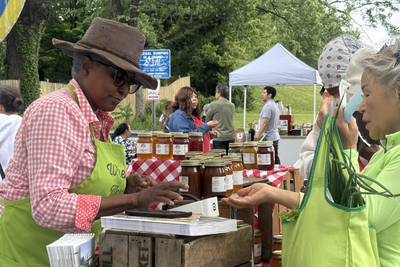
The two advocates post messages, distribute flyers and go door-to-door to promote the farm and the twice-monthly farmer’s market that has stalls with fresh produce, homemade ice cream, honey and handicrafts. They are encouraging entrepreneurs to set up shop, and to learn from one another in workshops that tie into their values.
“Right now, I think what our vision is, is that this becomes a magnet for the community, what the community has to offer,” Davalos said. “There so much knowledge here within the community that [is being lost]. We need to showcase it, and it’s a perfect opportunity for folks to make traditional drinks” or foods.
Minority-majority community reaffirms identity
Roca says the result empowers the community at the grassroots, reaffirming its identity.
“This is creating a civic muscle for other things,” she said. “It’s not just about food security, or it’s not just about can I grow a tomato. It’s going to help to improve the schools. It’s going to help mobilize resources to fix a road, all these different things.”
About 17,000 students from 20 schools live within a 2-mile radius of the Loiederman school in the Wheaton-Glenmont area, a majority-minority community, largely Hispanic, but also with a significant African and Asian immigrant population. Medina says that proximity could help save lives in a natural disaster.
“This space being so close to where people live will activate with increased food production, public charging stations, and other resources needed in a climate disaster,” she said.
CKC has signed a 10-year agreement with the county school system at Loiederman with the hope of replicating its farm model in other schoolyards.
“We would love to protect this property in perpetuity, but really the opportunity here is to make it so valuable to the school and to the community, that we couldn’t imagine life without something like this,” Medina said.
And it will take kids like Steven, a Loiederman seventh grader in the afterschool farm club to make the project thrive.
“I like the outdoors,” he says as he eagerly hauls woodchips with his good friend Bryson, alternating who shovels and who spreads the chips. “I feel great giving back to Mother Nature, doing these things around the farm. I like the hard work.”
Annapolis, MD