Rock Hill courting ‘Palmetto Rock’ for failed Panthers practice site
Apr 27, 2026 | 8:40 pm ET
Description
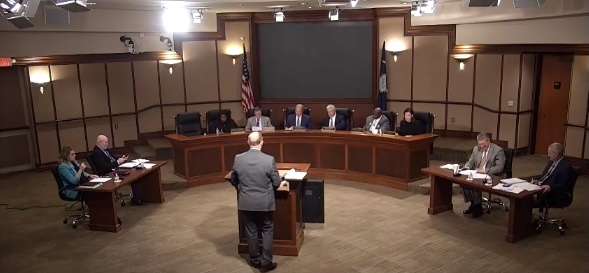
Rock Hill City Council voted unanimously Monday, April 27, 2026, to give initial approval of a deal to sell 50 acres on the site of the failed Carolina Panthers practice facility and team headquarters. (Screenshot of Rock Hill City Council livestream)
ROCK HILL — Four years after the owner of the Carolina Panthers halted construction on a $500 million practice facility and team headquarters in Rock Hill, the city has a potential buyer for a portion of the prime real estate off Interstate 77.
The state’s fifth-largest city is seeking to sell 50 of the 240 acres it owns as part of a legal settlement with the pro football team’s billionaire owner, David Tepper.
City council unanimously gave initial approval of the sale ordinance Monday. Officials did not disclose details of the deal, such as the sales price, how much the buyer — identified only by the code name “Palmetto Rock” — might invest, or how many new jobs it might bring.
City leadership has previously said it planned to target the life sciences or pharmaceutical industries.
York County’s economic development committee is expected to meet behind closed doors this week to discuss what role the county may play, city spokeswoman Katie Quinn told the SC Daily Gazette.
The vote Monday marks the first serious move toward a potential sale by the city since it took over the property after the failed Panthers development.
Tepper’s abandonment of that marquis economic development deal in 2022 had marked a first for the state.
“We’ve never had a business that I know of actually just notify us that they were going to fail to attempt to make the commitment,” state Commerce Secretary Harry Lightsey told a state House oversight committee in April 2022.
The team, in a 2019 announcement, had promised to move 150 employees to the Palmetto State in exchange for an estimated $115 million in state tax breaks.
The state Department of Transportation also spent $80 million to build an interchange to the site.
But more than halfway through construction — with $170 million spent on the 5,000-seat stadium, 500-seat indoor practice facility, and 600,000-square-foot headquarters building — Tepper, a hedge fund billionaire and the NFL’s richest owner, made what his organization called a “difficult but prudent decision” to shutter the site.
In addition to housing the NFL team’s practice facility and headquarters, the site was touted as a major visitor and business destination in the fast-growing suburb of Charlotte. As the property built out with offices, stores, hotels, apartments and a sports medicine clinic from Charlotte-based Atrium Health, city officials estimated, total investment would top $1 billion.
The point of contention was $225 million in bond financing from Rock Hill that would have covered the cost of streets, sewer and other public infrastructure.
Carolina Panthers owner donates $5M to USC for scholarships, professorships
Tepper’s organization blamed the city for the halted construction, saying it failed to put public bonds on the market.
Rock Hill countered that Tepper’s group had actually prevented it from issuing bonds, which the city would have paid off with future tax revenue generated from the development.
Tepper’s development company filed for bankruptcy in 2022. A settlement approved by a federal bankruptcy judge led to the city’s ownership of the property.
The Tepper organization never received any of the state tax breaks and also had to cover its $5.3 million share of the state interchange cost.
In early 2023, the city and a contractor struck a deal to dismantle the massive, partially built structure — which included 10,000 tons of steel and 40,000 cubic yards of concrete.
The two agreed to split the proceeds from selling off the steel and other unused equipment, such as air conditioners, on site.
But the land has stood empty in the interim.

Columbia