Homelessness in WV increased in 2025, federal estimates shows
Jun 08, 2026 | 5:55 am ET
Description
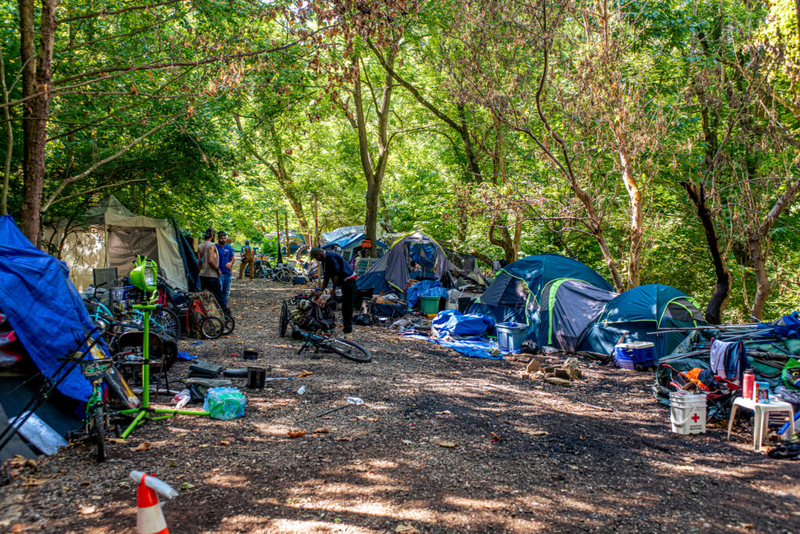
In this July 2024 photo, homeless people in Wheeling stayed in tents at the one place that was exempted from the city's camping ban. The city has since closed the exempted site. (Photo by Daniel Finsley/Finsley Creative for West Virginia Watch)
Homelessness grew by more than 8% in West Virginia from 2024 to 2025, but decreased in the rest of the country, according to estimates released by the federal government.
In West Virginia, 1,925 people were living on the street or staying in a shelter on one night in winter 2025, an 8.2% increase over 2024’s count of 1,779.
In the United States, the number of homeless people declined 3.4% from 2024 to 2025, and has risen 27% since 2013, according to the U.S. Department of Housing and Urban Development.
The numbers reflect HUD’s annual Point in Time Count. The counts — done by volunteers in communities around the country — offer a snapshot of shelter and unsheltered homelessness. The surveys are federally mandated to take place each year during the last 10 days of January.
Advocates say Point in Time counts underestimate the true scale of the homelessness crisis by excluding some homeless people, for instance those who are staying with friends or family because of economic hardship and those in jails or hospitals. A state-commissioned report released in 2024 found that on average, between 2018 and 2023, on average 3,624 people per year in West Virginia experienced literal homelessness.
Advocates for homeless people celebrated the national decrease from 2024 to 2025, but warned that the Trump administration’s policies could make homelessness worse. The agency has announced a shift in policy away from a housing first model, which prioritizes getting people into housing without first requiring drug treatment and other prerequisites, toward programs that emphasize treatment.
HUD released a plan last year that advocates said would have led to more than 850 West Virginia residents and 170,000 people nationwide losing housing. A court blocked that plan.
“The data is clear that the status quo of ‘housing first’ has failed to meaningfully reduce homelessness, resulting in crisis levels of people living on the streets,” HUD Secretary Scott Turner said in a news release about the 2025 Point in Time count. “HUD is restoring its programs to advance recovery and self-sufficiency and to ensure that taxpayer-funded benefits serve American families.”
In a June 1 news release, Renee Willis, president and CEO of the National Low Income Housing Coalition, said that a rise in homelessness is unacceptable, and any reduction in the number of people on the street or risk is welcomed.
“However, we cannot ignore that effective federal solutions to end homelessness exist and are now under threat,” she said. “Homelessness is a housing issue, and this administration continues to reduce investments in targeted federal affordable housing resources that could prevent homelessness from worsening.”
Besides the general increase, West Virginia saw a 27% increase in families with children experiencing homelessness, according to the estimates. The state was still among the four states with the smallest percentage of homeless families. Only 237 people in families in West Virginia were experiencing homelessness, according to the Point in Time count.
Of the 1925 West Virginians who were homeless last year, about 46% were unsheltered, according to the report.
Matthew Hedrick is chief data officer for the West Virginia Coalition to End Homelessness, which is a continuum of care for 44 counties in the state. Hedrick said several factors likely contributed to the increase in homelessness and homeless families in the state.
“Housing affordability continues to be a significant challenge, with rising rents, limited affordable housing options, and increasing housing costs making it harder for households to remain stably housed,” he wrote in an email to West Virginia Watch.
He added that last year’s Point in Time count was stronger, with more volunteer participation and expanded outreach, which likely identified more people experiencing homelessness.
“It’s also important to remember that the PIT Count is a single-night snapshot and should be viewed alongside other data sources and local trends,” Hedrick said. “However, the ongoing shortage of affordable housing and broader housing instability remain major concerns across West Virginia.”
Not every part of West Virginia saw a significant increase in 2025. The Kanawha Valley Collective, a continuum of care that covers Kanawha, Clay, Boone and Putnam counties, counted 338 people in 2025 — just six more people than in 2024, executive director Traci Strickland told West Virginia Watch.
Homelessness increased both nationally and in West Virginia in 2024, which advocates say was because of ending COVID relief funds and lack of affordable housing.
Strickland said West Virginia’s housing issues are compounded by transportation problems.
“You have to find safe, affordable housing often somewhere near a bus line if people don’t have transportation,” she said. “So the further you go down the rabbit hole of needs, the more specific your housing needs to become.”
The state also has mental and physical health problems that contribute to homelessness, she said.
“I feel like people don’t talk enough about people’s physical health as it contributes to homelessness,” she said. “It’s not even something that we report on the Point in Time — the number of people that we see with chronic health conditions, whether they’re heart conditions, lung conditions — the number of people with amputations is almost unbelievable.”
Strickland said physical health can hinder people from getting housing even when they have government housing assistance, and finding accessible housing can be a challenge.
“We have a lot of apartments with a lot of stairs in the city, probably more than people realize,” she said. “I think accessible units are one of those things that you don’t really think about until you’re looking for them.”
Charleston, WV