Lancaster district judge grants injunction in state lawsuit against Lincoln’s minimum wage ordinance
Jul 17, 2026 | 5:24 pm ET
Description
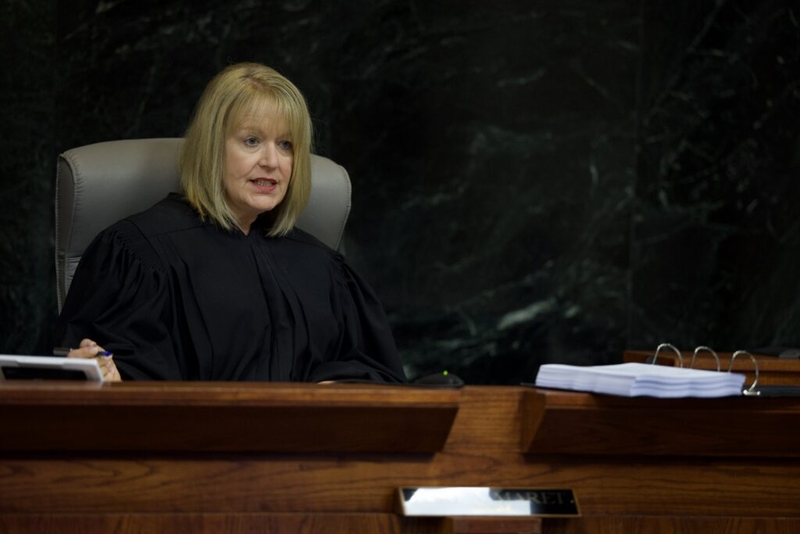
Lancaster County District Judge Lori Maret listens to attorneys during a hearing where the Nebraska Attorney General's Office is challenging a Lincoln city ordinance enacted in response to a new state minimum wage law at the Lancaster County Courthouse on Thursday, July 2, 2026, in Lincoln. (Pool photo by Kenneth Ferriera/Lincoln Journal Star)
LINCOLN — A district judge Friday blocked the city of Lincoln from starting a local minimum wage that would pay a different rate than the state’s.
Lancaster County District Court Lori Maret granted a temporary injunction in Nebraska Attorney General Mike Hilgers’ lawsuit a day before the state’s new minimum wage law takes effect. Maret wrote in her eight-page order that Hilgers has standing to sue. She did not rule on the merits of the case.
Hilgers sued Lincoln in June after the City Council approved an ordinance to maintain a $15 minimum wage for all workers and allow higher annual increases in line with a 2022 statewide ballot measure voters overwhelmingly approved. That put the city ordinance at odds with the state’s new law the Legislature approved this year that weakened the voter-approved increases. The state law allows employers to pay 14- and 15-year-olds $13.50 an hour, and makes a 90-day training period for 16- through 19-year-olds to be paid that lower rate. The state law also caps the yearly increase at 1.75% per year instead of a cost-of-living index.
Lincoln City Attorney Yohance Christie argued during a July 2 hearing that the city ordinance won’t hurt the state because it’s a local issue, and pointed to the majority of Lincoln residents that voted for the 2022 ballot measure. Yohance also argued that the city is within its rights to set a wage rate above the state’s “floor.”
Maret, however, cited a New Mexico case regarding minimum wage, and said she believes the ordinance is likely a matter of statewide concern.
The judge wrote that the state would be “irreparably harmed” if the ordinance contradicted state law.
“The remaining two elements — the balance of the hardships and the public interest — do not weigh strongly for or against a temporary injunction. Both sides are similarly interested in enforcing their own laws,” Maret wrote. “They will suffer a similar hardship if their laws are not enforced during the pendency of this case. The public interest is simply that the law be enforced.”
The District Court judge denied the state attorneys’ request to block both the ordinance and any similar or subsequent ordinances related to wages — saying it was “overbroad and under-specific in several respects.” She limited her ruling to the one ordinance before her.
That means it won’t affect Omaha’s recently passed ordinance, which keeps that city’s minimum wage at $15 an hour for all workers.
“If the city enacts another minimum-wage ordinance, then the validity of that ordinance can be challenged at that time,” Maret said. “Also, whether an ordinance is ‘similar’ to another ordinance is not a specific standard.”
Lincoln, NE