Redistricting arms race, closed primaries not good for democracy
Jun 02, 2026 | 5:00 am ET
Description
Redistricting and other electoral actions are impacting turnout. (Getty Images)
In July 2025, President Trump kickstarted a round of mid-decade redistricting when he encouraged Texas to engage in a partisan gerrymander — “a very simple redrawing, we pick up five seats.” Trump learned a dangerous lesson from 2020 — it is easier to engineer an outcome before an election than trying to “find” more votes afterwards.
After this call to arms, more than a dozen states have redrawn the geographic boundaries of their legislative districts ahead of the 2026 midterm elections. This is a failure of both parties — but as the dust settles, it appears that Republicans will pick up a net advantage of ten seats before a single vote is cast.
How did we get here?
Part of the blame should lie with the U.S. Supreme Court. In the 2019 case Rucho v. Common Cause, the court abdicated responsibility permitting states to engage in egregious partisan gerrymandering. More recently, the Supreme Court further gutted the Voting Rights Act in Louisiana v. Callais et al. Taken together, the Supreme Court has created a landscape where self-interested partisans prioritized their own jobs and the fortunes of their political party above principle or voters.
Many Southern states saw this as an opportunity to dilute the voting power of racial minorities and pick up additional Republican seats – even in places where voting was already underway. Senate Republicans in South Carolina, however, were able to defeat this push to implement new maps. What lessons can or should they learn from Indiana – where, similarly, Senate Republicans thwarted a mid-decade redistricting attempt?
Ahead of our recent May primary, President Trump posted to social media, “There are eight Great Patriots running against long seated RINOS [Republicans in Name Only] — Let’s see how those RINOS do tonight! President DONALD J. TRUMP.”
US Supreme Court limits use of race in congressional district remaps, diluting Voting Rights Act
Our primary results would suggest that standing up to President Trump has imminent electoral consequences.
Six Trump-endorsed candidates were able to defeat Republican incumbents who opposed redistricting, pending two recounts. A closer examination, however, might tell us that gobs of money and political pressure can lead to a small, unrepresentative pool of the electorate supporting mid-decade redistricting. More than $13.5 million was spent on state Senate races. That is a 5,000% increase since the 2024 primaries. Yet only 17.30% of registered Hoosier voters turned out to the polls. In these eight races, that amounts to $2,386 per vote for the Trump-endorsed candidates (or $1,394 per all votes cast). That’s obscene. That is also on brand for a state with a documented democracy problem.
Two recent events highlight how far Indiana is away from free and fair elections where all voters, not politicians or a small unrepresentative group of party insiders, make decisions.
First, the results in Senate District 23 are still pending a recount. While incumbent Spencer Deery, R-West Lafayette, has a narrow lead of 3 votes, his Trump-endorsed challenger Paula Copenhaver is claiming that votes were “illegally cast” by progressives. As a result, many Republicans are renewing their call for closed primaries — which would exclude political independents who amount to almost half of all Indiana registered voters. It would also limit opportunities for voters to cast a ballot in a meaningful race when so few of our general election races are competitive.
The second event is the upheaval in the Republican Secretary of State race.
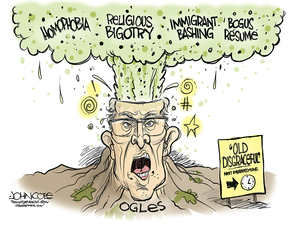
In spite of a rash of controversies, only recently did U.S. Sen. Jim Banks, Attorney General Todd Rokita and other Republican elites abandon incumbent Diego Morales. While Morales is (and always has been) unfit for office, the hubris to weigh in now when the party faces the possibility of losing the race to Democrat Beau Bayh or independent Greg Ballard highlights the undemocratic nature of how Indiana elects many of its statewide officials. A small group (about 1,800) of delegates to the state party convention will choose between Morales, David Shelton, Jamie Reitenour, and Max Engling. Indiana is one of less than a handful of states that utilize conventions and not primary elections to select party candidates for statewide offices.
In the last six months, Hoosiers have seen their leaders attempt to redraw legislative districts prematurely just to gain a partisan advantage, utilize millions in out-of-state funds to overwhelm our elections, threaten to change election laws to close primaries to engineer a desired outcome, and let a small group of party elites and an unrepresentative group of party delegates choose nominees for statewide office.
No wonder Hoosiers can rarely be bothered to turn out to vote. Until these things change and voters are given and take advantage of meaningful opportunities to participate, Indiana will be a democracy in name only.
Indianapolis, IN