Early data, observations at polls signal high voter turnout in Maine’s primary election
Jun 10, 2026 | 4:18 pm ET
Description
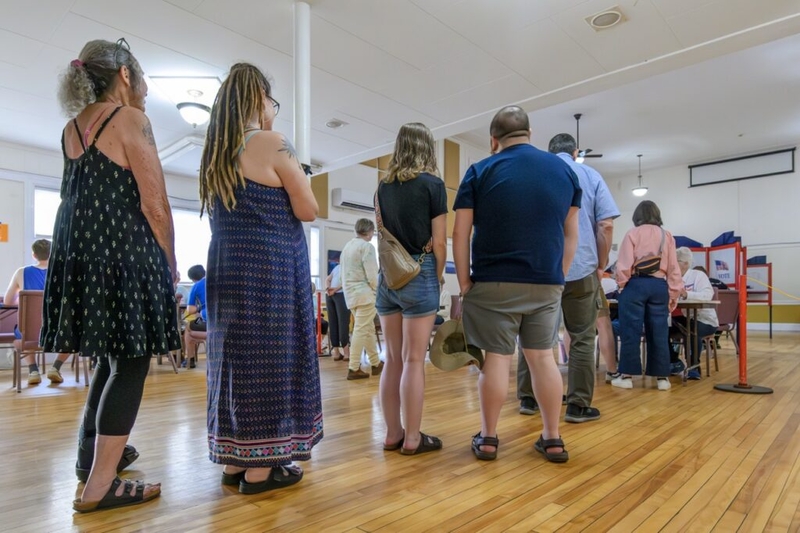
Voters wait in line at the Woodfords Club in Portland, Maine during the June 9, 2026 primary election. (Photo by Jim Neuger / Maine Morning Star)
Some Maine polls ran out of ballots and saw long wait times during Tuesday’s primary, illustrating the interest in the many crowded, and in some cases nationally watched, contests.
Chief Deputy Secretary of State Kate McBrien said she knows of at least three towns that ran out of ballots — Portland, Westbrook and Kennebunkport — at some point Tuesday. (State law stipulates that only law enforcement is authorized to deliver more.)
Some towns ran out of local ballots but not state ones, or vice versa, McBrien said. Buxton ran out of local ballots, for example.
At least 11 polling locations had greater than ten minute wait times to vote and several towns had wait times of 45 minutes, including Camden, Falmouth, multiple locations in Portland, Poland, Waterboro, and Yarmouth. That’s according to the League of Women Voters of Maine, which deployed nonpartisan volunteer election observers to various polling locations.
As McBrien traveled throughout the state on Tuesday, she said she consistently saw steady lines, which poll workers told her had been the case all day. In many places, there was a noticeable absence of the usual lulls between meal times. Several municipalities also had lines forming outside before the polls had opened.
“That’s not totally unusual,” McBrien said of the latter, “but it does show people who are eager to vote.”
It’ll be weeks until the statewide turnout totals are known (by law, Maine has 20 days after an election to report certified results, though the breakdown from there on things like turnout may take longer). But, these anecdotes from the polls and absentee voting data provide some initial insight.
The total number of absentee ballots that ended up being requested for the primary were 93,571, and as of the latest data from 5 p.m. Tuesday, 84,181 had been returned and accepted.
That’s about three times the number of people who voted by absentee ballot during the last midterm election in 2022. However, Maine began offering semi-open primaries in 2024, meaning unenrolled voters can choose one political party’s primary to vote in.
In this year’s primary, Democrats outpaced Republicans in early turnout. Roughly 72% of absentee ballots returned had been for Democratic contests, while about 22% were for the Republican primary.
But those figures include independent voters who weighed in. Unenrolled voters chose to vote in the Democratic Primary roughly three-to-one based on absentee figures.
While the Maine Democratic Party touted the distinction as demonstrating independent enthusiasm and momentum for their candidates heading into November, it could also be that independents chose to weigh in on Democratic races because there were more competitive elections on that side of the aisle.
That’s what Jeremy Gruber from Open Primaries, a national organization pushing for increased access for independent voters in primary elections that was a key leader in the effort to create semi-open primaries in Maine, believes.
For example, the Democratic primary for Maine’s U.S. Senate seat that Graham Platner won garnered significant national interest due to the seat being considered key to the balance of power in Congress and a week of fresh controversies leading up to Election Day.
“If the Democrats think that somehow that means that there is now a long-term alliance between Democrats and independents in the state of Maine, they have another thing coming,” Gruber said. “Independents are, have historically been, in Maine and around the country the most volatile of voters.”
Augusta, ME