Puna Murders Raise Questions About Restraining Order Process
May 29, 2026 | 6:01 am ET

Description
Photo courtesy of Honolulu Civil Beat
After Jacob Baker was caught following a more than 24-hour manhunt, questions still swirled about why he may have brutally murdered three people in the Puna area and what could have been done to stop him.
Three days before the first body was found, two women who said they’d been threatened by Baker applied for temporary restraining orders in the Third Circuit District Court in Hilo. Their applications were denied by a judge.
Whether or not a restraining order would have made a difference in this case is speculation. But the fact that the women's TRO petitions were delayed over the weekend only to be rejected raises questions about the process and what recourse people have when they believe they are in danger.
The state Judiciary doesn’t publish statistics on how often TROs are granted or denied, but lawyers who represent people in these cases say that, in their experience, judges approve a majority of TRO petitions, preferring to err on the side of caution if a person could be in danger.
“If push comes to shove and they’re in doubt, they’ll probably grant it,” said Steve Cedillos, a criminal defense and family law attorney in Honolulu, “They don’t want anything to come back on their watch.”
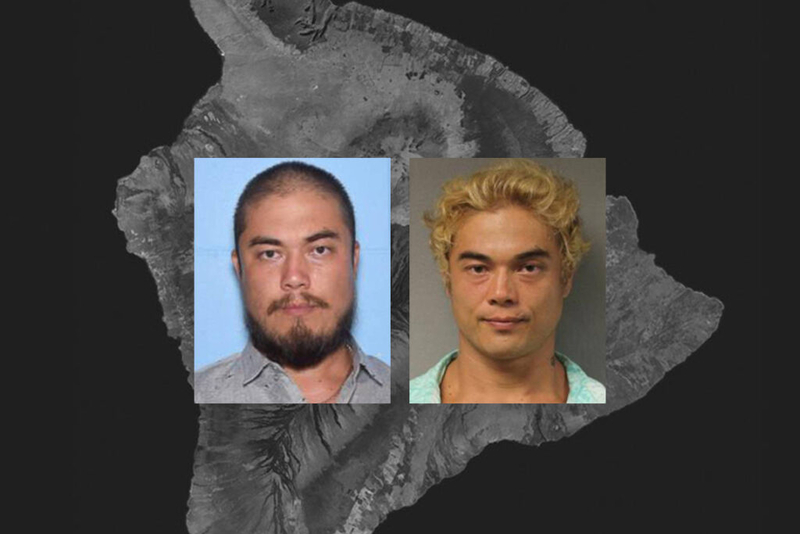
Baker, the 36-year-old now charged with murder in connection with three deaths, appears to have begun his alleged killing spree Monday night. He is accused of killing 69-year-old Robert Shine, 79-year-old Chitta Morse and 69-year-old John Carse.
The killings have rattled the close-knit community and left many frustrated with how slowly information was released to the public.
Police launched an islandwide manhunt Wednesday morning that culminated with Baker’s arrest at around 2:30 p.m. Thursday after he was spotted in a field and then found hiding in a small cave.
Most Petitions Are Granted
Petitions against a family member or intimate partner are filed in Family Court and often deal with allegations of domestic violence, while District Court handles TRO petitions involving people who are not related, such as neighbors or acquaintances.
Petitions filed in District Court are less likely to be granted than TROs in Family Court, said William Dean, who owns ʻOhana Law Firm in Hilo. Precisely why isn’t clear to him, but he said that shouldn’t be the case. While petitions in Family Court are sometimes filed in an attempt by parties in a custody or divorce dispute to gain an advantage, District Court TROs are less likely to be motivated by self-interest, according to Dean.
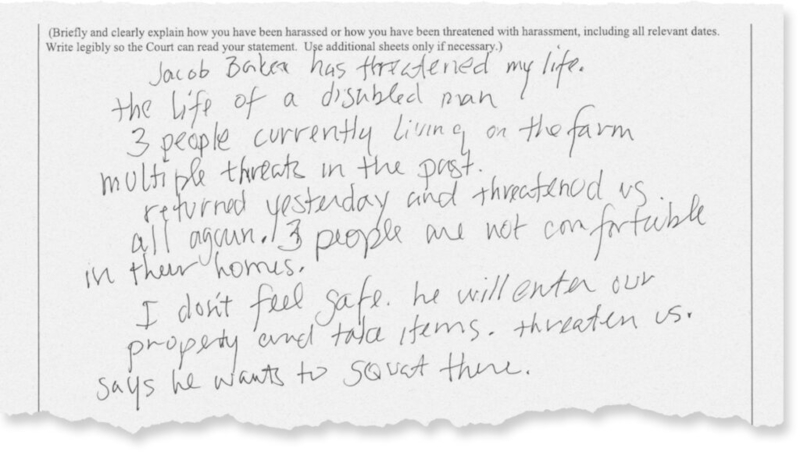
A judge can grant or deny an initial petition for a temporary restraining order as soon as it’s filed. The bar at that point is relatively low. Judges only need to determine whether there is probable cause, meaning it’s more likely than not that physical harm, injury or assault occurred or that such harm is imminently likely to occur. People asking for protection submit a sworn affidavit explaining the allegations and outlining specific circumstances.
If the petition is granted, a hearing within 15 days determines whether the order can be extended beyond an initial period of 90 days. Orders in District Court can be in place for up to three years. In Family Court, they can last much longer, even decades.
Judges weigh a number of factors, including whether there is a pattern of harassment or a history of violence. Baker, for instance, did not have a record of violent crimes, although he had received several DUIs and a handful of low-level charges.
It’s also helpful if petitioners have legal representation, according to Dean. Lawyers who handle these cases say that it helps if the person petitioning the court for protection can specify examples of harassment, including dates and as much detail as possible.
But ultimately, Cedillos said decisions come down to a particular judge’s discretion.
“At least half of it, I think, comes down to the judge,” he said.
He recently had a case in which two neighbors in a condo building got into an argument in an elevator. The altercation wasn't physical, but as his client got out of the elevator on his floor, one of the people promised to settle the dispute later — something the judge who granted the initial petition viewed as a threat. At the hearing, the trial judge disagreed and the order for extended protection was thrown out.
Retired Judge Robert Mark Browning, who served for more than a decade in Oʻahu’s Family Court, said TRO petitions are unlike any other court proceeding because a judge has to decide based on only one side.
“You’re issuing an order against someone, if there’s enough there, without them present, and so that makes it different, extraordinary,” he said. “The constitutional safeguard is that a hearing is immediately set to review that order so that both sides can present their cases.”
Browning said he approved the vast majority of TRO petitions that came before him in Family Court, particularly if the person said they were directly threatened by someone — and recently.
“If somebody says, ‘I was threatened by this person,’ that’s enough to bring it to a hearing,” he said.
Both of the TRO petitions filed by the women in Puna said Baker had threatened them.
“Jacob Baker has threatened my life,” wrote petitioner Janelle Honer.
A second petitioner, Angelia Romero-Hanson, wrote that Baker had threatened to kill other women living on the farm where she was staying.
But the judge, Michelle Kanani Laubach, denied both due to “insufficient evidence.”
Judiciary spokesman Brooks Baehr did not respond to questions about why the judge denied both applications.
‘Just Pieces Of Paper’
Dean said it’s unlikely having a TRO would have made a difference in this case.
“TROs are just pieces of paper at the end of the day,” he said. “If somebody's going to kill somebody, they're not necessarily going to be dissuaded by an order. But it could.”
Multiple high-profile killings in recent Hawaiʻi history have involved TROs.
Theresa Cachuela, a young mother, beautician and social media influencer, was fatally shot by her estranged husband days before Christmas in 2023 despite having an active TRO against him. She had called police at least three times in the weeks leading up to her death to report her husband violating his order.
Weeks later, a 42-year-old woman on the Big Island was killed by her ex-boyfriend even though she had a TRO against him.
On Maui in 2024, Janinekara Sturgeon was stabbed to death by her boyfriend four months after obtaining a restraining order against him.
Between July 2023 and June 2024, nearly 3,000 TROs were filed in district courts across the state — more than 800 of those on the Big Island alone.
While TROs can be easily violated and don’t always stop perpetrators from harming their victims, they are important tools to provide additional protection to victims, Browning said. Anyone caught violating a TRO, for example, by contacting their alleged victim or showing up at his or her house, can be immediately arrested and charged with a crime.
“It’s 100% better than not having one, for safety reasons,” he said. “If that individual has violated, they go to jail and get charged with a crime.”

Honolulu, HI