NC Democratic Party leader Anderson Clayton runs to the problem – engaging voters
May 29, 2026 | 6:01 am ET
Description
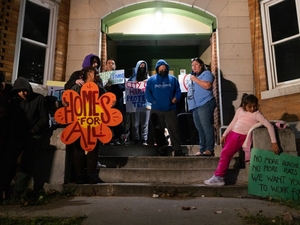
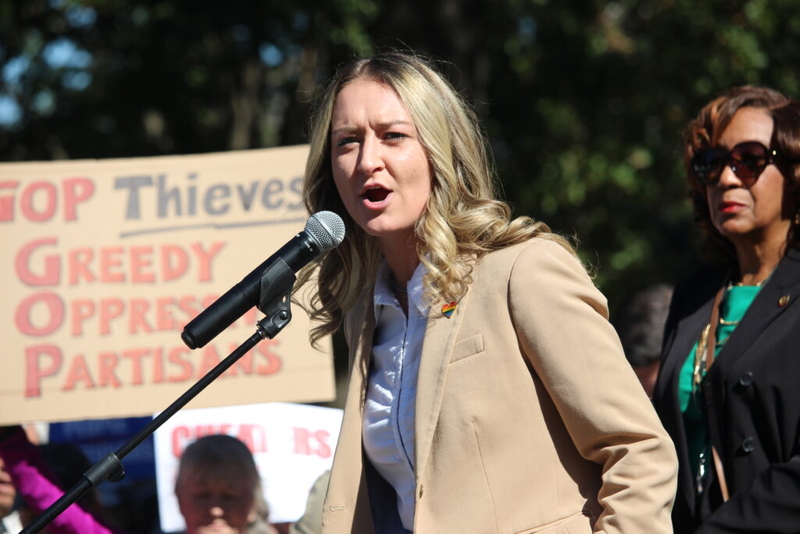
North Carolina Democratic Party chair Anderson Clayton speaks to supporters protesting the state's new Republican-drawn congressional map outside the old State Capitol building on Oct. 21, 2025 in Raleigh. (Photo: Galen Bacharier/NC Newsline)
Anderson Clayton, head of the North Carolina Democratic Party, has ambitious goals for a party eager for success after losing control of the state legislature in 2010 and the state Supreme Court in 2022.
Appeal to rural voters. Increase Black voter participation. Notify voters if they need to add government ID numbers to their registration. Make sure legal voters don’t have their ballots thrown out. And of course, help Democrats win more elections in a state where Republicans hold majorities in both chambers of the General Assembly and the appellate courts.
She added to the list this year an attempt to convince the Democratic National Committee to make North Carolina one of the states that will hold its 2028 presidential primary before Super Tuesday.
She was in Washington, D.C., on Thursday, hitting the DNC Rules and Bylaws Committee with her characteristic blizzard of words as she championed North Carolina as an early primary state.
“Thank you for your energy,” a committee member said as the questioning ended. “Everyone is awake now.”
In Washington, Clayton emphasized many of the themes she discussed in an interview with NC Newsline this week, which included gaining back ground in rural areas and engaging Black voters.
An immediate measure of any success will be whether Democrats are able to win more seats in the state legislature this year, and help Democratic Supreme Court Justice Anita Earls win a second term.
North Carolina early primary voting surges ahead of 2024, driven by Democratic enthusiasm
Historical patterns, the national mood, and demonstrated voter interest point to a good year for Democratic candidates.
The president’s party nearly always loses seats in midterm elections. A clear majority of state voters told pollsters in March that the country is moving in the wrong direction, and judging from the primaries, Democrats appear to be more motivated than other groups to vote this year.
Participation in early voting surged this year, driven by Democratic and unaffiliated voters, NC Newsline reported. In the count of all primary ballots, turnout for registered Democrats was close to 25%, turnout for registered Republicans was about 20%, and for unaffiliated voters, more than 15%.
Gerrymandering gives Republicans an edge
However, Democrats still face strong headwinds in North Carolina, chief among them gerrymandered legislative districts that give Republicans advantages.
An analysis of the legislative districts by the Quantifying Gerrymandering group at Duke University found that the legislative maps would preserve the Senate’s supermajority and maintain the House Republican majority even if Democrats win more than half the votes statewide.
Still, Clayton said Democrats are expecting to gain at least five more seats in the state House, which would bring their total to 54 members out of 120.
Candidate recruitment has been key, Clayton said. “I do believe that the biggest thing the party has to do right now is recruit good candidates and make sure they get elected,” she said, adding that it’s an outgrowth of building up county parties and beefing up community organizing.
“One of the main things that I wanted to see when I came into this job was a year-round organizing program, because I didn’t want a campaign to just pop up every three months or even six months before the election cycle,” she said.
Clayton has been the state party’s chair since February 2023.
The party has six full-time regional organizing directors whose job it is to build up county parties and help them with voter outreach — whether it’s knocking on doors or hosting meetings at locally-owned small businesses.
Reaching rural voters
Getting the Democratic party and its candidates to reengage with rural voters has been a top priority for Clayton’s tenure as state party leader.
“It’s not been a process that I knew was going to happen over a short period of time because the failures didn’t happen over a short period of time,” she said. “Rural North Carolina didn’t leave us overnight, but we’ve got to invest in it for the long haul,” she said.
That’s meant contesting nearly every legislative seat, she said. “People in rural North Carolina are finally going to have a Democrat to vote for.”
Despite these efforts, Democratic party registration in North Carolina fell below Republican registration this year for the first time. And voter registration in both major parties is now outnumbered by people who choose to register as unaffiliated.
Young people are choosing to register unaffiliated because “they’re fed up with the political system” and “no party wants to help them,” she said.
“That’s something that our party has to prove, that we’re actually the party of help,” Clayton said. “And I need to trust my Democratic elected officials that when they’re in positions of power, they’re going to do good with that power because that’s what voters want to see right now from each party.”
Since peaking at 73% in the state during Barack Obama’s first presidential run in 2008, Black voter turnout has slipped below 70% in general elections since Obama left office.
Clayton points to gerrymandering as one of the factors causing Black voters in rural counties to tune out. Republican legislators approved districts in eastern North Carolina to give their candidates a better chance of winning, and in some cases they eliminated districts where Black voters had a chance to elect the candidate of their choice.
Gerrymandering disenfranchised the Black and brown voters who have lived in the eastern part of the state for generations, she said. Moreover, the district boundaries changed so often, voters no longer knew who represented them.
“It’s made people alienated from the political process,” Clayton said.
To reach the goal of making North Carolina an early primary state in 2028, Clayton has to win agreement from the Republican legislators she’s been criticizing to change the primary date
She argues that an early primary would benefit both parties. It would mean significant campaign spending in the state and give an economic boost to parts of North Carolina that need it, particularly western and eastern counties.
“I speak green, and I think Republicans do as well,” Clayton said.
So far the GOP seems uninterested.
No one has filed a bill this session to change the date of the 2028 primary. The offices of House Speaker Destin Hall and Senate Leader Phil Berger did not respond to an email seeking comment.
Raleigh, NC