Providence’s Superman building takes flight with $10M more in public incentives
Aug 24, 2026 | 6:03 pm ET
Description
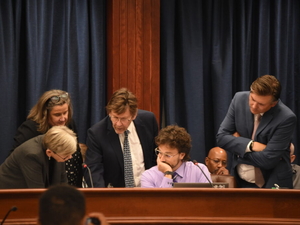
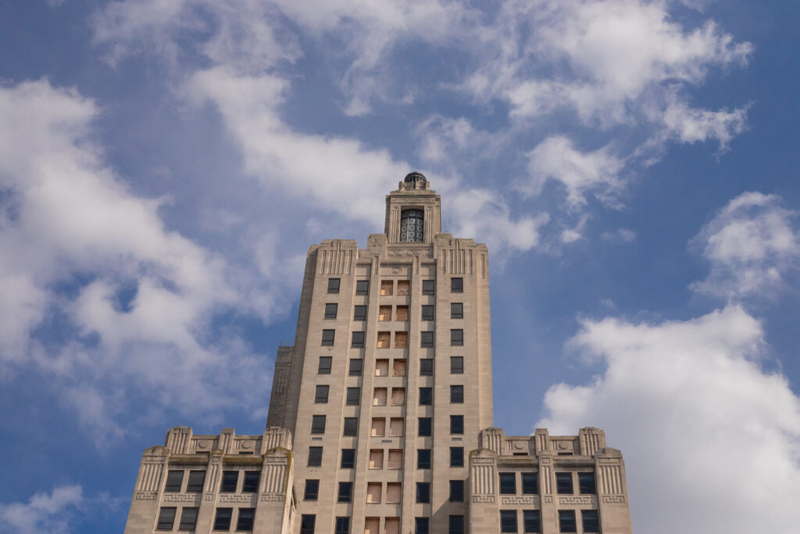
A unanimous vote Monday, Aug. 24, 2026, by the Rhode Island Commerce Corporation Board of Directors for a pair of state incentives totaling $9.5 million breathes new life into the 26-story skyscraper at 111 Westminster St., Providence. (Photo by Alexander Castro/Rhode Island Current)
The cost to redevelop Providence’s iconic Superman building has multiplied, and so has the state taxpayer-backed financing.
Rhode Island Commerce Corporation on Monday approved nearly $10 million in additional state incentives intended to help High Rock Development complete the $327 million transformation of the vacant office skyscraper overlooking Kennedy Plaza.
The requested subsidies were made public via meeting notices four days earlier as first reported by The Boston Globe. The dollar figures of public subsidies requested were not made public until an hour before the economic development agency’s 5 p.m. board meeting.
“I have just as many questions as you,” Karl Wadensten, a Commerce board member, said in an interview four hours before the full board met Monday afternoon.
Yet the appointed panel, chaired by Gov. Dan McKee, gave swift consent to public financing for the project, which aims to breathe life into the 26-story office tower at 111 Westminster St. The unanimous vote for a pair of state incentives totaling $9.5 million came within 25 minutes.
“Our contribution will help to leverage that if the developer is successful at the federal level,” Commerce Secretary Stefan Pryor said, while stressing that the state dollars will not “flow” until after the project is built and completed.
“Taxpayers are protected in this very important matter,” he said, noting that state incentives authorized through Commerce now represent a smaller share of the total project cost. The developer is also upping its contribution, backed by private equity, from $32 million to nearly $52 million.
Wadensten cited the “clarity and the safeguards” as reason for his change of heart during the meeting, noting his initial skepticism.
Nicknamed because of its resemblance to The Daily Planet newspaper building where Clark Kent worked in the 1950s TV show, the Superman building has been empty since 2013, when Bank of America moved out.
In 2022, the state inked a deal with High Rock to remake the bank building as a 285-unit apartment complex, with 20% of units designated as affordable housing, and first-floor commercial space. The agreement included $65 million in state and city financing for the $220 million project, also funded through private equity, and potentially, a federal transportation loan.
Why so expensive?
Supply chain woes, inflation, and interest rates have “conspired” to increase costs for projects nationwide, Pryor said during the meeting. Providence is no exception, with the new, $327 million price tag representing a nearly 50% cost hike, along with a slight increase in total residential units to 308.
Much of the cost difference will be covered through a $160 million low-interest loan through the U.S. Department of Transportation, which was recently greenlit for credit underwriting after program rules were rewritten by the Trump administration, Pryor said.
The state financing includes $4.5 million in sales tax rebates for construction costs. The tax credits were unveiled in the 2025 legislative session, when the developer asked, and lawmakers agreed to, raise the cap on credits issued through the Rebuild Rhode Island tax credit program to let the project qualify for additional rebates. It already received $15 million in 2022.
A month after the end of the 2025 legislative session, High Rock’s principal, David Sweetser, died, casting more uncertainty over the project.
A replacement manager from inside the company was named in August 2025, but there has been little visible progress since then. The last work permit filed with the city of Providence, to install a temporary boiler in the alley outside the building, was approved in December 2025 and expired in June.
High Rock now expects to qualify for construction-based tax credits from fiscal 2028 to fiscal 2032 — two years behind the prior schedule, according to a state budget memo included in the public documents. While credits are approved up front, refunds aren’t returned to recipients until after projects are completed and certified under state laws.
There are also conditions attached to a separate $5 million chunk from the state’s First Wave Closing Fund, including a public impact analysis prepared by Commerce that considers job creation and taxpayer risk.
The First Wave Closing Fund was created in 2015 to provide “lynchpin financing unavailable from other sources” for projects that are “of a critical or catalytic nature for Rhode Island’s economy and community.” The program can include state budget funds, federal or private contributions, and repayment of principal and interest from other loans made through the funds, according to state law.
High Rock was awarded $7.8 million through the First Wave funding in 2022. If the developer sells the property, there is an opportunity for “modest” repayment to the state, Pryor said.
McKee weighs in
Labor agreements ensure the project will be built with union labor, a key selling point to McKee, who as an ex-officio member of the Commerce board only votes to break a tie.
“I really want this project to go,” McKee said. “I think it’s a critical issue that we pull the trigger, so to speak, when the opportunity is there.”
McKee continued, “But look, we can’t box in this type of investment forever.”
Asked by McKee about the project timeline, Michael Crossen, High Rock’s manager, said the company expects to finalize the federal transportation loan by the end of the year. He did not provide an expected completion date, but emphasized the company’s commitment and investment in the property.
The property was valued at $13.5 million in 2026, according to the city assessment database. A 30-year tax deal made between the developer and the city of Providence in 2022 would save the developer $29.4 million in city property taxes over the next 30 years if the development is completed. The payment schedule assumes the regular payment of $500,000 in annual property taxes — undiscounted — through 2026, with discounts beginning in 2026 as the property value increases alongside its redevelopment.
The project is one of many points of disagreement between Providence Mayor Brett Smiley and his Democratic challenger, Rep. David Morales.
Smiley remains supportive of the project, while noting the incentives approved Monday are state-governed programs, not part of the city’s purview.
“While the incentives being considered today are state programs, the Mayor supports Rhode Island Commerce’s efforts to help this project to move forward — creating hundreds of new homes and import jobs along the way,” Carl Austin Miller Grondin, a spokesperson for Smiley, said in an emailed response.
Morales has criticized the developer for lack of transparency and the cost for the affordable apartments — half of which are capped at 120% area median income (AMI), or $94,124 for one person living in Providence under the original agreement.
“Unless High Rock will be offering more affordable housing units for households at 80% AMI, we should not be granting further subsidies,” Morales said in an emailed statement.
Minutes after the Commerce board vote Monday, Bill Fischer, a spokesperson for High Rock, issued a statement of thanks.
“We are excited about the opportunity to bring the project’s many benefits to the community, including much needed housing, hundreds of jobs and the reinvigoration of Downtown Providence and Kennedy Plaza,” Fischer said.

Providence, RI