Zach Lahn calls for state regulation of data centers, surveillance cameras
Aug 24, 2026 | 6:17 pm ET
Description
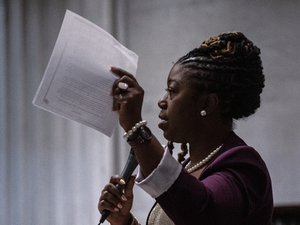
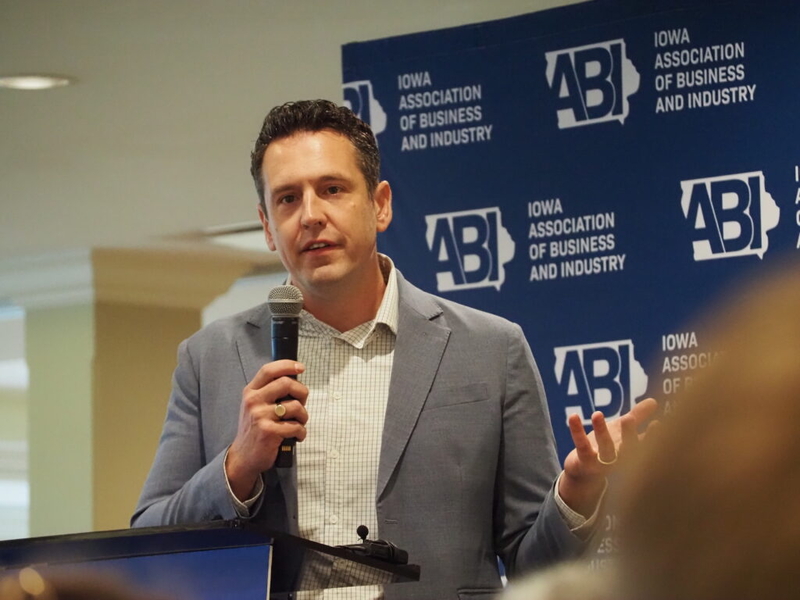
Iowa Republican gubernatorial candidate Zach Lahn gave a speech and answered questions at a candidate forum Aug. 24, 2026 hosted by the Iowa Association of Business and Industry in West Des Moines. (Photo by Robin Opsahl/Iowa Capital Dispatch)
Zach Lahn, the GOP nominee for Iowa governor in 2026, said Monday many of the major concerns about new technologies like data center power use and Flock cameras are issues that need to be regulated at a state level.
Lahn, a businessman, spoke about his gubernatorial campaign and answered questions at an Iowa Association of Business and Industry candidate forum in West Des Moines. His general election opponent, Democrat Rob Sand, spoke to ABI members in June at the organization’s conference. ABI staff said Lahn was invited to speak at that event, but could not attend.
The Republican candidate said Monday he came into the race as an “outsider” and first-time candidate. Lahn said his “Iowa first” vision, which focuses on improving quality of life and encouraging young people to stay and live in the state, was a message that has resonated with GOP primary voters and Iowans overall.
Prioritizing Iowa would also be a staple of his economic policy if elected, Lahn said at the forum. For example, he criticized a multinational company, which he did not identify but said has been “given a tremendous amount of refundable tax credits by the government,” then went onto sue a “third generation Iowa company.” Though the Iowa company eventually won the lawsuit, he said the government subsidized the larger company.
“If you look at some of these tax incentives we’ve been giving as a state, oftentimes we’re incentivizing companies that are competing against Iowa’s homegrown businesses,” Lahn said. “… It doesn’t make sense. We have scarce resources we’re trying to allocate as a state. If we want to build a culture, we’ll invest in Iowa’s homegrown businesses first.”
Lahn has also made previous comments saying he would place new restrictions on foreign workers with certain nonimmigrant U.S. work visas, and called in a campaign ad for H-1B visa holders to be banned from employment by Iowa state government and universities. Sand has cited this ad from Lahn in his own campaign events, quoting “Iowa jobs are for Iowans,” as he and other Democrats have criticized Lahn for having lived in and registered to vote in Kansas, and for continuing to make trips to the state using his personal airplane.
At the ABI event, Lahn was asked about his approach to energy policies specifically related to data centers. The candidate has said he would support a temporary moratorium on data centers, and said he believes the focus needs to be on how a data center will improve the Iowa communities where they’re located.
“I’m not someone who’s saying we should ban (data centers) outright, I don’t think that’s the case. I’m trying to bridge this gap of saying that a temporary pause, a moratorium, to get the rules of the game in play, to be able to say that if you’re going to come to Iowa, the question you need to answer for Iowa citizens is, ‘how are you going to benefit all Iowa?'”
In April, Lahn told the Des Moines Register he would support raising taxes on Iowa data centers by five times to lower property taxes.
Lahn said at the ABI conference his approach to data centers would involve no tax incentives for data center companies, requiring the companies to pay for their electricity use, and requiring the companies “make sure that the environmental concerns are addressed and taken care of.” He also said he believed environmental concerns could be an area where data centers could find inroads with Iowa communities by taking steps to improve water infrastructure.
He said he met with a company that didn’t know Iowa faced water quality issues, and told them, “You really want to make a difference when you go to a community, offer to build a nitrate removal system on the water supply, and then deliver the water to the municipality.”
“And it’s like a light bulb went off with their engineer,” Lahn said. “And now I’ve had a couple different conversations about this directly, where they say, ‘we think we can actually do this.’ You do that, you’d be a totally different story in our communities. People would actually be saying, ‘Wow, you’re here to benefit me and my kids.'”
Sand has also introduced a data center policy plan which includes several of the same priorities as Lahn has discussed, including limiting tax incentives and having data centers pay for utility costs, as well as calling for “accountability and transparency over new data centers” through public disclosures on energy and water use, as well as the permanent and construction jobs created through the center.
Lahn said the discussion on data centers — as well as about the use of Flock cameras, AI-powered automatic license plate readers which photograph vehicles — are spaces where technology has been implemented in communities before people have had a chance to decide whether the technology is operating legally and fairly. Several Iowa localities have challenged both Flock cameras and data centers through local government actions.
“Tech is way ahead of ‘how do we properly use the tech,’ and you don’t need to go any further than listen to Elon Musk for a little bit of time talk about what’s going to happen with AI,” Lahn said. “… We have real concerns here. So, the state level is where we should adjudicate these things. This is not a federal decision, in my opinion.”
Des Moines, IA