Providence mayoral candidates debate housing, ICE and their vision for city’s future
Jul 24, 2026 | 12:05 pm ET
Description
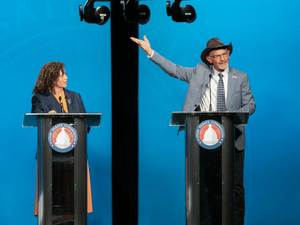
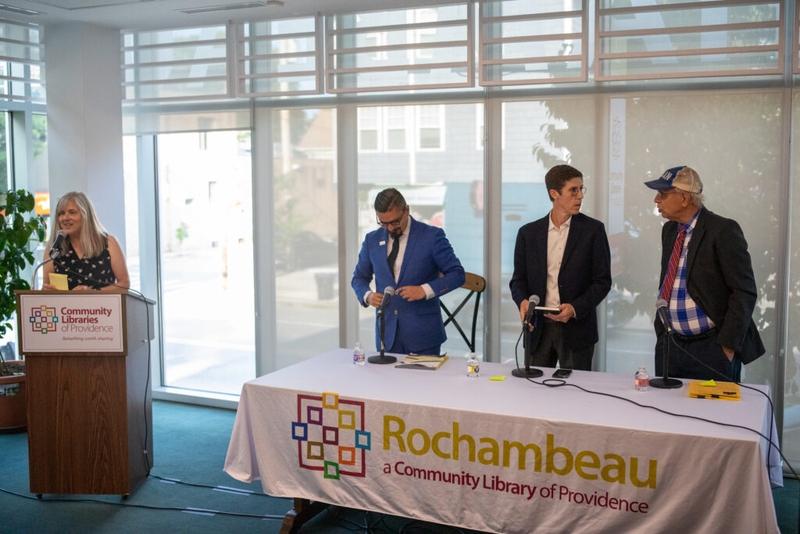
Community Libraries of Providence Executive Director Cheryl Space, left, introduces Providence mayoral candidates (left to right) David Morales, Brett Smiley and Dave Talan before a debate at Rochambeau Library on Thursday, July 23, 2026. (Photo by Alexander Castro/Rhode Island Current)
Is a mayor tasked with managing a city’s realities, or helping make new ones?
These two ways of thinking about governance provided the central tension during a mayoral debate at the Rochambeau Library on Providence’s East Side Thursday evening.
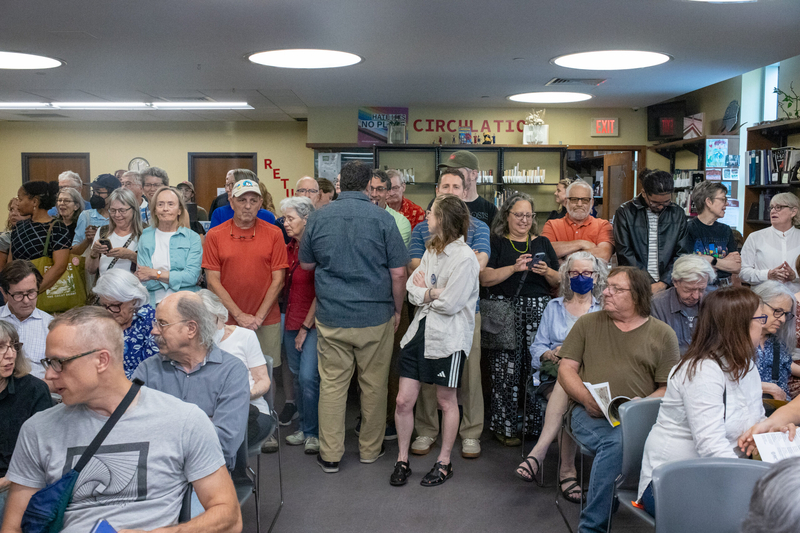
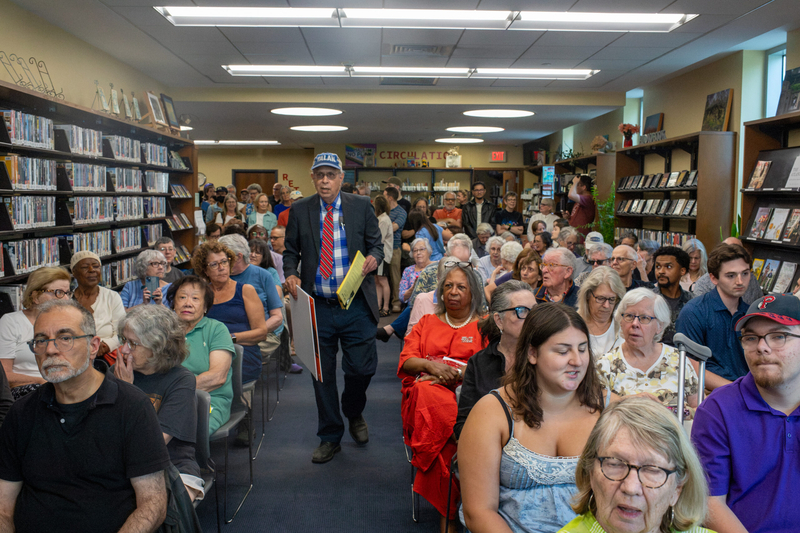
A crowd quickly filled the six dozen or so seats set between the library’s DVD collection and its magazines. There were people standing near the circulation desk. There were people sitting on the floor. There were people standing so far away that they could not even see the candidates.
As if in accidental solidarity, the candidates did not use the chairs provided for them, but instead stood as they made their cases for why they should be mayor.
Since the race’s first debate in April, the contenders have changed, but the protagonists have not. Current Providence Mayor Brett Smiley, 47, will face Providence Democratic Rep. David Morales, 27, in the September primary. The victor will face Republican Dave Talan, 77, the only lifelong Providence resident running, in November’s general election.
Each man used his opening remarks Thursday night to present his vision for the capital city.
Smiley relied on his record as mayor, describing a Providence with less violent crime, streets nearly scrubbed of illegal ATVs and dirt bikes, and new schools and homes popping up citywide. Smiley also noted that his administration has participated in 10 lawsuits against the federal government. He continued to invoke “our crazy President” Donald Trump’s name as evidence he has — and would continue — to protect the city from federal overreach.
“Do we want to continue to make the positive changes that we’ve been making in Providence or do we want to go backwards?” he asked of the crowd.
For Morales, these and other efforts have not sufficed.
“We’re a tight-knit community where neighbors look out for one another,” he said. “And I believe we deserve that same type of care and compassion coming from City Hall.”
Morales floated a question to the crowd: Were they happy with the last four years of Smiley’s tenure? The state representative offered rising housing costs, a “dysfunctional” public works department and an immigrant community afraid of ICE as evidence that not all is well. Morales promised a City Hall that would listen more, intervene more often and communicate more directly with residents.
Talan talked with voters outside the library before the debate began, handing out bilingual fliers printed on bright yellow copy paper which listed his plentiful life experience, from Army service and civic involvement to coaching Little League. He promised to improve city services while reducing taxes and minimizing what he sees as fiscal bloat in the Providence Public School District.
“I’m going to give you more details on how I can fix all the problems in the city of Providence,” Talan said, “and how everything will be fine and dandy in Providence under the administration of Mayor Dave Talan.”
A shortage of silver bullets and secret answers
The event — hosted by Community Libraries of Providence in partnership with the League of Women Voters of Providence, which moderated the debate — was the latest installment in the ongoing rivalry between Morales and Smiley.
The first portion of the event, a prepared question-and-answer session, made clear that the mayor must tackle a long to-do list each day, ranging from the everyday — cracked sidewalks, library hours and the size of trash barrels — to more existential matters like climate change.
Housing questions showcased a familiar split between Morales and Smiley, who have sparred for months over Smiley’s veto of the City Council’s rent stabilization measure.
The mayor has frequently proposed building more as one of his preferred solutions for the city’s housing woes. Providence must work with private developers, Smiley said, to rectify the shortage of housing stock.
“The city cannot subsidize every building, and in fact, we only subsidize buildings that have affordable housing,” Smiley said.
Morales suggested the city squeeze value out of unused properties.
“You go down North Main Street. You go down Smith Street. You go through Elmwood,” Morales said. “There are vacant lots and empty buildings that exist that we should be leveraging as a city and not being solely reliant on the private market.”
Providence “should be able to acquire some of this land ourselves” and craft a public developer model seen in places like Seattle and Atlanta, Morales said.
Talan favored private development and a slim, limited selection of subsidies over more permanent funding sources. Some of the empty buildings downtown, he said, could also be used for schools, not just apartments.
The second portion of the debate involved questions from the audience, including a few from viewers watching online, that drew on an assortment of the city’s most recent issues. Smiley defended protections in the city’s current contract for Flock surveillance cameras, Morales said the city’s existing contract should be scrutinized and terminated if abused and Talan emphasized data privacy.
“I don’t want the data being given to ICE or anybody who doesn’t really need it,” he said.
Smiley and Talan supported the proposed relocation of the Kennedy Plaza bus hub, but Morales promised to listen to rider feedback before moving forward with any plan, citing skepticism that it comprised “a plan [made] without actually consulting with the riders that use it day to day.”
Over the approximately 75-minute debate, Smiley and Morales often diverged as sharply from one another in policy and rhetoric as either did from the Republican Talan.
Smiley opted for a model of nimble management and shrewd acknowledgment of fiscal and administrative limits. One of those constraints is the city’s colossal and unfunded pension liability. Its annual payment is about $120 million, Smiley said, compared with roughly $15 million if the system were fully funded.
“We have a pension fund that is woefully underfunded because of sins of the past, largely from the [Buddy] Cianci administration,” Smiley said, noting the “excessive pensions” doled out during the 1990s.
Still, the city is “making progress,” Smiley said, even if there was “no silver bullet or secret answer” for the problem.
“While it’s not a popular answer, the honest answer is we need to just keep paying the bills,” Smiley said.
Talan largely agreed, saying he wished the city could legally reverse some of the outsized pensions from the past but knew of no way to do so.
Morales had a different take, calling the unfunded pension liability “a serious issue that requires immediate urgency.” He warned that a decade from now, the city could be spending more than $200 million of its budget on the pension liability if nothing changes. Morales proposed exploring voluntary retiree buyouts, merging the city’s pension system with the state’s or renegotiating the payment schedule with labor.
“In just a few years, we will be eligible to re-amortize and refinance this debt,” Morales said. “And we need to do it in coordination.”
Receipts and promises
Smiley answered Morales’ activism by frequently unfurling receipts of his administration’s work, from increased library funding to affordable housing construction and additional resources invested in sidewalks and sustainability. Smiley argued that many of Morales’ proposals amount to but a redux of the current administration’s efforts.
Morales portrayed the programs Smiley has promoted as too small, inaccessible or passive to meet residents’ needs. He argued that teachers remain overworked, transit riders have been ignored, and immigrants feel “abandoned.”
The state rep suggested City Hall should play a more interventionist role, whether creating a public developer to buy up vacant properties and build housing or appointing multilingual liaisons to work with the city’s small businesses that he said feel “disconnected from City Hall.”
Morales also promised to take on “the environmental injustices that are happening in the South Side of our city,” including the industrial strip and port on Allens Avenue where a number of facilities “are literally contaminating our air, our water, and our soil.”
If capacity shaped the perimeter of Smiley’s idea of governance, morality defined Morales’ parallel stance.
When asked whether Providence police should arrest ICE officers who trespass on private property, Smiley noted his policy that Providence will honor only judicial warrants, but not ICE’s “administrative warrants, which are signed by ICE agents who receive almost no training.”
Morales countered, “All across Providence, ICE agents are violating our sanctuary city laws and kidnapping our neighbors.”
Morales accused City Hall of silence when federal immigration officers detained Providence residents. He promised to communicate confirmed ICE activity publicly and pursue legal action against agents who violate the city’s sanctuary laws.
Talan, somewhere in the middle of it all, endorsed Smiley’s policy that the city refuse to assist ICE, framing it as a matter of trust.
“If people are afraid to report to the police because they think they’re working with ICE, we lose a valuable tool,” Talan said. “My observation of going door to door is that ordinary citizens, even ones who were born in this country, would be reluctant to report to the Providence police if they thought they were helping ICE.”
The third and final mayoral debate in the Community Libraries of Providence-hosted series is scheduled for Tuesday, Aug. 4, at South Providence Library.
Providence, RI