Providence leaders propose tax break to spur affordable housing development
Apr 02, 2026 | 4:21 pm ET
Description
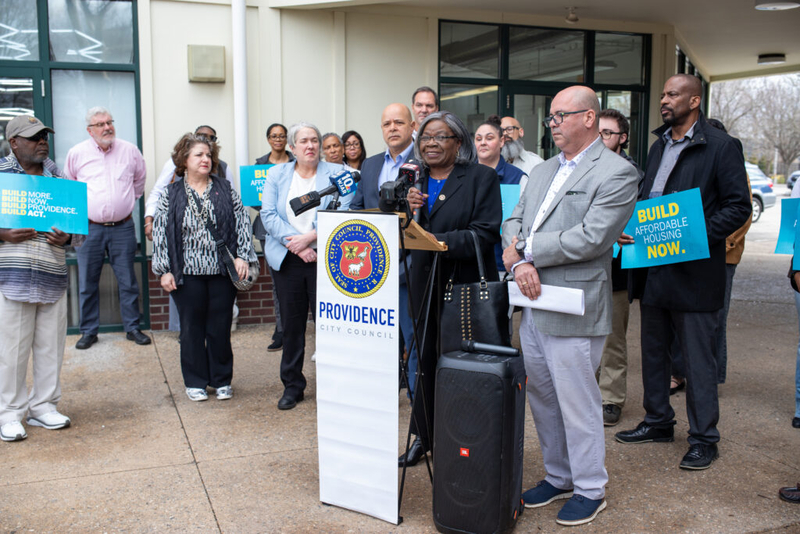
Providence City Council Deputy Majority Leader Mary Kay Harris speaks during a press event announcing the proposed Providence BUILD Act outside an affordable housing development in Providence on Wednesday, April 1, 2026. The ordinance would create a new tax stabilization structure for eligible affordable housing developments. (Photo by Alexander Castro/Rhode Island Current)
Providence City Council leaders have a plan to make affordable housing easier to build in the capital city via a new tax structure for eligible development.
The Providence BUILD Act was announced by Council President Rachel Miller and Deputy Majority Leader Mary Kay Harris during a press event Wednesday outside an affordable housing development on Broad Street. Joined by affordable housing developers and community partners, Miller and Harris underlined why they want to make it easier for developers to build affordable homes.
“We are in the middle of a housing crisis that is pushing out the very people who make this city what it is: working class families, seniors like myself, young people just trying to stay here and build their life,” Harris said. “And when you listen to working people, and when you talk to the folks actually trying to build affordable housing, you start to see where the system is breaking down.”
Low-income housing is currently taxed at a special rate, and municipalities assess properties’ taxes at a rate that equals 8% of their gross scheduled rental income — a provision known as the “8 Law.” But this tax rate only goes into effect once a unit is occupied. During construction and before an initial tenant’s rent begins, the property is taxed at a regular rate.
“Houses can be hit with full property tax bills before a single unit is occupied, before any rent is coming in,” Harris said.
Michelle Wilcox, president and CEO of Crossroads Rhode Island, said at the event that the organization’s Summer Street Apartments project, which now houses around 200 formerly homeless people after opening in October 2025, accrued a $500,000 tax bill during the construction phase.
“That’s money that should be going into housing, into services, into building more units, not into covering avoidable costs during construction,” Wilcox said.
In its current draft, the BUILD Act would offer an alternative to this method of taxation. The proposed ordinance would use a tax stabilization agreement during the gap between building and occupancy for eligible housing projects.
“When projects get delayed, and they often do, that burden grows. … It grows on people who are seeking housing,” Harris added. “So we have to ask, does that make sense? Does that reflect our values? Because if we’re serious about solving this crisis, we can’t be putting up barriers to the very housing we say we need.”
Miller said that, under the two-year agreements, projects needing significant rehabilitation would see taxes equal to 8% of rent receipts, while newly constructed projects would not receive a tax bill until units have been certified for occupancy.
Developers who meet the state’s definition of creating low- and moderate-income restricted housing would be eligible, and at least half of the units in a development would need to fall under this label to be eligible for the tax relief. Projects needing substantial rehab would need to rack up at least $250,000 in costs to qualify, while mixed residential and commercial projects could also qualify if they produce at least six dwelling units and meet the ordinance’s other conditions.
Miller posed the ordinance as part of a larger package of housing-related policies the council has been formulating this year “to ameliorate the affordability crisis that we are experiencing in every neighborhood of our city,” she said.
The ordinance is set to be introduced Thursday night at the City Council’s regular meeting at 6 p.m. The City Council is also expected to take up and vote on the hotly-debated rent stabilization ordinance at the same meeting, after it recently passed successfully out of committee.
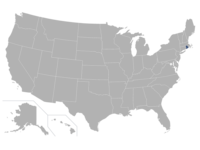
Providence, RI