Once banned from education, she hid her books in a Quran. Now she holds a doctorate degree.
May 26, 2026 | 8:00 am ET
Description
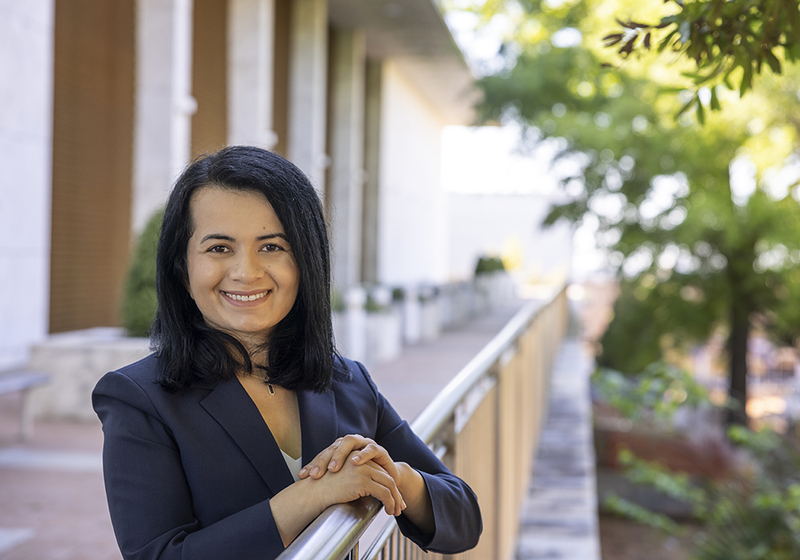
In Taliban-controlled northern Afghanistan, Zo Sediqi first entered a formal classroom at nine years old. Now she has a doctoral degree from the University of South Carolina and works as associate director in the college's career center. (Photo courtesy of USC)
COLUMBIA — As a young girl in Taliban-controlled northern Afghanistan, Zo Sediqi wasn’t allowed to go to school. She was 9 years old when she first stepped foot in a formal classroom.
“There were so many girls, and they were all wearing black dresses with white scarves,” she remembers. “It was just so new.”
Before that, she and her sisters received their education in secret.
It gave Sediqi a great respect for education. Since then, she has built a career around learning, earning her doctoral degree in higher education administration from the University of South Carolina earlier this month.
It was the support of their father that made early education possible for Sediqi and her sisters. Sediqi learned English, a rarity for the region, as well as math from a tutor in their home. Her mother, who had a third grade education, learned alongside them.
Later, Sediqi learned from a tutor who lived a couple blocks away. Walking to her lessons in the city of Mazar-e-Sharif, Sediqi wrapped her books in the cover of a Quran — the only writing women were legally allowed to study.
U.S. military opens opportunities
Then, in 2001, the United States invaded Afghanistan following the terrorist attacks of Sept. 11. With the Taliban driven out, Sediqi could attend school with other girls in the city.
It did take Sediqi some time to adjust to a formal school setting. But her teachers quickly realized she was proficient at reading and math. They advanced her to the fifth grade, and she graduated secondary school at age 16.
As to why her father had paid for her to learn in private at an early age, Sediqi said she’s not sure of his reasons. None of the women in his family had even gone to primary school.
“But probably one of the main reasons is he saw how women were treated in his life. That’s my theory,” Sediqi said.
Sediqi earned many scholarships but anytime there were expenses related to education, her father always said yes.
“Something that he explicitly said is women are more empowered if they are educated,” she said. “If they are financially independent, they will not be abused or have family violence.”
Sediqi’s father moved around the country with her mother until Sediqi was born. That’s when they settled in Mazar-e-Sharif, capital city of the Balkh province south of Uzbekistan, where he opened a pharmacy.
The city is known for its religious and historic sites, primarily the Shrine of Hazrat Ali, also called the Blue Mosque, where visitors and locals come to pray or wander the gardens. Street vendors sell food all around the city center and many people come to feed the flock of white doves that nest near the mosque.
Sediqi said people watching at the mosque as well as wedding celebrations were popular pass times in the city. She, however, preferred to spend most of her time studying and volunteering.
“I was very much heavily focused on learning English, academics,” Sediqi said. “I would get out of home probably at 6 in the morning, and I would come back at like 8 or 9 p.m. I never felt exhausted. It gave me energy.”
Over the summers she watched movies and television shows with the English subtitles on. One of her favorites was “The Pirates of Caribbean.” She liked the character of Elizabeth Swann the best.
“Back then, I watched it and I didn’t know most of what it was saying. I didn’t know the whole story,” she said. Sometimes, to understand a word in the subtitles, “I’d pause it and look it up in the dictionary.”
When she returned to school the following semester, she said her friends would remark on how much her English had improved.

College in Afghanistan and the U.S.
Sediqi said her father had always wanted to be a doctor. He urged his six children, of whom Sediqi is the oldest, to pursue careers in medicine. Two of her siblings — a brother and a sister — are medical doctors, Sediqi said.
By earning her doctorate, Sediqi fulfilled her father’s dream in her own way.
It was in college, studying English at Balkh University, where Sediqi really hit her stride.
She met professors who had studied abroad, and they inspired Sediqi to work towards the same.
After graduation, she stayed on at Balkh University as faculty — the youngest in the college’s history, at age 20. But she still had dreams of going to college in a different country.
“Back then, in Afghanistan, the U.S. invested a lot in the war and military and all that, but they also had educational programs,” Sediqi said.
She first attended a U.S. Embassy sponsored English teaching program in India.
But one of the biggest programs was the Fulbright cultural exchange program.
Sediqi was accepted in 2015, via Fulbright, into the three-month Afghan Junior Faculty Program at Purdue University.
When she qualified a second time in 2017 — this time to pursue a master’s degree as a Fulbright Fellow studying higher education student affairs at Western Michigan University — she had a choice to make. She also received a job offer at the U.S. Embassy in Kabul.
“I wanted to study how higher education works,” she said. “I chose the Fulbright Program.”
After graduating from Western Michigan, Sediqi was hired on at USC in the career center, where she now works as associate director of employer relations connecting students with internships and other workforce opportunities.
She’s conducted studies on artificial intelligence and its impact on entry level positions for recent graduates as they try to land their first job.
“I cannot imagine working anywhere else besides higher education. I just love it,” Sediqi said. “Since I got into college, I was like, this is really nice. I want to stay in this forever.”
It’s the empowerment that education gives people that drives Sediqi’s passion.
“It’s transformational, not just for individuals, but also for society,” she said. “It’s heartbreaking for me to hear the rhetoric on the declining trust in higher education — the notion that higher education used to be a public good and now people are looking at it differently.”
Taliban control again
Sediqi also has seen how fragile access to education can be. After Taliban forces regained control of Afghanistan in 2021 as U.S. withdrew all troops from the country, schooling again became illegal for most women and girls over 12.
A former student of Sediqi’s had been preparing to participate in the Fulbright Program, but the return of the Taliban meant the U.S.-run exchange program was no longer available.
So, Sediqi helped the student, connecting her with other international scholarship programs available to women so the student could come to the U.S. for college.
“She made it. She did a master’s here,” Sediqi said “It was a tough journey for her, but she finished. She’s working in the U.S. now and she is helping hundreds of students.”
Sediqi also has worked with an education professor at USC, Payal Shah, on a research project telling the story of one Afghan girl “Atena,” who completed her high school degree online.
“There are a lot of narratives about the ban and how girls can’t go to school, but there is still a small population of girls who are continuing their education online,” Sediqi said. “Their voices need to be reflected because there is still some hope for this country.
“I couldn’t change any laws or policies in Afghanistan. The only thing I could do was use my skills to share the voices of populations in the world that nobody is listening to or paying attention to,” she added.

Columbia