Oklahoma childcare system unlikely to have ‘large scale’ fraud but DHS has risk areas, report finds
Aug 27, 2026 | 4:26 pm ET
Description
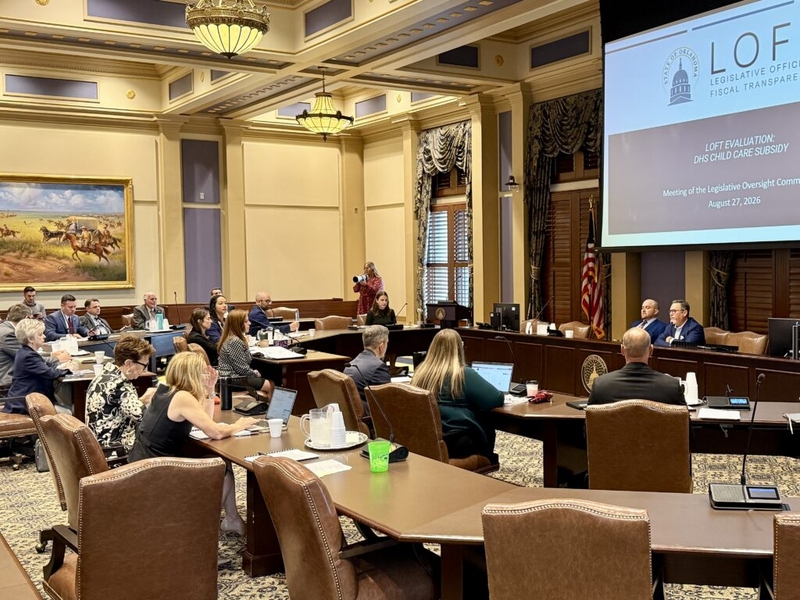
The Legislative Office of Fiscal Transparency presents lawmakers with a report on fraud in Oklahoma's childcare subsidy program on Aug. 27, 2026 at the state Capitol. (Photo by Emma Murphy/Oklahoma Voice)
OKLAHOMA CITY — Oklahoma’s childcare subsidy system is likely to be resistant to large-scale, coordinated fraud, a state agency investigation found.
Prompted by millions of dollars of fraud discovered in Minnesota’s childcare subsidy system, Oklahoma’s Legislative Office of Fiscal Transparency conducted an investigation into the state’s Department of Human Services to see how the state agency verifies eligibility and proper use of federal and state childcare dollars.
LOFT Director Regina Birchum said Tuesday while presenting the agency’s report to lawmakers that while risks for fraud and abuse are present, Oklahoma’s subsidy program is unlikely to experience “large-scale coordinated fraud.” The agency’s efforts to prevent and detect fraud are also often compartmentalized and when abuse is found, it’s usually not pursued criminally.

Birchum said over the past year, there has been national attention on allegations of fraud and misuse of childcare subsidy funds. President Donald Trump’s administration has singled out cases of rampant fraud in Minnesota. Federal officials announced that 15 people in Minnesota had been criminally charged related to Medicaid fraud. The federal government also asked states to provide justification for how dollars are spent.
The structure of Oklahoma’s childcare subsidy program is very different from Minnesota’s and has more checks in place to verify provider eligibility and proper use of funds, according to the LOFT report. These checks include more robust and surprise inspections, attendance verification, and identify verification for enrolling providers, according to the report.
LOFT’s report did find a failure to collect copayments from those seeking childcare services that is being “ignored” by Oklahoma Human Services. The report also pointed to a few specific instances of state employees and childcare providers committing fraud.
Detecting and rooting out fraud within the agency is often too compartmentalized and the state agency is “reluctant” to pursue criminal charges, often diverting to administrative cases to recoup funds, according to the report.
Birchum said LOFT is recommending the state Legislature require Oklahoma Human Services refer all cases that meet the statutory definition of fraud to district attorneys, establish whistleblower laws that define protected activities and adverse actions against an employee, and add the office of the alternate inspector as a recipient of whistleblower complaints.
Over a dozen recommendations were issued to the state agency, including:
- Adopting a clear position on pursuit of fraud over administrative penalties;
- Submitting all substantiated fraud cases to a district attorney and only pursuing them administratively when declined;
- Instituting new training and procedures to incorporate fraud identification;
- Dedicate more personnel to the Office of the Inspector General’s investigative branch; and
- Require childcare providers to test whether client copayments have been paid.
Jeffrey Cartmell, director of Oklahoma Human Services, said the agency’s upcoming budget request should include a request for more resources to investigate fraud.

Cartmell said he and the staff at the Department of Human Services are also frustrated by any fraud and have been working to make structural changes and adjust guardrails to prevent future abuse of public funds. He said any employees who defrauded the state are no longer employed.
The agency is working to ensure no single person has oversight of the internal audits and removing barriers between investigative units at the agency, he said.
“I think we would disagree a little bit with the characterization that the agency is reluctant to criminally pursue,” Cartmell said. “We do have a federal obligation to recover money that were spent as a result of fraudulent programs. The most efficient way, generally, to recover those funds, fill that federal statutory obligation, is to go after administrative action, not criminal prosecution, which is one of the reasons why the agency tends to, on paper, prioritize those actions.”
House Budget Chair Trey Caldwell, R-Faxon, said the agency has not requested additional resources to root out fraud during his time on the appropriations committee.
“My concern is along the lines of not going after the fraud because who that when someone is defrauding the system, whether it be an individual trying to get the benefit or whether it’s the provider that is trying to make up the difference and the shortfall for that month, who they’re really stealing from are people that need this program the most or the providers that need the extra funding,” he said. “And when that money goes missing, there’s only a finite amount of resources.”
Senate Budget Chairman Chuck Hall, R-Perry, said he and his fellow lawmakers recognize childcare providers are facing issues beyond the fraud discussed at Thursday’s meeting, but this report was focused on “one small aspect” of the condition of the industry in Oklahoma.
“We also know that there are funding related issues out there,” he said. “We know that there are communication issues, or the lack thereof, with providers, with parents, and those that are administrating the program on behalf of the state. But we are here today to strictly focus on the fraud and risk aspect of this as it relates to childcare.”
Oklahoma City, OK