Dorchester judge promises quick decision in second redistricting challenge
Aug 27, 2026 | 5:26 pm ET
Description
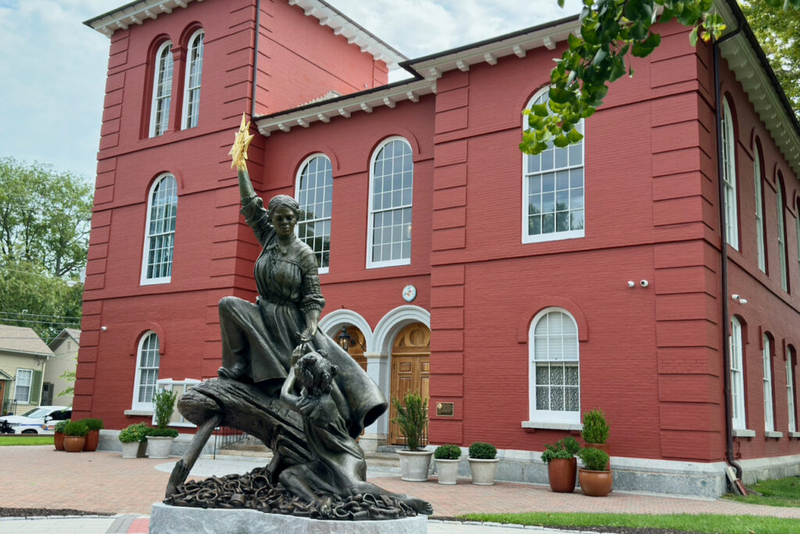
The Dorchester County Circuit Court building in Cambridge. (Photo Bryan P. Sears/Maryland Matters)
An Eastern Shore Republican lawmaker said he is “very confident” that a Dorchester County judge will strike down a proposed amendment to the Maryland Constitution that seeks to set standards for how congressional districts are drawn.
The case heard Thursday in a Cambridge courtroom is the second of two cases challenging House Bill 2100. Del. Chris Adams (R-Middle Shore) told reporters after a hearing before Circuit Court Judge S. James Sarbanes that he expects the judge will rule in favor of himself and other plaintiffs, and that the case will be part of an appeal hearing before the Maryland Supreme Court next week.
“I think no matter what happens here today, this will swiftly find its way at the Maryland Supreme Court, and again, I feel very confident that we’ll be in a prevailing position when that’s over,” Adams, one of five plaintiffs in the case, said outside the Dorchester County Circuit Court.
In addition to Adams, other plaintiffs include Lindsay Wheatley, a member of the Dorchester County Republican Central Committee; and Republican Sens. Mary Beth Carozza (Lower Shore), Johnny Mautz (Middle Shore) and Chris West (Baltimore and Carroll).
The nearly two-hour hearing was the second in three days on the redistricting question. Republicans on both sides of the Chesapeake filed lawsuits seeking to block the proposed amendment they believe is a door to eliminating the last Republican-represented congressional district in Maryland.
Maryland Republicans take round one in redistricting challenge
On Wednesday, Anne Arundel County Circuit Court Judge Robert J. Thompson struck down the amendment citing process and deadline problems. In his 10-page decision, Thompson said the wording of the ballot question mandated by the General Assembly was “intentionally misleading, and this should disqualify the ballot question as currently written.”
“The legislature has an obligation to be honest and transparent in its dealings, especially when it comes to amending Maryland’s constitution,” Adams said Thursday. “So, those questions on due process … the state is trying to articulate that they weren’t abiding by, and nor did they need to abide by those very important restrictions. I’m not persuaded. I believe that the courts are not persuaded either.”
Many of the arguments made in Dorchester County by attorneys seeking to block the ballot question were similar to the Anne Arundel County filing.
Strider Dickson, in arguments before Sarbanes, said the General Assembly proposal goes further by effectively eliminating all but “minimal federal requirements” for drawing congressional districts and severely limiting the public’s ability to challenge future maps.
“So you say, all right, traditional districting criteria are out the window, the legislature doesn’t have to follow that,” Dickson said. “Then they go further and say that no provision of the Maryland Constitution applies to congressional districts. That’s very different than saying just those traditional shape requirements don’t apply, because now they’re saying there’s no limits whatsoever in the Maryland Constitution on congressional districting, and that includes free elections, freedom of speech, due process, equal protection. None of those protections in the Maryland Constitution would apply to congressional redistricting.”
Democrats pushed the proposed amendment through during a two-day special session in early August. Supporters said the change was needed to address a 2022 decision on the state’s newly drawn congressional districts.
In that case, Judge Lynne Battaglia said congressional districts must be compact and contiguous and mindful of geographical features such as the Chesapeake Bay. It was a novel ruling, as that standard was once thought to only apply to state legislative districts.
I think no matter what happens here today, this will swiftly find its way at the Maryland Supreme Court, and again, I feel very confident that we'll be in a prevailing position when that's over.
Rather than challenge Battaglia’s ruling at the time, Democratic lawmakers and then-Gov. Larry Hogan (R) reached a compromise, changing a map that had eight Democratic-leaning districts to the current map that has one Republican-held seat.
While Battaglia’s ruling was not precedent, Senate President Bill Ferguson (D-Baltimore City) cited it as a reason for not moving forward with House bill bill passed in February that redrew the districts to give Democrats a chance at controlling all eight congressional seats. The bill stalled in the Senate when Ferguson buried it in the Senate Rules Committee.
Unlike Thompson in the Anne Arundel case, Sarbanes did not express concerns about the issue from the bench. But in questioning both attorneys, he appeared to challenge arguments made by Assistant Attorney Daniel Kobrin more than Dickson.
In closing, Sarbanes said he was aware of the ever=tightening election calendar and promised a ruling possibly by the end of the day or by midday Friday.
“It will not be a work of art but at least you will know what my ruling is,” Sarbanes said before ending the hearing.
An appeal of the Dorchester County case would likely be locked into the existing schedule for the appeal already filed in the Anne Arundel County case.
The Supreme Court of Maryland has said it will hear oral arguments on Sept. 3.
A brief from the state must be filed for the Anne Arundel case by the end of the day Friday. Kobrin, speaking in court Thursday, said the appealing party in the Dorchester County case would also have to meet that deadline.
The parallel court challenges introduce some potential chaos to the election calendar.
Election officials must post proofed ballots on Aug. 31. Thompson issued an order prohibiting the proposed amendment from appearing on the ballot, then stayed that order pending the appeal next week.
Because of that delay, ballot proofs posted online for three days starting Monday will include Question 3, the proposed amendment.
Those ballots are to be sent to the printer at the end of the day on Sept. 3 — the same day as arguments before the Supreme Court of Maryland.
Election officials expect a decision on the appeal by the end of the day.
Without such an order, roughly 1,200 versions of the ballot prepared for voters around the state will be printed and include the contested proposed amendment.
A decision issued after the close of business on Thursday could set up a situation similar to what happened Virginia in May, when a redistricting question went to voters but was later rejected by Virginia courts.
With ballots printed, a ruling from the Supreme Court of Maryland upholding the Circuit Court decision would likely require the high court to issue an order nullifying the ballot question and any votes cast for or against it.
Annapolis, MD