Montana Republican Party bylaws contradict state law, judge says
Aug 27, 2026 | 5:05 pm ET
Description
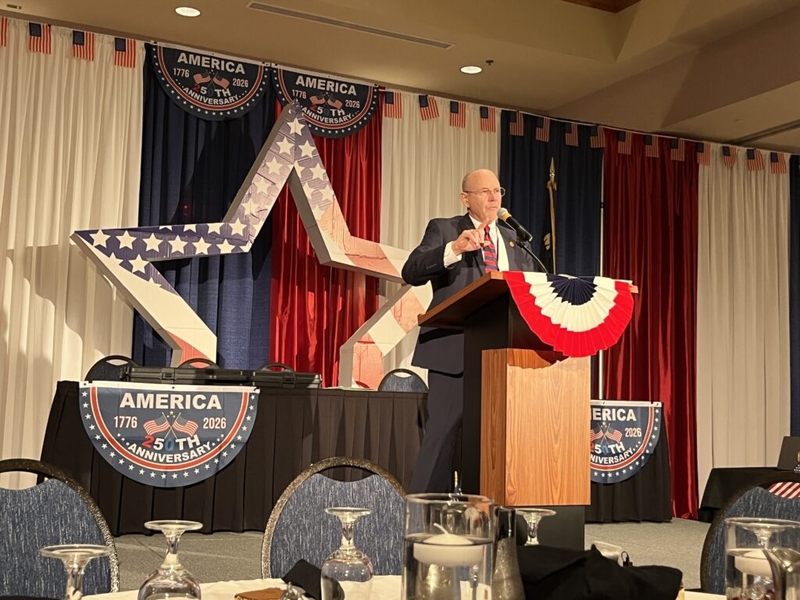
State GOP Chairman Art Wittich talks to Republicans at the party convention in Missoula in June 2026. (Keila Szpaller/The Daily Montanan)
Several sections of the Montana Republican Party’s bylaws contradict state law, a district court judge ruled on Wednesday, but both sides of the lawsuit claimed victory in the case.
Lewis and Clark District Court Judge Michael McMahon struck down six sections of the 2026 bylaws that impose illegal requirements on Republican candidates and regulate the terms and vacancies of precinct committee representatives. The heart of the lawsuit, McMahon said, stems from the GOP’s “efforts to have its cake and eat it too.”
The bylaws, passed at the party’s convention in June, raised concerns with a group of Republicans who argued the state GOP was consolidating too much power, ignoring the will of voters and creating a system where elected officials could be controlled — and removed — by the party at will.
The Republican central committees of Yellowstone and Chouteau counties and several individuals sued to prevent the bylaws from taking full effect, winning a partial victory.
State GOP chairman Art Wittich has defended the new party bylaws, saying they passed with 97% of the delegates at the party convention voting in favor.
But McMahon wrote in his order that “it does not matter how many people pass a bylaw contrary to law; it is still illegal.”
Republican state Rep. Bob Barker, a plaintiff in the case, said the ruling was a victory for the “rule of law” and the “grassroots foundation” of the state’s Republican Party.
“No pay-to-play. No loyalty pledges. No party veto over election results they don’t like. In our representative republic, the voters get the final say, not party bosses,” Barker said.
In a statement to the Daily Montanan, a state GOP spokesperson said the party was also treating the ruling as a “major win.”
“In effect, (the judge) agreed with us that Montana law allows the Party to promote its platform and institute new membership practices,” the party’s statement said. “The only sections he continued to enjoin were portions of six subsections of the Bylaws concerning our county precinct people, but he provided guidance on how we can manage that under Montana Law.”
[subhedCircumventing state law][/subhed]
A primary issue with the party’s bylaws, McMahon wrote, is that while they govern the internal workings of an organization, the GOP uses a state-sponsored system to elect officials, such as committee representatives, which garners more scrutiny.
“The First Amendment does not give the state party associational rights to veto the outcome of a state-administered primary election it affirmatively chose to select precinct committee representatives,” McMahon wrote.
Instead, the GOP could opt to either administer its own elections or forgo the process entirely and appoint precinct committee members — two options offered under state law, which would increase the party’s control.
While many provisions of the bylaws were challenged in the lawsuit, McMahon only listed six that violate state law.
Three parts of the bylaws impose illegal requirements on candidates for precinct office holders, according to McMahon.
A party spokesperson did not respond to specific questions for Wittich about whether the party would be changing its processes for selecting precinct people in the future.
For example, Article 7.4, describes participation in the party’s governance structure — including serving as an elected precinct representative — as a “privilege of association, not a right,” and requires that members act in good faith to support the party’s purpose.
But precinct representatives are defined in state law and cannot be considered a “privilege” of party membership.
A subsequent article, 7.7, defines Republican Party membership, which includes an affirmation of support and paying dues.
McMahon wrote that statute is invalid for imposing conditions on candidates or office holders. The Montana Constitution prohibits “oaths, declarations and tests” as requirements for office.
Another section changes what happens if there are no county committees — letting the party appoint acting precinct chairmen or chairwomen, who may then appoint precinct committee members. But state statute, McMahon says, lays out the process in reverse — the party may appoint committee representatives, who then elect officers.
“This bylaw provision contradicts not only the statutory scheme, but also the entire premise of small-r republicanism fundamental to the United State and Montana Constitutions: Popular sovereignty percolates up from the people, rather than flowing down from a party appointee,” McMahon wrote.
Three other provisions in the bylaws were considered illegal by setting terms for precinct committee representatives and determining when those positions become vacant — because state law explicitly covers those scenarios.
The GOP bylaws set the term for a committee representative as two years, beginning when an election is certified or a representative is appointed, and continuing until the next election certification or appointment.
State law states that a committee representative term is two years “from the date of election or appointment.”
McMahon wrote that the GOP offered up a “series of quotes so mangled as to remind the court of lawmaking’s proverbial sausage,” in trying to justify its bylaws.
The state GOP also sought to define ways of suspending, disqualifying, or removing precinct committee representatives, but vacancies in those positions are also expressly set out in law — only “death or written resignation” of an incumbent, or when they no longer reside or are registered to vote in their precinct.
A few challenged provisions were left intact by the judge’s order, including that the state GOP can require oaths and dues from its members — as long as it is not a condition for serving in an elected position. Several other sections defining general party membership were also left alone as applying only to internal matters.
Republican state Rep. Llew Jones, who was not part of the lawsuit but recently prevailed in a lawsuit brought by party leaders seeking to prevent him from running for the state Senate this fall, said McMahon’s ruling was “generally favorable to our side.”
“The party keeps its internal membership rules — the judge was careful about that line — but it does not get to stand between a Montana voter and the person that voter elected,” Jones said in a statement. “It is unfortunate that it takes a district judge to settle how a county central committee seats the people its own voters elected. But that is where we are.”
McMahon ultimately wrote that the GOP was attempting to both benefit from having the state administer and pay for elections, while reserving the power to overturn those elections.
“The ‘republic’ in our republican political system consists of, as said by the most revered Republican in American history (Abraham Lincoln), ‘government of the people, by the people, for the people,’” McMahon wrote. “If the state party is dissatisfied with Republican voters’ election ballot choices it is free to use a less republican form of representation by conducting its own private elections under its own rules or making appointments under its own rules.”
Helena, MT