No Labels governor candidate Hugh Lytle faces two challenges to boot him from ballot
Apr 07, 2026 | 7:55 pm ET

Description
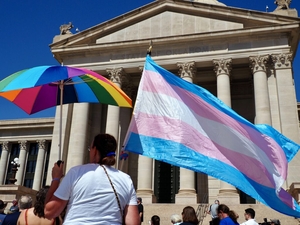
Hugh Lytle, an independent candidate for governor, held a press conference on Feb. 16, 2026, outside of the state house to criticize a bill that would make his party name, the Arizona Independent Party, illegal and he said would derail his campaign. (Photo by Dermont Stevenson/Cronkite News)
Independent candidate for Arizona governor Hugh Lytle is the target of two challenges that aim to get him thrown off the 2026 ballot.
Lytle is a wealthy entrepreneur who has used his background as a quarterback for Arizona State University in his campaign, even though he was sidelined by an injury before he ever played a game.
Lytle claims that Gov. Katie Hobbs is behind a challenge to his candidacy filed by Craig Beckman, who is represented in the challenge by Coppersmith Brockelman, a law firm that has represented Hobbs in past election challenges.
Hobbs’s former chief legal advisor, Bo Dul, now works for Coppersmith Brockelman and is one of the attorneys representing Beckman. She resigned from the governor’s staff about a year ago.
The Hobbs campaign declined to comment on Lytle’s claims.
Lytle collected signatures to qualify to run for Arizona governor under the Arizona Independent Party label, but a court ruled last month that the party must revert to its former name, the No Labels Party.
Secretary of State Adrian Fontes, a Democrat, approved the name change last fall, but just days before the deadline for candidates to qualify for the ballot, a judge ruled that Fontes didn’t have the power to do so, and invalidated the change.
In the challenge, Coppersmith Brockelman attorney Austin Yost took Lytle to task for the attempt to change his party’s name, and repeatedly referenced his wealth. In particular, Yost pointed out that Lytle lives in a 6,300-square-foot Scottsdale mansion with five bedrooms and six bathrooms that is valued at nearly $7 million.
“Mr. Lytle is no stranger to bending — and breaking — the rules to try to secure ballot access,” Yost wrote. “First, he sought the No Labels Party’s nomination for Governor, but rather than run as the No Labels Party, the Party illegally changed its name to the so-called ‘Arizona Independent Party.’”
In the challenge, Yost argued that all of the more than 5,900 signatures that Lytle submitted to the secretary of state are invalid.
Lytle needed a minimum of 1,771 signatures to make it on the ballot as a candidate for the No Labels Party.
But because Lytle’s nominating petitions used the address of his Scottdale business instead of the residential address that Arizona law requires, none of the signatures on them should be counted, Beckman’s challenge argues.
“Enough is enough,” Yost wrote. “This Court should make clear that the rules apply to everyone: a candidate’s wealth and persistence do not allow him to violate the ballot-access requirements as he sees fit.”
Lytle’s campaign sidestepped the legal issues and instead went after the governor in a Tuesday statement that encouraged Hobbs to own up to being behind the challenge.
“The fact that Hobbs and her allies are willing to spend staggering sums on attorneys to silence Arizona’s Independent revolution is a sign his message is resonating,” the Lytle campaign said.
The Lytle campaign also claimed the suit pointed to Hobbs’ failure to live up to campaign promises, like her pledge to reform private school vouchers.
“It’s no wonder she doesn’t want any competition,” the campaign said.
As of January, nearly 36% of Arizona voters were registered Republicans, 28% were registered with the Democratic Party and 34% were unaffiliated with any party, typically described as independent voters.
During election years, Republican and Democratic candidates fight to win over those unaffiliated voters. Neither party wants those votes siphoned off to a third-party candidate — particularly not a Democrat like Hobbs, who already must overcome a voter registration disadvantage. Hobbs only beat Republican Kari Lake in 2022 by about 17,000 votes, and the GOP’s large edge in the number of registered voters means she needs as many independent votes as she can get.
The Lytle campaign went after both major parties for their success in reversing the name change of the No Labels Party to the Arizona Independent Party.
“Both parties are more interested in political tricks than letting voters even have a say,” Lytle said. “In this case, the voters DID have a say and nominated an Independent for the first time in two decades. And the politicians are now trying to silence those voters and anyone challenging their authority.”
The other challenge to Lytle’s candidacy was filed by fellow independent candidate for governor Teri Hourihan, who describes herself as a conservative. Lytle has positioned himself as a moderate.
Hourihan claimed that most of Lytle’s signatures were invalid for numerous reasons, including illegible signatures, unqualified petition circulators and signatures from people who either aren’t registered to vote or are registered to vote at an address different from the one they wrote on the petition.
“More than 6,000 people signed our petition which I like to call ‘Arizona’s Declaration of Independents,’” Lytle said in the campaign statement. “That’s more than three times what is required by law. Our revolution will survive these challenges and prevail at the ballot box.”
The challenges will undergo expedited court proceedings so that they’re resolved before ballots are printed in advance of the July 21 primary election.
Phoenix, AZ