Utilities balk at industrial customers generating their own power, selling excess on the grid
May 23, 2026 | 11:00 am ET
Description
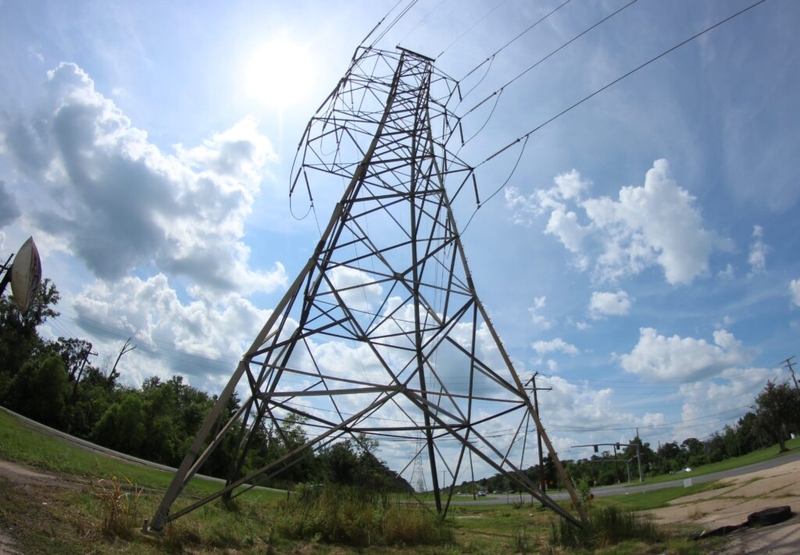
An energy transmission tower carries electricity outside of LaPlace, La., on July 1, 2024. (Photo credit: Wes Muller/Louisiana Illuminator)
A proposal to allow industrial facilities to build private power plants and grids that could compete with utilities appears to have stalled in the Louisiana Senate, despite gaining late support from earlier opponents.
Senate Bill 490, sponsored by Sen. Bob Hensgens, R-Abbeville, would allow large-scale power users to build their own private electricity networks and sell up to 50% of power they generate without being regulated as a utility.
The bill awaits a Senate floor vote Hensgens has delayed for weeks. Even if it were approved, time is running out in the legislative session for the measure to advance through the House of Representatives. Lawmakers must finish their work and adjourn by June 1.
Hensgens declined multiple in-person requests for comment on why he hasn’t moved the bill.
The state’s largest utilities, Entergy and Cleco, oppose the measure.
“SB 490, as written, and amended, would shift power costs from large industrial users onto residential customers, which we believe to be unfair,” Entergy Louisiana spokesman Brandon Scardigli said in an email. “Recent data shows Louisiana already enjoys some of the lowest power rates in the country … making this bill unnecessary.”
The Alliance for Affordable Energy originally opposed the proposal, but some late-stage amendments led the consumer advocacy group to change its stance. Groups representing companies most likely to build their own power networks, including the Louisiana Midcontinent Oil & Gas Association and Louisiana Energy Users Group, also support the bill.
The Alliance for Affordable Energy sees Hensgens’ proposal as a step toward utility deregulation, opening the door to alternative power sources for Louisiana customers with only one choice of electric utility, said Jackson Voss, government affairs and policy coordinator.
Large industrial facilities in Louisiana with the capacity to generate enough electricity to provide some of it to the broader grid need approval from the Louisiana Public Service Commission to do so. Hensgens’ bill would bypass many of the approval requirements for this additional power supply to be made available.
“The traditional utility approval process can take years and creates uncertainty that risks sending these high-paying [industrial] jobs and billions in capital to other states,” Hensgens told the Senate Commerce Committee at an April 15 hearing on his bill.
The initial version of Hensgens’ legislation primarily benefitted large industrial power users, such as data centers. He amended it Monday to be applicable to any electricity users, which could allow residents or small businesses to also build their own power grids.
Louisiana’s largest industries tired of waiting for renewable energy
Another amendment provided some Public Service Commission oversight if regulators determine a private grid negatively impacts other ratepayers.
This was not enough to win support from Public Service Commissioner Davante Lewis, D-Baton Rouge. Large industrial users simply want to act like public utilities without the regulation, he said.
Hensgens said his bill would protect ratepayers from cost spikes connected to data centers. He pointed to Entergy’s recent deal to build power plants for Meta’s Hyperion data center in Northeast Louisiana, which includes a 15-year contract to buy electricity from the utility.
The average natural gas-powered plant has a 30-year lifespan, so Hensgens and critics of the Meta-Entergy deal have questioned whether residential customers could get stuck with any costs from those plants becoming stranded assets if Meta doesn’t renew its contract after 15 years.
“This is a better way to move faster than Entergy can move, and this is a better way for us to protect the residential payers because this bill says that the microgrid is 100% paid for by the microgrid [users],” Hensgens said.
The Louisiana Legislature has generally avoided creating laws on utility issues the Public Service Commission regulates, and its Republican majority is typically amenable to proposals that benefit the oil and gas industry. But in debate over Hensgens’ bill, lawmakers seemed intent on keeping the two sectors separate and distinct.
“This is not self-generation,” Sen. Stewart Cathey Jr., R-Monroe, told oil and gas lobbyists at the April 15 committee hearing. “This is you trying to sell power. I mean that’s ultimately what you’re trying to do … So I think that’s a little misleading to say this is just another aspect of self-generation.”
To Cathey’s point, the proposal would likely hurt the profit margins of utility companies if their large industrial customers could suddenly generate their own power and sell their supply to the public. Industrial customers consume roughly 70% of the energy generated in Louisiana, according to a federal government analysis.
Without their industrial customers, utilities might have to shut down some of their power plants, resulting in the same kinds of stranded assets Hensgens envisions could come from the data center deals.
Hensgens and Voss both said the latest revisions to the bill prevent that scenario by allowing the Public Service Commission to limit any industrial power supplier that negatively impacts the public grid and threatens a utility’s financial viability.
The Senate Commerce Committee advanced Hensgens’ amended bill without objection, but it has less than a calendar week to cover the rest of its path to gain legislative approval. That path would normally include a hearing in the House Commerce Committee, which is not scheduled to meet again this session.
Baton Rouge, LA