Fearing troops or ICE at the polls, Arizona organizers train hundreds as election observers
Jul 11, 2026 | 10:19 pm ET

Description
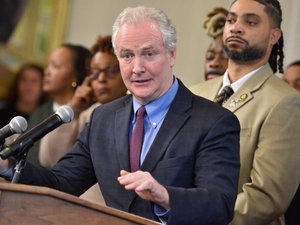
LUCHA Executive Director Alejandra Gomez speaks to attendees of the Congreso 2026 poll observer training in Phoenix on July 11, 2026. (Photo by Jerod MacDonald-Evoy/Arizona Mirror)
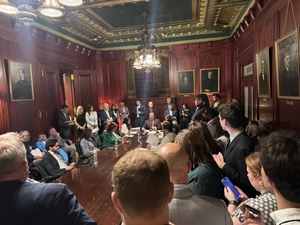
As President Donald Trump’s Department of Justice has said it plans to send election monitors to Arizona and other swing states, community organizers are focusing on training hundreds of locals on how to be election observers — with an emphasis on what to do if the National Guard or immigration agents arrive at the polls.
“The threats facing our democracy are not theoretical,” Vivian Serafin, a member of Living United for Change in Arizona, told members of the press that gathered for a roundtable discussion about the training on Saturday.
nad
LUCHA, along with the Arizona Center for Empowerment, organized training events in Phoenix’s heavily Latino Maryvale neighborhood and in Tucson Between the two events over 250 people received the training, according to LUCHA.
As reporters sat in a reception hall in west Phoenix that usually hosts weddings and quinceañeras, LUCHA displayed a heat map showing U.S. Immigration and Customs Enforcement activity in Maricopa County alongside past and future polling locations.
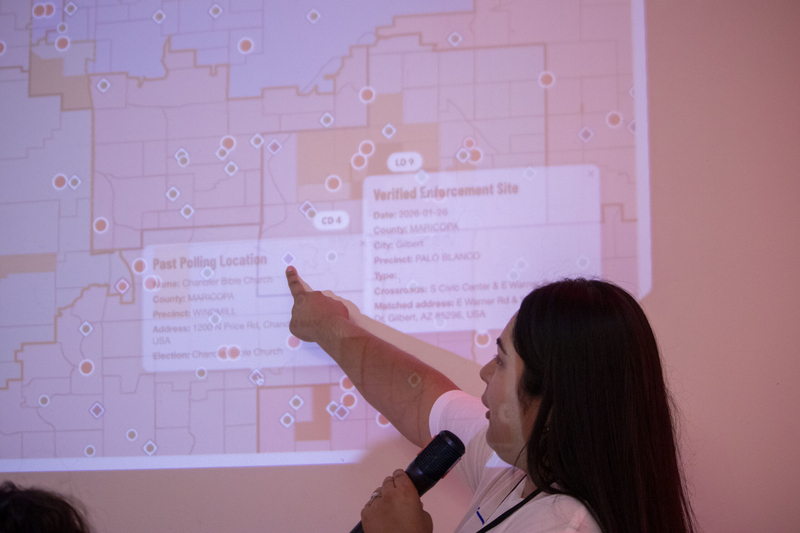
Legislative districts with large Hispanic populations showed more frequent ICE enforcement operations. Many were near past or future polling locations, something that guided the training, LUCHA said.
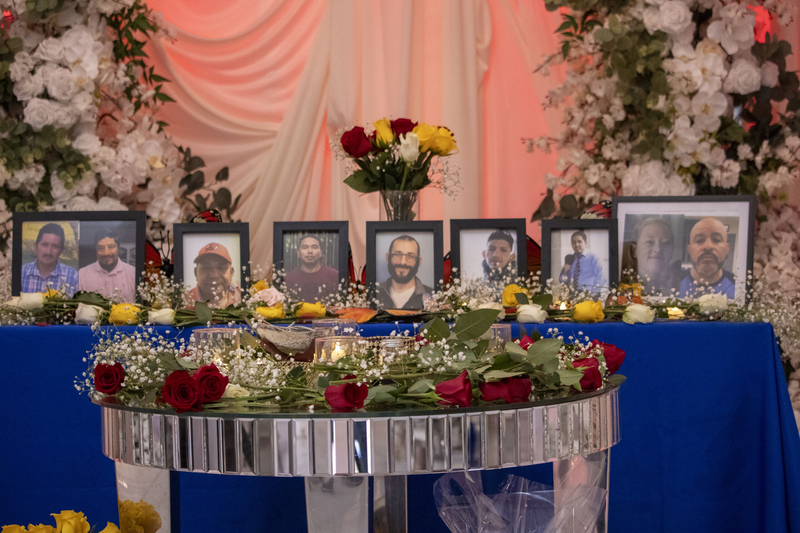
Those enforcement actions, and the deadly consequences they have brought, were also center stage Saturday: The training session featured a memorial for people shot and killed by immigration agents in recent months.
“The Trump administration is laser-focused on making it harder for regular folk to vote,” LUCHA Executive Director Alejandra Gomez told reporters. “They want chaos, because chaos suppresses turnout.”
That “chaos” is coming in the form of observers from a Department of Justice that has embraced election conspiracy theories and the administration’s firing of key election administration officials ahead of the midterms, Gomez said.
“We are not being dramatic — we are reading the signals,” Gomez added. “We are here because democracy is not protected by hope alone. It is protected by people.”
The event, dubbed “Congreso 2026,” is about “turning concern into action” and empowering communities that are impacted by the Trump administration’s push to seize control of election administration so they can inform their neighbors of their rights when it comes to voting, according to Gina Mendez, one of the organizers.
“That way, when elections happen, they are able to defend voters in their neighborhood,” Mendez said.
And the defense LUCHA is preparing voters for is the likelihood of Trump sending the National Guard or immigration agents to polling locations.
Earlier this year, Arizona lawmakers attempted to pass legislation that would have forced all 15 of Arizona’s counties into agreements with ICE to be at polling places and drop boxes during the midterm and primary elections. That bill died without receiving a formal hearing.
The Trump administration has also said it has considered sending ICE to polling locations, and recently a poll worker in New York was confronted by ICE agents over a social media post she made that was critical of the agency.
“I really wanted that to be a solemn moment,” Karime Rodriguez with Arizona Center for Empowerment, who helped design the training, told the Mirror about a scenario for trainees in which they’re informed in the middle of responding to the National Guard being sent to the polls that ICE will be arriving, as well.
Rodriguez said that, while the scenario may seem extreme, it is possible, considering the rhetoric that has come from the Trump administration. Trump has said in the past that he is willing to send both the National Guard and ICE to the polls, and his administration has not ruled it out when directly asked about the possibility.
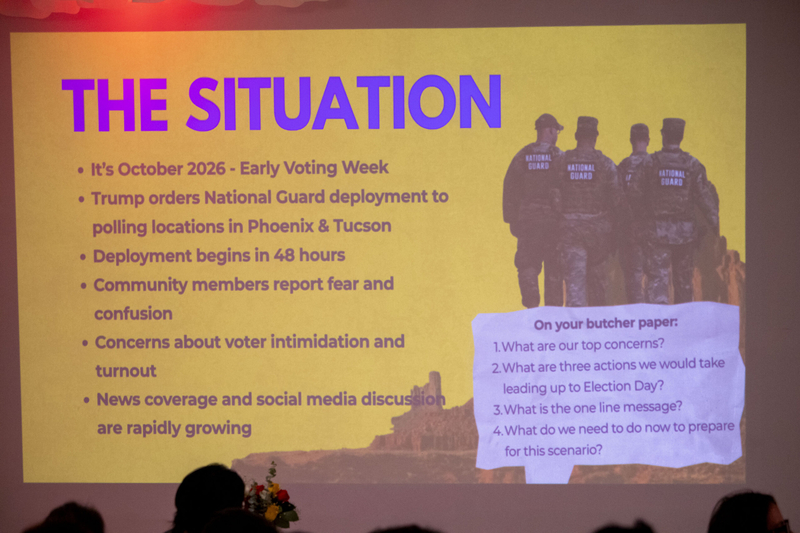
As a bright yellow slide displaying “The Situation” came across the screen for attendees to respond to a mock scenario, alerting them that Trump had issued an executive order to send troops to the polls, attendees began to furiously write notes on butcher paper as they worked in small groups to formulate a plan and predict potential issues.
As attendees were discussing how they would respond to the scenario in the 10 minutes they were allotted, they posed questions to each other as they worked to come up with possible solutions: Will the media be suppressed by Trump talking heads or social media algorithms? How can they bypass that? Will National Guard troops even want to listen to the President?
For Rodriguez, the training is about helping Arizonans learn how to react quickly and decisively in the face of Trump administration actions that will chill voter turnout. The goal is to present scenarios so observers don’t freeze on Election Day, so they can better “observe, report and activate” when the time comes.
“At its core, this training is to help us learn how to lean on our neighbors more,” Rodriguez said.
Early voting has already begun for the primary election with the last day to mail-in your ballot being July 14. If you miss that deadline or are not on the early ballot list, you can vote in person up until election day which is July 21.
Phoenix, AZ