New restrictions on state involvement in immigration enforcement take effect Wednesday
Jul 28, 2026 | 11:37 am ET
Description
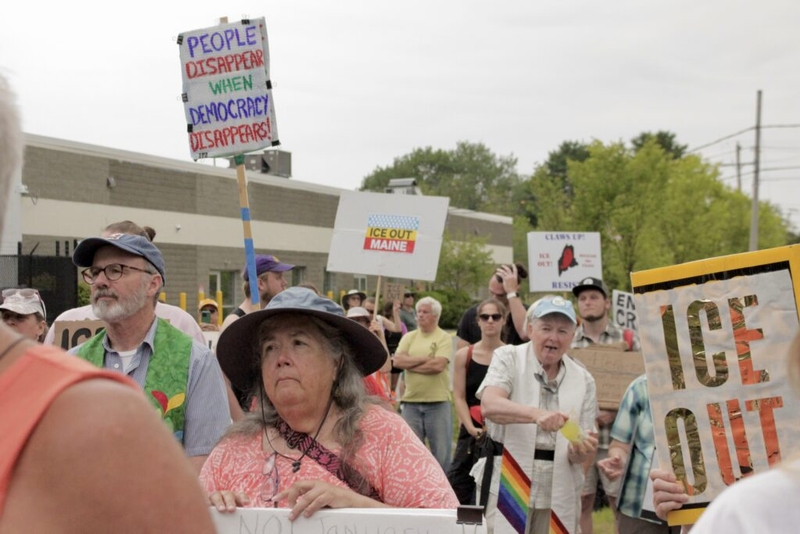
Protesters gathered outside an Immigration and Customs Enforcement facility in Scarborough, Maine on July 14, 2026, one day after an ICE officer killed a man in Biddeford. (Photo by Eesha Pendharkar/Maine Morning Star)
As President Donald Trump’s immigration enforcement tactics face renewed scrutiny after the fatal shooting of a man in Biddeford, new Maine laws take effect Wednesday that prevent local resources and agencies from being used to support mass deportation efforts.
Local police and jails are restricted in how they can work with federal immigration agents, while those agents are now banned from entering non-public places within public schools, state libraries and certain hospitals without a judicial warrant. Tenants also have new protections against the disclosure of their personal information.
Maine legislators passed these measures last session in order to counter the Trump administration’s mass deportation agenda. Some plans had to be walked back from more ambitious proposals, given that state law cannot dictate the actions of federal authorities when they are performing their lawful duties under the U.S. Constitution’s Supremacy Clause.
“While we should take comfort in them,” Zach Heiden, chief counsel for American Civil Liberties Union of Maine, said of the new laws, “we should not see them as an excuse to take the pressure off of our federal officials to reform actions at the federal level.”
The ACLU plans to continue to push for other state-level protections, including restricting law enforcement access to surveillance cameras and passing a comprehensive data privacy law, said policy director Michael Kebede.
The limits of what the state can do to counter federal immigration enforcement clash with calls from Mainers for state and city leaders to take stronger action to protect the community after a U.S. Immigration and Customs Enforcement agent shot and killed 25-year-old Johan Sebastián Durán Guerrero in Biddeford on July 13.
“That moment reminded all of us that the decisions and the role that government plays in our lives are not abstract,” said Ruben Torres, advocacy and policy director of the Maine Immigrant Rights Coalition, joining the ACLU in a Tuesday press briefing.
How police discretion has contributed to immigration arrests, and how that’ll change
The fatal shooting has drawn increased attention to the ways Trump’s immigration agenda has impacted Maine, as enforcement had become less visible — though continued — after a large-scale ICE operation in January, which left many immigrants and people of color fearful to leave their homes.
Federal authorities have detained asylum seekers and other immigrants in Maine who were legally allowed to be in the country and who had no criminal records, actions counter to the administration’s stated goal of targeting “the worst of the worst.”
Restrictions on local cooperation
One of the laws restricts local authorities from carrying out federal immigration enforcement, as some have done in the past. While the law officially takes effect on July 29, many local agencies have already issued directives for their staff to comply.
Local police were already not required to and generally did not have the authority to enforce immigration laws. The Trump administration revived a program called 287(g), which deputizes local police officers to detain immigrants. Maine currently has no such agreements after the Wells Police Department — the only local agency that had entered into such a contract — canceled its agreement last fall following public opposition.
The new law prohibits 287(g) agreements, as well as restricts police from looping in federal authorities about immigration matters absent official agreements. That includes banning police transfers of people to immigration authorities unless they have a court order or criminal warrant, and banning jail communications with ICE about the release dates of people being detained, among other restrictions.
The law does not only limit cooperation with specific agencies, such as ICE, but broadly restricts any effort to investigate, enforce or assist in the investigation or enforcement of federal civil immigration law.
“This means that if the federal government created a new immigration enforcement agency or started using any existing federal agency for immigration enforcement, our ‘ICE out of policing’ law would limit Maine law officials from engaging in many types of collaboration with that agency or agents of that agency,” Kebede said.
Gov. Janet Mills had held the bill in limbo for several months after it passed in 2025, citing concerns about the restraints being confusing, before she ultimately allowed it to become law without her signature earlier this year.
Some members of law enforcement raised concern about the proposal hindering federal partnerships that sometimes touch on immigration issues, such as drug enforcement task forces, so the bill was amended so that only work done by local police for the primary purpose of immigration enforcement would be banned.
Several Maine municipalities have also passed their own ordinances to extend these restrictions to city employees.
Protected areas
Maine now has a state-level version of the “sensitive locations” policy that Trump revoked. It uses existing constitutional protections to require immigration authorities to produce a valid judicial warrant to enter non-public areas, with narrow exceptions.
This type of policy had been in effect across administrations of different political parties, including Trump’s first administration. Former President Joe Biden had expanded the definition of “protected areas” and imposed the greatest limits on officer discretion.
Maine’s version of this policy will specifically prohibit workers at certain public schools, state libraries and state health care facilities from voluntarily allowing immigration agents into those locations’ private areas or providing them access to records in the absence of a judicial warrant.
The initial proposal also sought to mandate such restrictions for childcare facilities and other hospitals. That’s not the case under the version that’s now law, however the measure does provide the option for those facilities and others to adopt such policies. The state attorney general is required to draft and publish model policies and guidance within 60 days of the law taking effect.
Renters’ rights
The idea for the law to strengthen tenant rights came about after ICE’s operation in January highlighted a weakness in state law: a lack of clear protections against the disclosure or threatened disclosure of tenants’ personal information.
The law prohibits landlords from sharing a tenant’s personal information with the intent to harass, threaten, intimidate or evict them — except in response to a judicial warrant or in “exigent circumstances.” Those restrictions also only apply outside of the judicial process outlined in the eviction statute and without a “legitimate business purpose.”
The restrictions in the law have several exceptions meant to alleviate concerns raised by landlords that the measure would make all evictions illegal, because information such as a person’s name, address and sometimes financial information has to be shared in court proceedings, notices to local law enforcement or with housing authorities.
While the law was a response to immigration enforcement, lawmakers have said the protections are applicable to all Maine renters, including seniors who can be put at risk of scams if their personal information is shared and survivors of domestic abuse who fear being located by a former partner.
Detention
Unlike many other states, Maine does not have a standalone ICE detention facility. The only ICE facility in Maine, which is located in Scarborough, is an administrative building for routine check-ins with three small, short-term holding cells. This has meant local jails are relied on for detentions.
The federal government pulled all of its ICE detainees from Maine’s largest jail in Cumberland County in January, after Sheriff Kevin Joyce publicly rebuked the detention of one of his corrections officer recruits who he said had a “squeaky clean record.”
Since 2025, community members have been calling for the Cumberland County Board of Commissioners to remove ICE from the county jail’s longstanding contract with the U.S. Marshals Service to house federal detainees. The board ultimately decided to do so — after Mills signed into law a measure clarifying that jails can refuse to hold immigration detainees, settling the legal question that had been at the heart of the contract dispute.
However, commissioners and the sheriff have noted that the decision doesn’t change the issues many have with ICE’s tactics, nor the larger detention apparatus. Most of the people detained in Maine have been swiftly taken out of state, in some cases as far as Texas.
Augusta, ME